

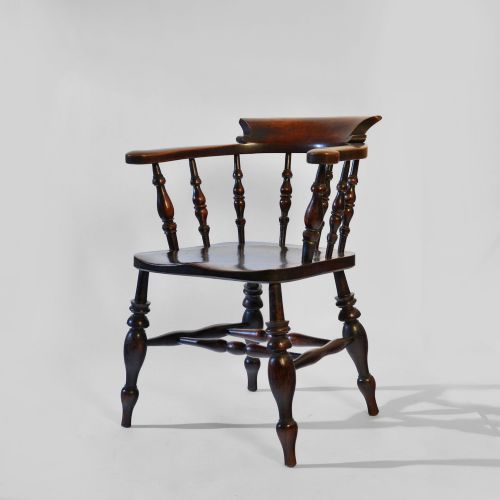
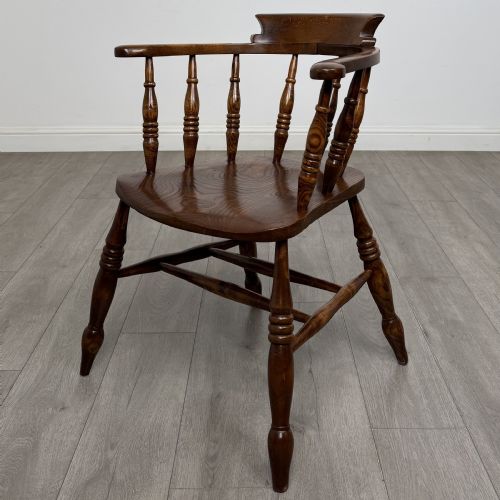
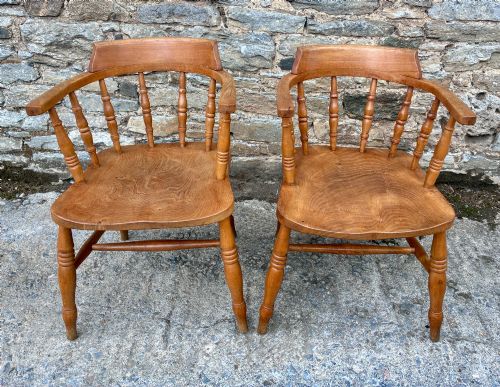
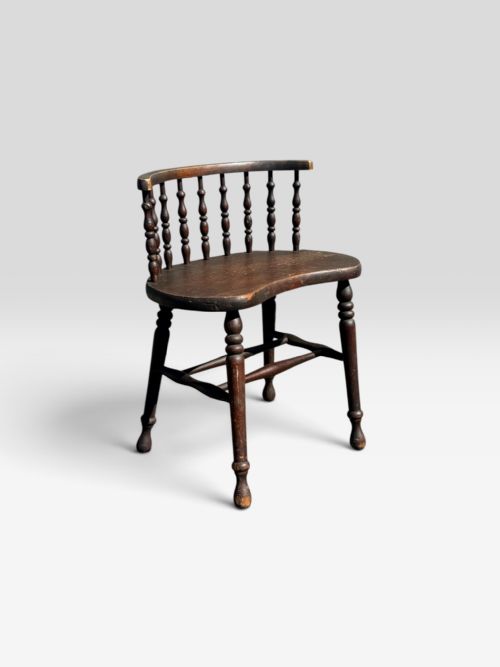
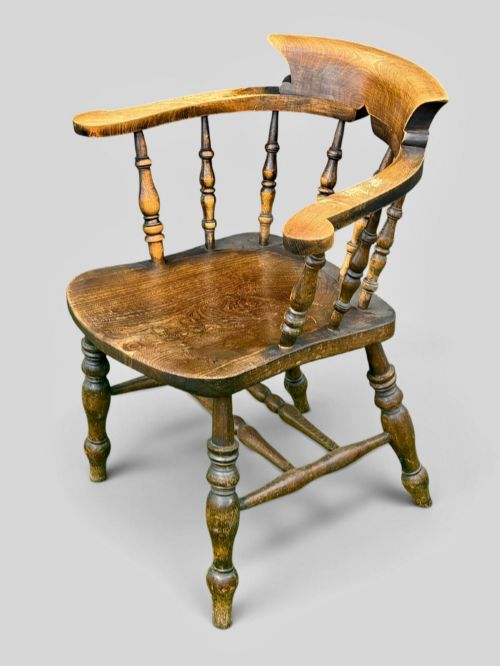
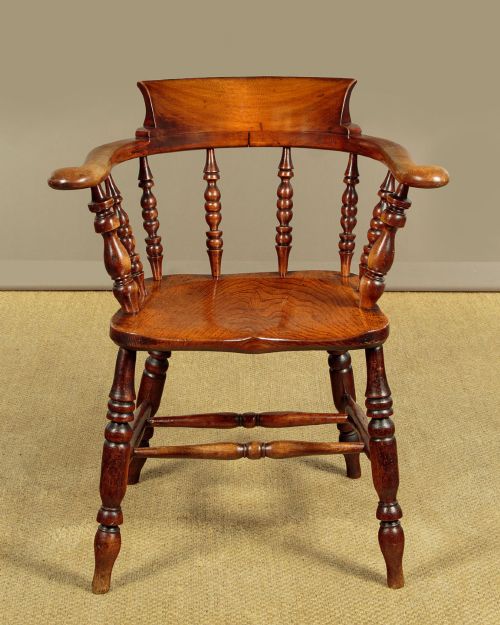
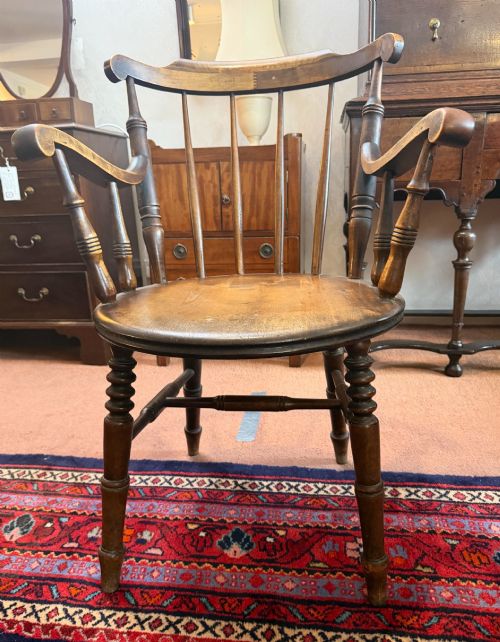
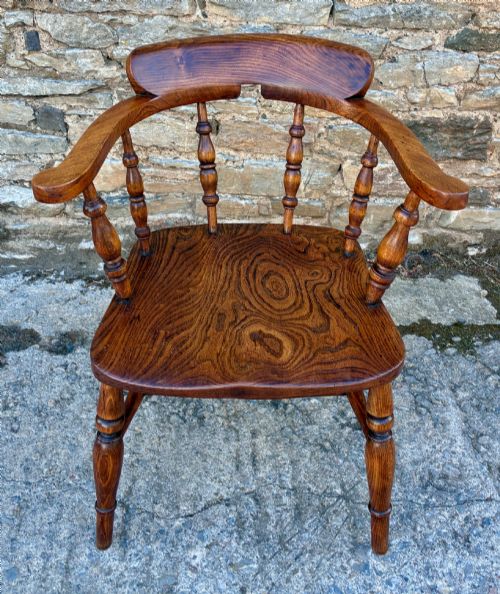
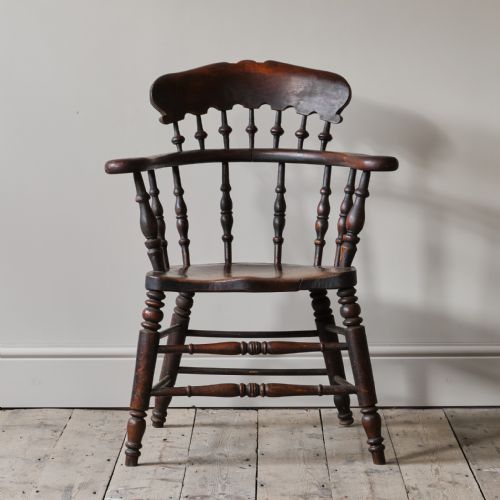
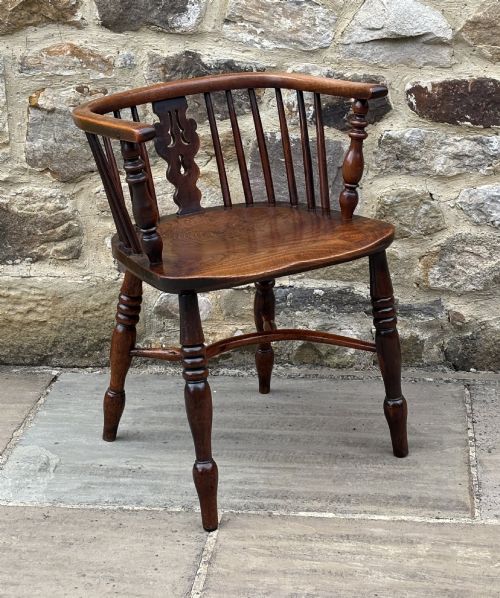
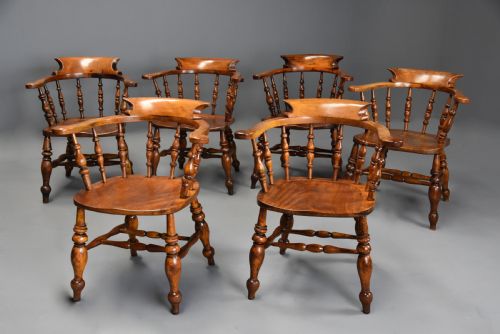
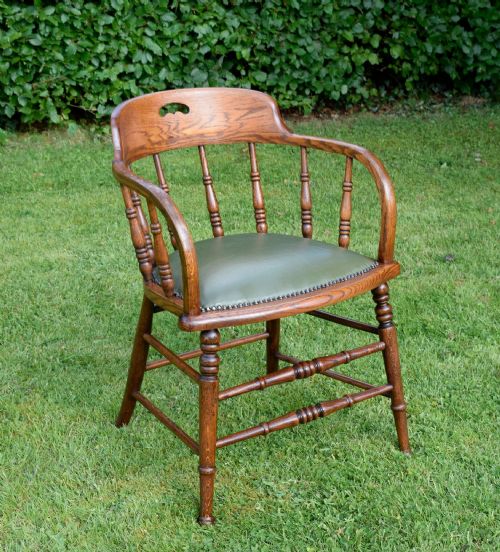
Captain Bow Armchair
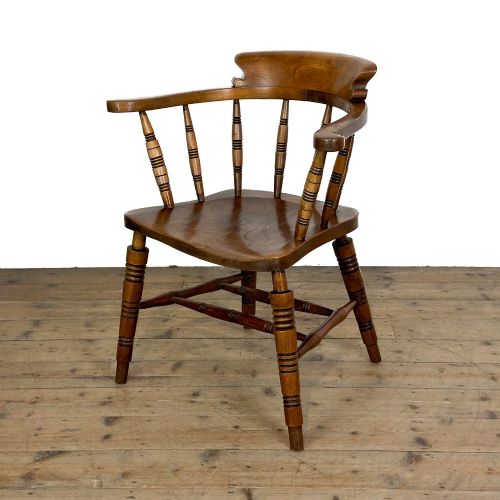
A captain bow armchair offers sturdy low-backed seating rooted in nineteenth and early twentieth century country house and office traditions.
Captain Bow Armchair
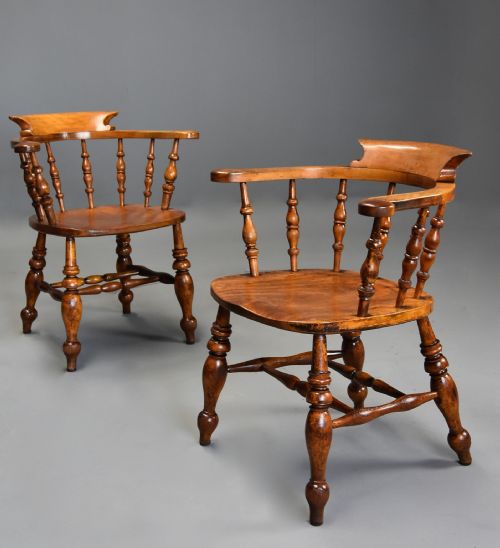
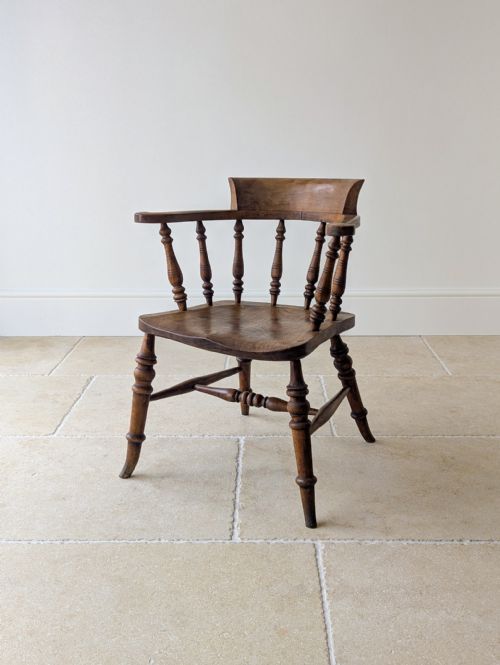
A captain bow armchair is a robust form of seating also known as a smoker's bow or low-back Windsor chair. These pieces trace their origins through the Victorian and Edwardian periods, serving primarily as functional desk, office, or country house elbow chairs.
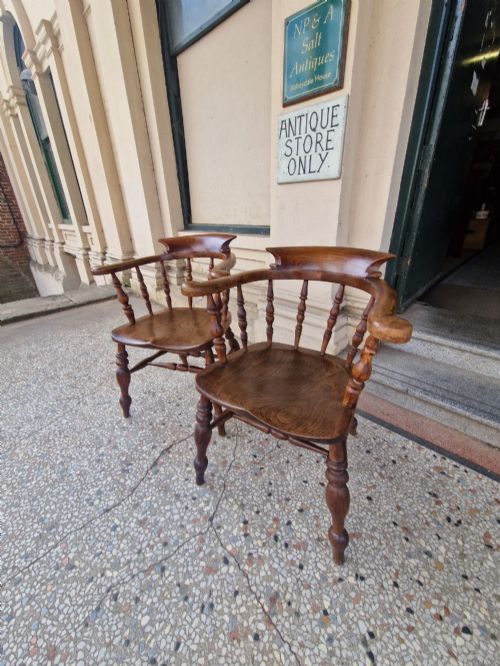
The version most commonly met on this page is an elm or beech framed chair dating from the nineteenth century up to the nineteen-twenties. They appear singly, in pairs, or occasionally in larger dining or office sets.
Makers designed these chairs for daily utility, combining a rounded spindle back with a solid timber saddle seat. They bridge the gap between vernacular country seating and formal office furniture.
Construction and materials
Makers utilised a combination of native timbers, frequently pairing solid elm seats with bent ash or beech for the curved arm rails and spindle backs. Oak and mahogany also appear in desk variants, sometimes complemented by leather upholstery and brass fittings.
The framing typically employs traditional Windsor construction methods, where turned legs and back spindles are wedged directly into bored holes within the thick wooden seat slab. This creates a rigid frame without relying on excessive metal fixings.
Captain Bow Armchair Retail Price Guide 2026
Typical asking prices for captain bow armchair among the pieces listed under this phrase on Sellingantiques today, from the lower quarter to the upper quarter. They describe what is for sale here now, not the wider market.
Listings feature captain bow armchairs spanning the Victorian and Edwardian periods, primarily constructed from elm, beech, ash, and oak.
Judging the range
Quality rests heavily on the choice of timber and the depth of the patination built up through decades of handling. Chairs retaining their original timber surfaces without excessive sanding command greater interest from collectors.
The comfort and proportion of the bentwood arm bow shape also differentiate examples. Firmer joins and well-turned spindles indicate careful regional workshop production rather than mass commercial output.
The Captain Bow Armchair Glossary
- Smoker's bow
- A low-backed wooden armchair with a continuous curved rail forming the arms and backrest. It shares direct lineage with the traditional Windsor chair.
- Windsor chair
- A chair built with a solid wooden seat into which the legs and back spindles are driven. This method provides structural integrity.
- Comb back
- A Windsor chair variation where the top rail resembles a small comb, with vertical spindles rising above the main arm bow. This style appears on several vernacular seating pieces.
- Patina
- The surface sheen and colour acquired by wood over long periods of use and polishing. Good examples exhibit a timeworn texture.
- Elbow seat
- An alternative historic term for an armchair, often used to describe office or desk seating with low arm supports.
Captain Bow Armchair: Frequently Asked Questions
What is a captain bow armchair?
A captain bow armchair is a sturdy wooden seat featuring a low, continuous curved backrest and arms supported by vertical spindles. They originate mainly from the nineteenth and early twentieth centuries.
These pieces were traditionally utilised in studies, offices, and country houses as comfortable desk or smoking chairs.
How do I tell an Edwardian chair from a Victorian one?
Dating relies on timber selection, turning styles on the legs, and overall construction weight. Victorian examples often display heavier elm and ash construction with deeper patination.
Edwardian pieces tend to show slightly lighter proportions while maintaining the traditional Windsor framing techniques of earlier decades.
Were these chairs used at desks?
Many examples are specifically categorized as desk or office chairs due to their compact dimensions and supportive low backs. They fit neatly beneath writing tables while offering sturdy elbow support.
Their solid wooden seats made them practical for daily administrative work.
How should I care for an antique wooden armchair?
Maintenance involves keeping the timber away from direct heat sources and sudden humidity changes to prevent wood splitting. Regular dusting with a dry cloth preserves the surface.
Applying occasional traditional wax polish helps nourish dry historic timber without harming the original finish.