


Campana Stone Urns
Campana stone urns are classical garden vessels shaped like wine goblets that anchor a terrace with formal balance and architectural weight.
Campana Stone Urns
When you search for campana stone urns, you encounter garden and decorative vessels drawing on neoclassical forms from the nineteenth century. These pieces display the characteristic inverted bell shape with flared rims and footed bases, often paired with handles.
The versions met on this page span the nineteenth century, Regency period, and early twentieth century. They appear in stone, reconstituted stone, marble, and terracotta, frequently paired with pedestals or plinths.
Originating from classical antiquity and revived through neoclassical taste, these urns function primarily as focal points in gardens and formal interiors. They bridge architectural structure and natural planting.
Materials and construction
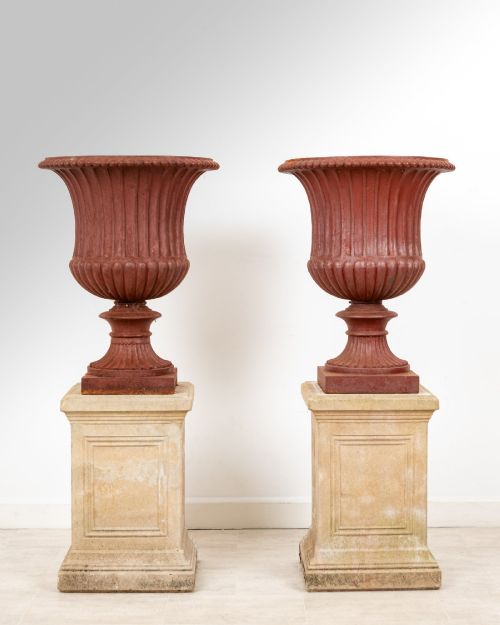
Makers utilised durable outdoor materials including natural stone, reconstituted stone, and terracotta. Cast iron also appears in the listings, frequently combined with stone pedestals to elevate the vessel.
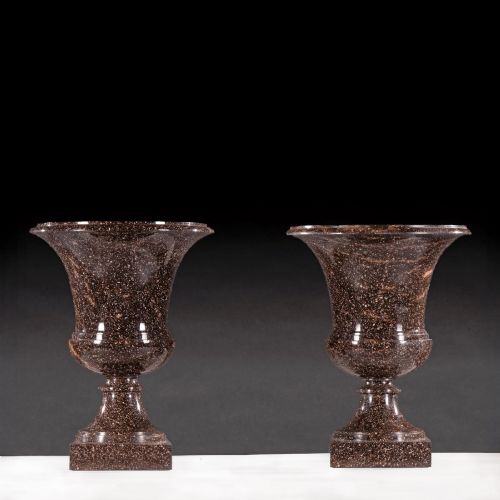
Carved details adorn handles and bodies, as seen in terracotta examples featuring carved heads. Marble and porphyry variants demonstrate precise cutting and polishing techniques typical of classical revival work.
Some terracotta examples feature sculpted heads keeping a stony watch over the garden from the handles.
Judging quality in campana urns
Quality rests upon the crispness of the classical moulding and the selection of material. Fine-grained marbles and distinct porphyry display superior geological depth compared to standard cast stone.
Proportion dictates the presence of a piece, where the flare of the rim balances precisely against the diameter of the foot. Sculptural additions such as carved handles elevate the piece from utilitarian to decorative.
Andrew Handyside·Selim Bright
The Campana Stone Urns Glossary
- Campana
- A bell-shaped vessel with a flared rim, sweeping body, and footed base. This form derives from ancient Roman bronze and marble vases.
- Neoclassical
- A style reviving classical antiquity during the eighteenth and nineteenth centuries, emphasising symmetry, proportion, and restrained ornament.
- Porphyry
- A hard igneous rock containing crystals, prized by lapidaries and stonemasons for its rich purple or reddish colour.
- Terracotta
- Fired unglazed clay used widely for garden vessels and architectural ornaments due to its porous warmth and workability.
- Plinth
- A heavy flat-topped base or pedestal supporting an urn, elevating the vessel within a garden or architectural scheme.
Campana Stone Urns: Frequently Asked Questions
Where do I place a campana urn?
These vessels suit formal terraces, garden pathways, and entranceways where their classical silhouette provides vertical punctuation. Placing them on stone pedestals or plinths lifts the profile above surrounding foliage.
Inside the home, smaller marble or porphyry examples function as decorative centrepieces on tables or architectural consoles.
Can these urns stay outside in winter?
Natural stone, cast iron, and reconstituted stone withstand frost well, though terracotta requires monitoring during severe freezes. Positioning them on feet or bricks prevents standing water from freezing inside the base.
Protecting delicate marble or porphyry pieces from harsh winter damp preserves the polish and carved surface detail over decades.
How do I date a campana urn?
Dating relies on material composition, tool marks, and stylistic shifts between Regency and Victorian neoclassical preferences. Nineteenth-century examples often show hand-finishing marks on stone or terracotta surfaces.
Earlier pieces around eighteen hundred tend to use dense marbles and porphyry, while twentieth-century versions utilise simpler reconstituted stone mixes.
What is the difference between stone and terracotta urns?
Stone urns offer monumental weight and crisp architectural lines suited to permanent structural placement in gardens. Terracotta introduces a warm earthy palette and allows for intricate carved details like figurative handles.
Both materials weather over time, but stone retains sharper profiles while terracotta develops a softer patina.