
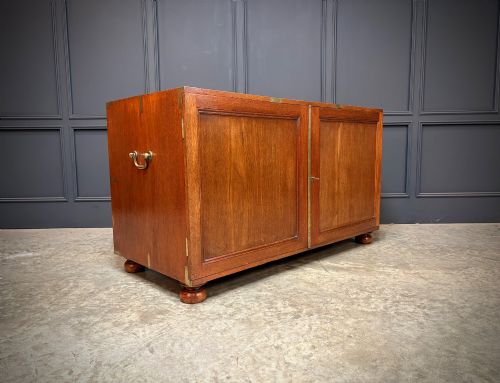
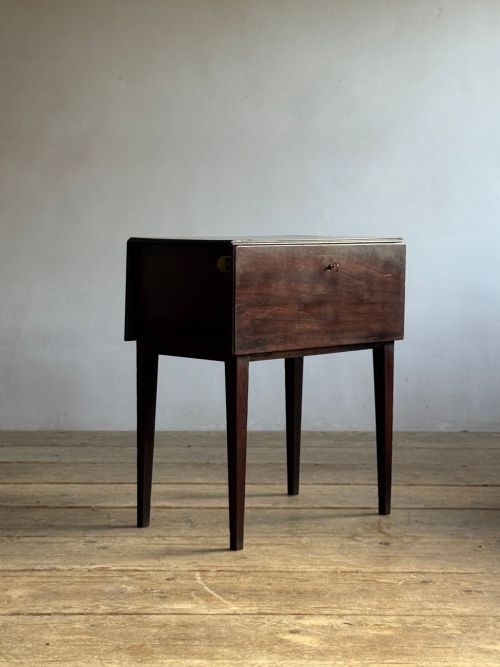
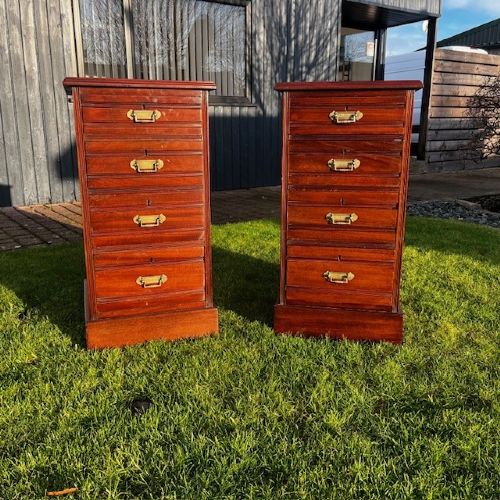


Campaign Side Cabinet
A campaign side cabinet offers portable elegance for the home, combining sturdy timber with brass mounts made for life on the move.
Campaign Side Cabinet
When you search for a campaign side cabinet, you are looking at utilitarian furniture built for travel and field use during the nineteenth century. The examples met on this page span the Georgian and Victorian periods, taking forms such as side cabinets, chests of drawers, and bedside chests.
Most pieces seen here are constructed in timber with metal detailing designed to withstand transit. These items bridge the gap between military necessity and domestic refinement, serving as practical storage that doubles as decorative furniture.
The origins stretch from English workshops to naval vessels and continental travel. Buyers find variations ranging from plain utilitarian Teak and Mahogany units to richly figured Burr Walnut and Dutch Marquetry.
How they were made
Makers utilised dense timbers such as Mahogany, Teak, and Walnut to resist the knocks of travel. These woods provide a stable carcase that handles the stresses of dismantling and reassembly.
Brass fittings protect corners, frame drawers, and form flush-fitting handles that prevent snagging during transport. Iron and fruitwood marquetry also appear, adding structural strength and decorative contrast.
The site listings combine nineteenth century pieces in Mahogany, Teak, and Walnut with stylistic influences ranging from Georgian simplicity to Dutch Marquetry.
What varies in quality
The standard of a piece depends upon the crispness of its brass joinery and the integrity of the timber framing. Superior examples maintain tight tolerances in their drawers and folding mechanisms despite decades of use.
Finer items display select veneers like Burr Walnut or intricate Dutch Marquetry, whereas simpler pieces rely on plain Mahogany or Teak. The distinction lies in the ambition of the design and the precision of the cabinetmaker's hand.
Ross of Dublin
The Campaign Side Cabinet Glossary
- Campaign furniture
- Portable pieces designed for military officers on the move. They often feature recessed brass handles and sectional construction.
- Wellington chest
- A tall, narrow chest of drawers secured by a locking hinged side pilaster. This form appears frequently in nineteenth-century walnut and mahogany.
- Marquetry
- Inlaid wood patterns forming pictorial or floral designs. Dutch examples in this grouping utilise this decorative technique.
- Flush handle
- A hardware mount sunk level with the wood surface. This prevents damage and catching during transit.
- Deception table
- A specialised form masking its true utility behind decorative drawer fronts. Georgian makers used these for discreet storage.
Campaign Side Cabinet: Frequently Asked Questions
What is a campaign side cabinet?
A campaign side cabinet is a portable storage piece built for officers during the nineteenth century. These items use durable timbers and protective brass hardware to survive rough transport.
Today, they function as versatile side tables and storage units in homes. Their compact proportions make them suitable for smaller rooms.
How do I identify a Victorian piece?
Victorian items often feature dense woods like Walnut and Teak alongside heavier brass mounts. They reflect the industrial production methods and revival styles of the nineteenth century.
Checking the interior construction and drawer linings helps confirm the period. Secondary timbers inside drawers typically match regional workshop practices of the era.
Were these cabinets actually used by the military?
Many pieces served officers in the field, on naval vessels, or during colonial postings. Their sectional design and robust construction were engineered for genuine travel.
Some examples carry specific provenance or ownership inscriptions linking them to naval captains. Others reflect the civilian adoption of military styling.
How do I care for antique mahogany?
Antique mahogany requires stable indoor humidity and protection from direct sunlight to prevent fading and splitting. Regular dusting with a soft cloth preserves the polish.
Applying occasional specialist wax maintains the moisture in the timber. Avoid placing these cabinets near heat sources or damp areas.
What is the difference between Georgian and Victorian cabinets?
Georgian cabinets generally display restrained classical proportions and lighter framing. Their joinery focuses on understated elegance suited to domestic interiors.
Victorian pieces often incorporate heavier timbers, elaborate veneers, and more prominent brass hardware. The influence of military utility became increasingly stylized during the later nineteenth century.