
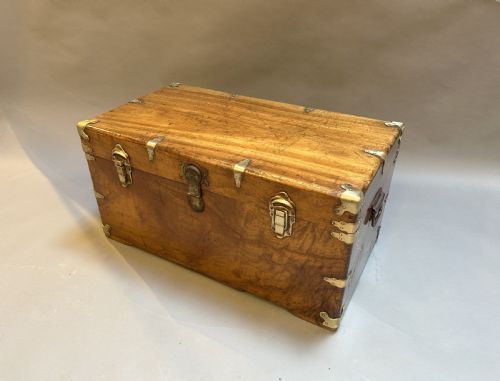
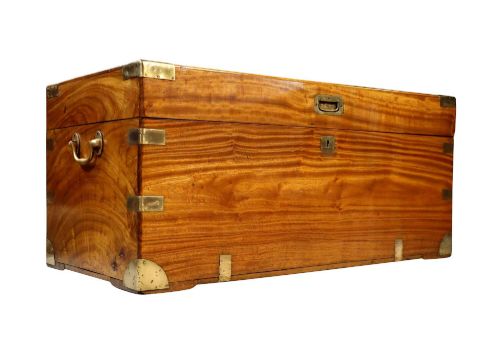

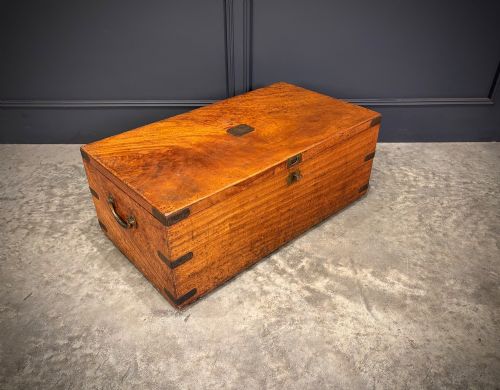


Campaign Coffee Table Chest
These campaign coffee table chests are rugged travelling trunks adapted for modern living, bringing portable military history straight into your sitting room.
Campaign Coffee Table Chest
When you search for a campaign coffee table chest, you find repurposed military luggage, travel chests and storage trunks from the nineteenth century and the Edwardian era. These items arrive in forms such as camphor wood trunks, coach chests and low drawer chests, originally built for officers on the move.
The pieces on this page lean heavily towards camphor wood and teak construction with characteristic brass bindings. Many maintain their practical origins as travel chests, while others show past conversions designed specifically to sit lower as coffee tables.
How they were made
Construction relies on durable timbers like camphor wood, teak, pitch pine and mahogany, chosen to withstand arduous travel. Makers reinforced these carcases with substantial brass corners, straps and binding to protect the edges during transit.
Recessed brass handles and flush hardware allowed trunks to pack tightly into transport without catching. Leather, canvas and iron also appear across the surviving pieces, adding further layers of protection for long journeys.
The listings here span the Victorian era, 1850, 1880, the Edwardian period, and 1920, utilising camphor wood, teak, mahogany, pitch pine, brass, leather, iron and canvas.
What varies in quality
Quality rests in the original specification of the hardware and the selection of timber. Heavy-gauge brass mounts and well-figured camphor wood or teak mark out pieces intended for senior officers rather than standard utility luggage.
The integrity of the conversion matters when chests are adapted for table height. Retaining original internal fittings, dovetail joints and untouched surfaces elevates a piece above simpler alterations.
The Campaign Coffee Table Chest Glossary
- Campaign chest
- A portable chest of drawers or trunk made in sections for military officers on active service. These pieces typically feature recessed brass handles and corner brackets to prevent damage.
- Camphor wood
- An aromatic hardwood native to Asia, prized for its insect-repellent properties and distinct scent. It frequently forms the core material of military trunks originating from colonial postings.
- Coaching trunk
- A sturdy travel chest designed to be strapped to the roof of a coach or carriage. They often utilise heavy leather, canvas and iron bindings.
- Brass bound
- The method of reinforcing wooden trunk edges and corners with protective brass plates. This technique provides both structural strength and a decorative finish.
- Steamer trunk
- A lower-profile travel trunk popular in the late nineteenth and early twentieth centuries. They fit easily into limited cabin spaces during ocean voyages.
Campaign Coffee Table Chest: Frequently Asked Questions
Are these original campaign chests?
Yes, the selection includes genuine nineteenth-century and early twentieth-century military and travel trunks. Many retain their original brass mounts, timber construction and travel wear.
Some examples have been adapted over time to function comfortably as coffee tables while keeping their historical character intact.
How do I care for camphor wood?
Camphor wood requires minimal maintenance due to its natural oils and dense grain. Dust regularly with a dry cloth and avoid placing the chest in direct sunlight or beside intense heat sources.
Keep the interior clean and dry to preserve the wood's natural aromatic properties.
Can I use a standard trunk as a table?
Many trunks and chests sit at a suitable height or can be gently adjusted to serve as a coffee table. Their flat tops provide a stable surface for everyday living room use.
Ensure the internal structure remains robust enough to support daily items and occasional weight.
How do I date a campaign chest?
Dating relies on timber choices, construction methods, and the style of the brass hardware. Pieces from the Victorian era often display heavy brass strapping and dovetail joints.
Edwardian and later items typically introduce different canvas coverings and lighter internal arrangements.