

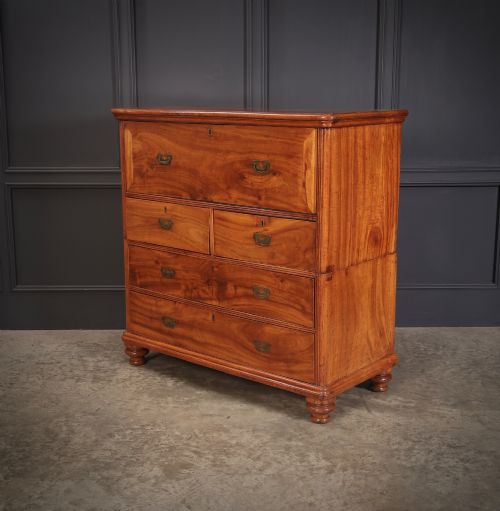
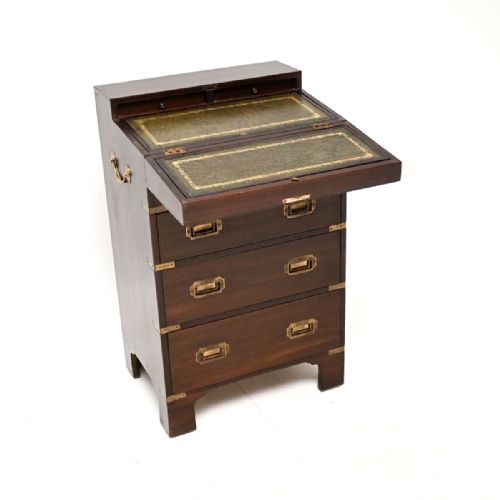


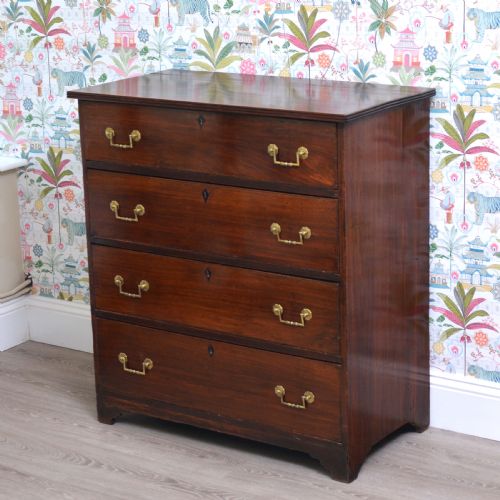


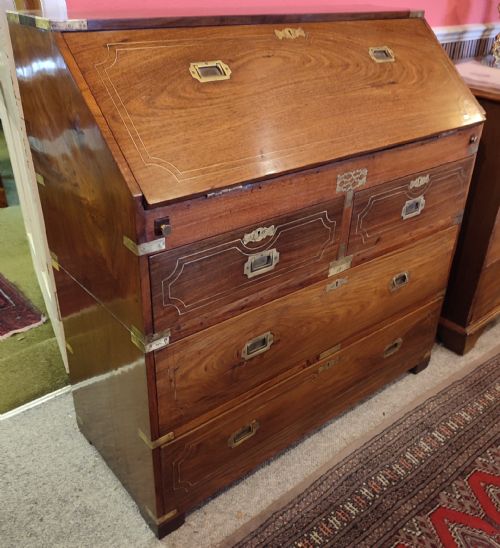
Campaign Bureau Chest
These campaign bureau chest pieces are portable writing desks and drawer units designed for travel, offering clever compartments and robust timber construction.
Campaign Bureau Chest
A campaign bureau chest combines the practical utility of a folding desk with the storage of a set of drawers, built for officers and travellers on the move. When searching for a campaign bureau chest, buyers encounter practical furniture designed to dismantle or travel easily.
The pieces appearing on this page span several distinct periods including Regency, Victorian, and Georgian eras, alongside 19th century examples and later 1930 interpretations. Materials range from traditional mahogany and rosewood to teak, padouk, satinwood, and yew wood.
Forms vary from standard chests of drawers and secretaire desks to folding configurations, metamorphic bachelor chests, and Anglo-Indian colonial pieces. The most frequently met versions are Victorian and 19th century mahogany or teak examples built for military and colonial use.
Materials and Construction
Construction relies heavily on dense, durable hardwoods such as mahogany, teak, padouk, and rosewood, which could withstand the rigours of transport. These timbers are frequently paired with brass hardware, including inset carrying handles, corner braces, and flush drawer pulls.
Writing surfaces and interior compartments often incorporate secondary materials like leather or felt to provide a suitable writing texture. Cabinetmakers utilised clever folding mechanisms, modular sections, and secretaire drawers that dropped down to reveal fitted stationery pigeonholes and small drawers.
Campaign Bureau Chest Retail Price Guide 2026
Typical asking prices for campaign bureau chest among the pieces listed under this phrase on Sellingantiques today, from the lower quarter to the upper quarter. They describe what is for sale here now, not the wider market.
Some chests retain hidden compartments originally designed for secret documents or a stray bottle of port.
Assessing Quality
Quality rests upon the precision of the joinery and the integrity of the timber selection, such as figured mahogany or rich padouk. Finer examples display meticulous attention to the fit of internal writing compartments and the seamless operation of folding elements.
The caliber of the brass fittings and the cleverness of the modular design also distinguish superior pieces. Original working mechanisms and unblemished secondary woods elevate an example above standard utility items.
The Campaign Bureau Chest Glossary
- Secretaire bureau
- A piece of furniture featuring a drawer that drops open to reveal a writing surface and small fitted compartments. This design provides desk functionality without requiring a permanent freestanding writing table.
- Campaign style
- Furniture constructed for military officers and travellers, characterised by portability, sectional construction, and recessed brass hardware. Such pieces were built to endure rough handling during transit.
- Metamorphic
- A descriptive term for furniture that transforms from one form into another, such as a chest converting into a desk. These clever pieces showcase inventive 18th and 19th century cabinetmaking.
- Padouk
- A heavy, durable tropical hardwood with a reddish hue, frequently utilised in colonial and military furniture. Its natural stability made it ideal for items exposed to changing climates.
Campaign Bureau Chest: Frequently Asked Questions
What is a campaign bureau chest?
It is a portable piece of furniture combining drawers and a folding writing desk, originally made for military officers.
These items allowed travellers to carry their administrative equipment securely across long journeys.
How were these chests used?
Officers used them to store clothing and personal belongings while providing a stable surface for writing dispatches.
The fold-out sections and secretaire drawers kept writing materials organised during transit.
How do I identify a Victorian piece?
Victorian examples often feature dense mahogany or walnut construction with robust brass corner brackets.
They typically display the heavier proportions and darker finishes characteristic of 19th-century cabinetmaking.