

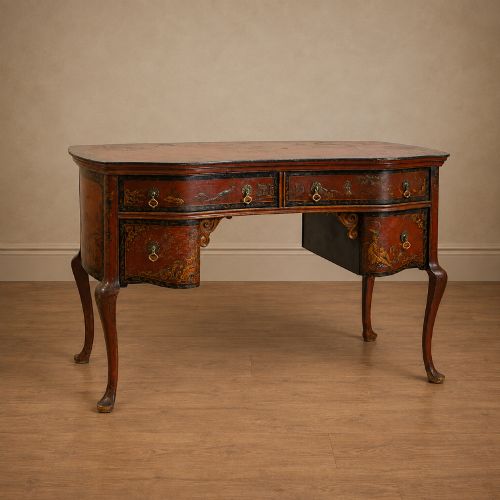

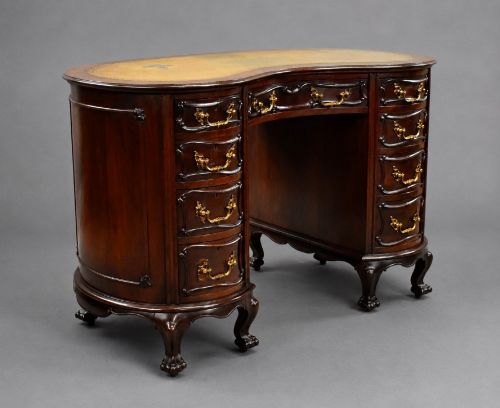
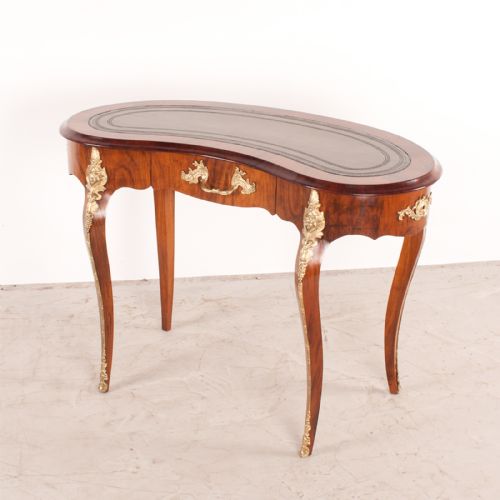


Cabriole Leg Kidney Desk
A cabriole leg kidney desk brings a sweeping, curved writing surface and graceful legs to a room, offering both compact utility and decorative presence.
Cabriole Leg Kidney Desk
A cabriole leg kidney desk is defined by its distinct curved top, designed to partially wrap around the user while providing a practical surface for correspondence or dressing. The form appears across the nineteenth and twentieth centuries, spanning Victorian, Edwardian, and Art Deco periods with distinct regional interpretations.
The versions most commonly met on this page are nineteenth-century Victorian examples, frequently fashioned from burr walnut or mahogany. These pieces range from freestanding library writing tables to more intimate ladies writing desks and occasional dressing tables.
Alongside standard English writing tables, the selection includes pieces influenced by French styling, such as Louis XV revival designs and Chinoiserie lacquered surfaces. Some pieces incorporate brass or ormolu mounts, adding ornamental detail to the characteristic curved silhouette.
How they were made
Construction relies upon native and exotic timbers, with burr walnut, mahogany, and rosewood forming the primary structural and surface materials. Craftsmen applied these veneers over solid wood carcases, utilising the natural grain patterns of burr walnut to create decorative visual movement across the curved top.
Metalwork plays a key role in finishing these desks, with cast brass and ormolu mounts applied to frame drawers, accentuate the kneehole, or trim the feet. Leather inserts frequently form the writing surface, often surrounded by blind or gilt tooling.
Surface decoration extends beyond wood and metal to include intricate marquetry inlay and painted lacquer work. Chinoiserie examples feature layered lacquer finishes depicting traditional decorative motifs, while other pieces rely on fine wood inlay to define the contours of the top.
Cabriole Leg Kidney Desk Retail Price Guide 2026
Typical asking prices for cabriole leg kidney desk among the pieces listed under this phrase on Sellingantiques today, from the lower quarter to the upper quarter. They describe what is for sale here now, not the wider market.
Some desks hide their inkwells in slide-out drawers, proving that even a kidney top likes to keep secrets.
What varies in quality
The standard of timber selection and veneer matching marks the division between ordinary examples and finer pieces. Superior desks display carefully balanced burr walnut or figured mahogany across the entire curved top, rather than mismatched grain patterns.
The execution of the carving on the cabriole legs and the precision of the ormolu or brass mounts indicate the level of craftsmanship involved. Finer items exhibit crisp, deeply undercut carving and heavier, more substantial cast metal mounts that integrate cleanly with the wood.
Attention to secondary details, such as finished backs allowing freestanding placement and the quality of the leather writing surface, separates standard production from higher-tier pieces. Desks designed to be viewed from all sides demonstrate equal consideration in construction across both front and rear elevations.
The Cabriole Leg Kidney Desk Glossary
- Cabriole leg
- A furniture leg that curves outward at the knee and tapers inward toward the foot, mimicking animal limbs. This form is characteristic of eighteenth-century design and its later nineteenth-century revivals.
- Burr walnut
- Wood taken from a walnut tree growth or burl, yielding complex, swirling grain patterns. It is sliced into thin veneers for decorative furniture surfaces.
- Ormolu
- Gilded bronze or brass applied as a decorative mount on furniture. It provides metallic contrast to dark wood surfaces.
- Bureau-plat
- A French style of writing table featuring a rectangular or curved top and drawers in the frieze. These pieces are typically finished on all sides for placement in the centre of a room.
- Chinoiserie
- European decorative art imitating Chinese artistic styles. It commonly involves painted lacquer work depicting figures, landscapes, or architectural elements.
Cabriole Leg Kidney Desk: Frequently Asked Questions
What is a cabriole leg kidney desk?
A cabriole leg kidney desk is a compact writing table featuring a curved, kidney-shaped top supported by S-curved legs. The design allows the user to sit within the curve of the desk.
These pieces were produced primarily during the Victorian and Edwardian periods, serving as functional writing surfaces or dressing tables for domestic use.
Where were these desks placed?
Many examples are finished on all sides, indicating they were intended to stand in the middle of a room rather than against a wall. Their finished backs made them suitable for drawing rooms and libraries.
Smaller variants often served as ladies writing tables or bedroom dressing pieces, fitting comfortably into corners or against windows where space was limited.
How do I care for the leather top?
The leather writing surface benefits from occasional cleaning with a slightly damp cloth followed by a neutral leather cream to maintain flexibility. Avoid harsh chemical cleaners or excessive moisture.
Keeping the leather away from direct sunlight prevents the material from drying out and preserves any gilt tooling applied around the edges.
How can I tell a Victorian desk from an Edwardian one?
Victorian desks frequently employ heavy burr walnut or mahogany with deep polish and cast brass or ormolu mounts. The styling often draws on earlier French revival or Rococo influences.
Edwardian pieces tend to present lighter proportions, sometimes incorporating finer inlay work or painted decoration while retaining the traditional kidney shape and cabriole support.