



Cabochon Opal Diamond Ring
A cabochon opal diamond ring brings together the smooth dome of an opal and the crisp sparkle of diamonds in gold or platinum.
Cabochon Opal Diamond Ring
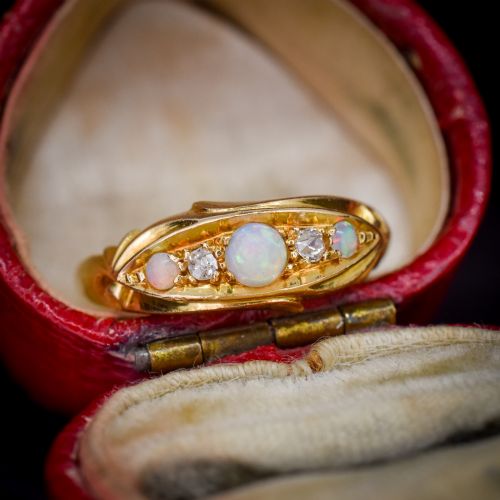
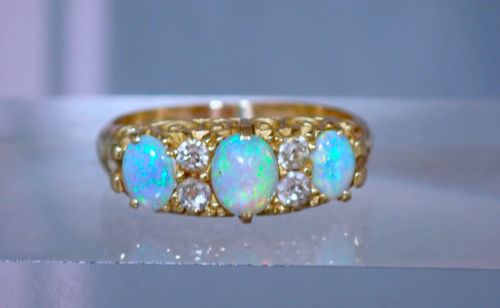
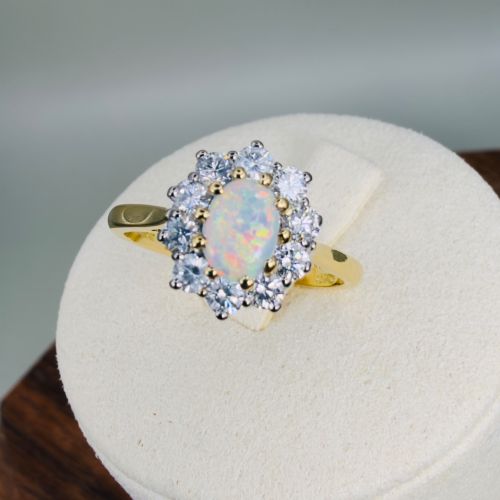
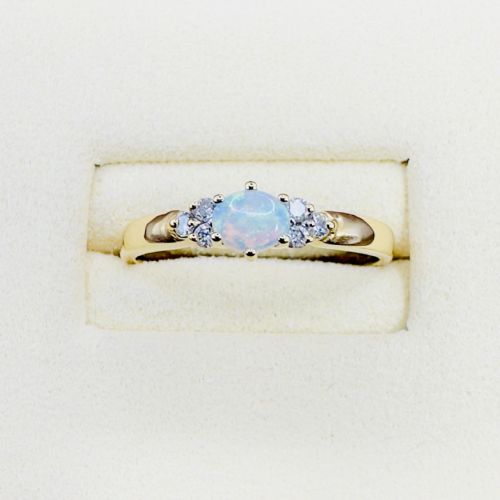
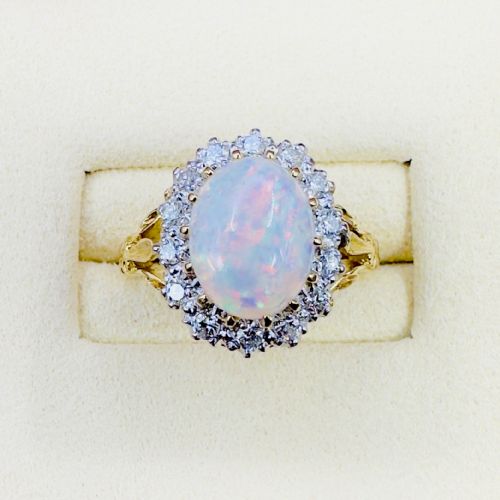
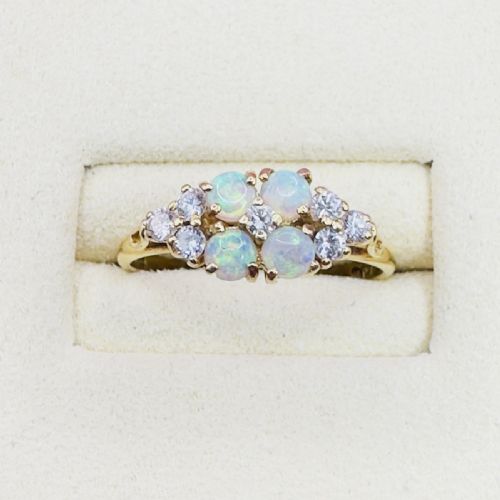
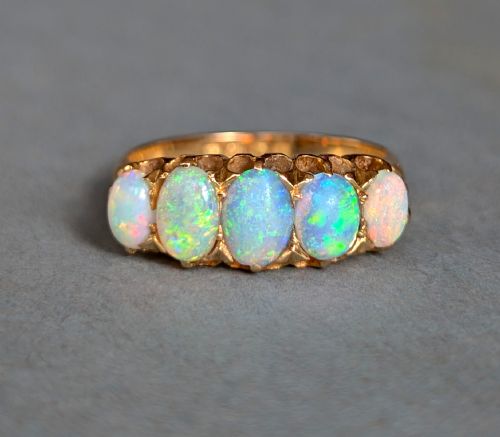
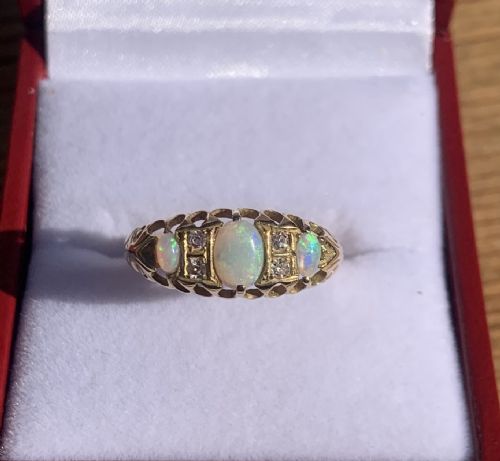
A cabochon opal diamond ring pairs a polished, rounded opal with surrounding diamonds, set in gold or platinum. When you search for a cabochon opal diamond ring, you encounter cluster formations, trilogy settings, and boat shapes spanning the Victorian era through the mid-twentieth century.
The most common formats on this page are cluster rings from the mid-twentieth century, alongside Victorian and Edwardian examples featuring yellow gold bands. These pieces rely on the play-of-colour in the central stone balanced by the clean brilliance of accent diamonds.
Makers and jewellers across the decades utilised distinct regional halls and mounting styles, from Chester hallmarks on nineteenth-century pieces to mid-century white gold clusters. Each era brings its own proportion, balancing the height of the opal dome against the shoulders of the band.
Materials and construction
Metals range from nine-carat and eighteen-carat yellow and white gold to platinum, providing durable foundations for softer stones. Jewellers secured opals in closed or open settings, often surrounding the central dome with brilliant-cut or rose-cut diamonds.
Techniques evolved from nineteenth-century hand-beaten band work and claw settings into mid-century cluster arrangements. Master craftsmen matched the natural contour of the cabochon cut, ensuring the stone sat securely within its diamond halo.
One tiny child-sized Edwardian ring waits patiently on this page, proving that grand Victorian tastes occasionally came in miniature.
The spectrum of quality
Quality rests in the optical vitality of the opal and the proportional harmony of the mount. Stones displaying vibrant flashes of spectral colour across the entire surface elevate a piece far above those with muted or dead zones.
The integration of the diamonds also dictates distinction, where well-matched stones with clean facet work frame the central opal rather than overpower it. Heavier gauge gold and crisp, legible hallmarks further separate standard workshop output from finer bench production.
The Cabochon Opal Diamond Ring Glossary
- Cabochon
- A gem cut with a smooth, rounded, convex top and a flat or slightly curved base, lacking facets. This style highlights the internal play-of-colour in opals.
- Cluster ring
- A ring design featuring a central stone encircled by a group of smaller gems, typically diamonds. This arrangement maximises visual impact on the hand.
- Trilogy ring
- A ring set with three stones in a row, representing past, present and future. In these listings, opals take centre stage flanked by diamonds.
- Boat ring
- A boat-shaped mounting, also known as a navette setting, stretching horizontally across the finger. This elongated silhouette was favoured during the Georgian and Victorian periods.
- Play-of-colour
- The optical phenomenon where spectral colours shift and flash across an opal as the angle of light changes. It forms the primary measure of the stone's visual appeal.
Cabochon Opal Diamond Ring: Frequently Asked Questions
How do I care for my opal ring?
Opals contain water and require gentle treatment, so avoid harsh chemicals, ultrasonic cleaners, and extreme temperature changes.
Remove the ring before heavy housework or gardening to protect the softer stone from scratches and impacts.
Are these opals natural?
The pieces listed feature natural opals, spanning white opals, water opals, and solid cabochons shaped from rough material.
Natural stones display organic inclusions and unique play-of-colour patterns distinct from synthetic substitutes.
How do I date an opal ring?
Dating relies on hallmark stamps, metal purity standards, and the specific setting style characteristic of periods like Victorian, Edwardian, or Art Deco.
Cluster arrangements and band profiles also shift across decades, from heavy nineteenth-century yellow gold to mid-century white gold.
Can these rings be resized?
Most gold and platinum bands can be adjusted by a skilled jeweller, depending on the gallery construction and shoulder stones.
Trilogy and multi-stone cluster designs require careful handling to preserve the integrity of the surrounding claw settings.