





Buttoned Leather Recliner
A buttoned leather recliner combines mechanical ingenuity with deep upholstery, offering a sturdy seat for rest or reading.
Buttoned Leather Recliner
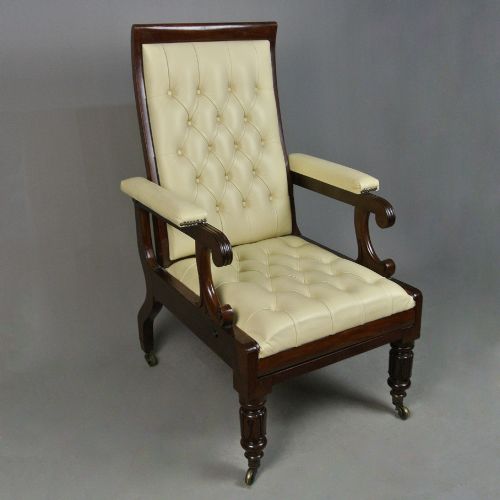
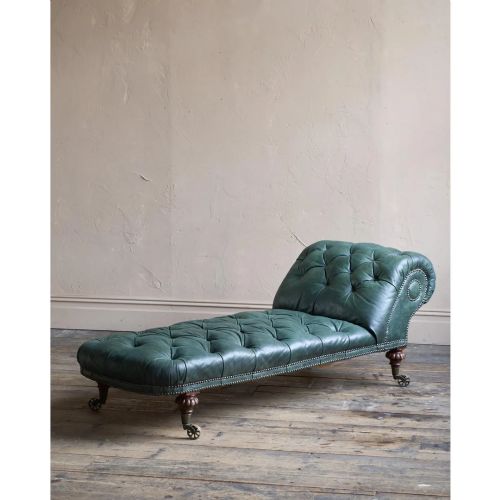
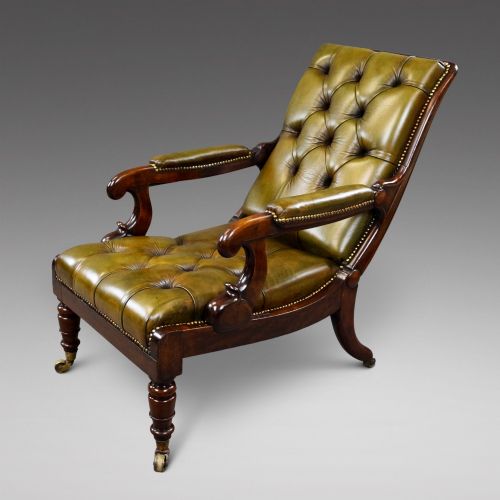
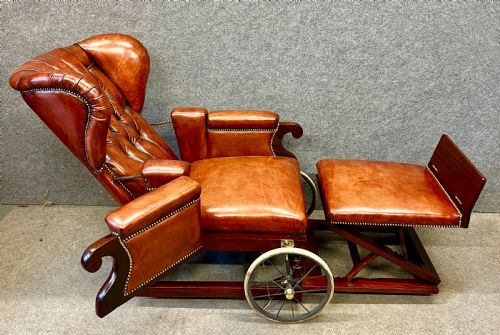
A buttoned leather recliner encompasses nineteenth-century library chairs, invalid wheel chairs, and chaise longues designed for adjustable comfort. You will most frequently encounter mahogany examples bearing the heavy buttoning characteristic of Victorian, Regency, and William IV periods.
Makers engineered these seats with patent mechanisms to alter the back angle, transforming a standard armchair into a resting place. Some incorporate writing slopes or caned bergère sides alongside the leather upholstery.
Origins span English workshops of the Georgian and Victorian eras, alongside French nineteenth-century examples. The forms range from library armchairs to chaise longues suited for convalescence.
How they were made
Craftsmen built the frames using solid mahogany, shaping the timber for structural support in library and reclining chairs. Brass components and iron mechanisms allowed the seats to adjust smoothly.
Upholsterers secured leather coverings with deep buttoning, pairing the hide with cane panels in specific bergère designs. Metal hardware, including patented systems, provided the adjustable function.
Buttoned Leather Recliner Retail Price Guide 2026
Typical asking prices for buttoned leather recliner among the pieces listed under this phrase on Sellingantiques today, from the lower quarter to the upper quarter. They describe what is for sale here now, not the wider market.
What varies in quality
The sophistication of the patent mechanism separates standard seating from high-end examples designed by known makers. Signed works command attention for their complex mechanical ingenuity.
The choice of solid mahogany and the precision of the leather buttoning dictate the visual weight and finish of the chair. Original brass fittings and cane work preserve the integrity of the piece.
Robert Daws London·John Ward
The Buttoned Leather Recliner Glossary
- Bergère
- An enclosed upholstered armchair with exposed wooden framing and cane panels. These typically feature loose squab cushions.
- Chaise Longue
- An upholstered chair elongated for reclining, combining the function of a seat and a day bed. Examples often date from the nineteenth century.
- Patent
- A legally protected mechanical invention applied to furniture, denoting specific adjustable reclining systems. Such innovations mark pieces by makers like Daws.
- Writing Slope
- A slanted desk surface integrated into furniture design. Certain library armchairs incorporate this feature for reading or correspondence.
Buttoned Leather Recliner: Frequently Asked Questions
How do I operate the reclining mechanism?
Many nineteenth-century chairs utilise mechanical systems operated by adjusting the back or arms.
Patented designs by makers like Daws move via internal iron hardware rather than modern levers.
Where were these chairs used?
Owners placed them in libraries, studies, and drawing rooms for reading and writing.
Some variants served specialised roles as convalescing invalid chairs.
What materials are standard?
Frames are constructed from solid mahogany, frequently paired with brass and iron hardware.
Upholstery consists of leather, sometimes accompanied by cane side panels.
How do I distinguish Regency from Victorian pieces?
Regency and George IV examples date from the early nineteenth century, displaying classical proportions.
Victorian and later nineteenth-century pieces often feature heavier proportions and distinct mechanical improvements.