
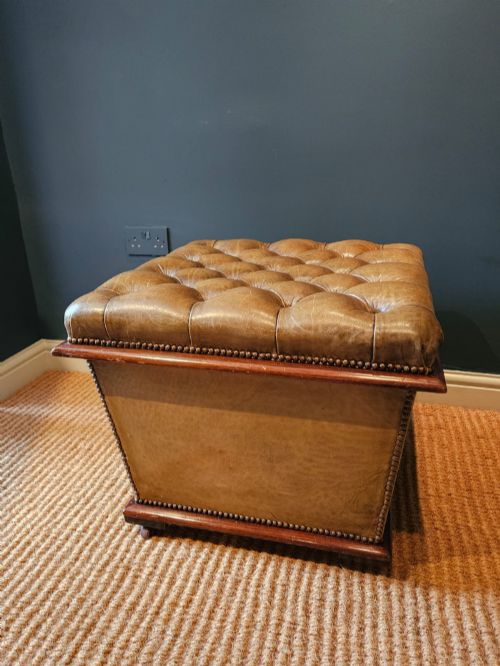


Buttoned Footstool
A buttoned footstool brings low, padded seating to a room, offering deep tufted upholstery and sturdy timber frames that ground traditional spaces.
Buttoned Footstool
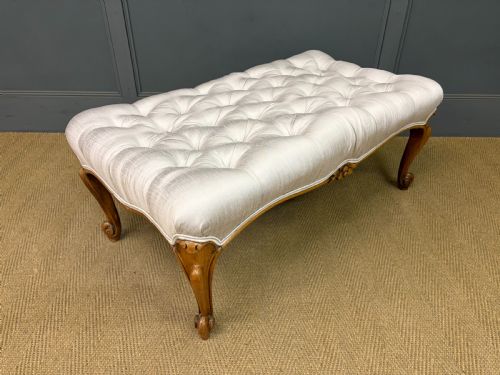
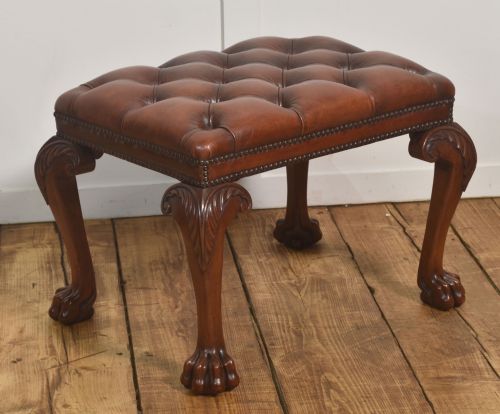
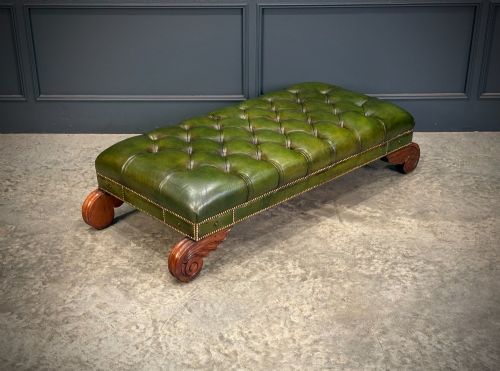
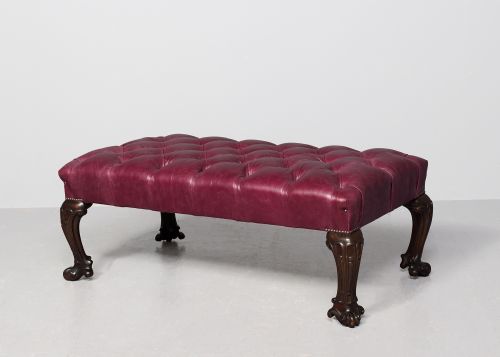
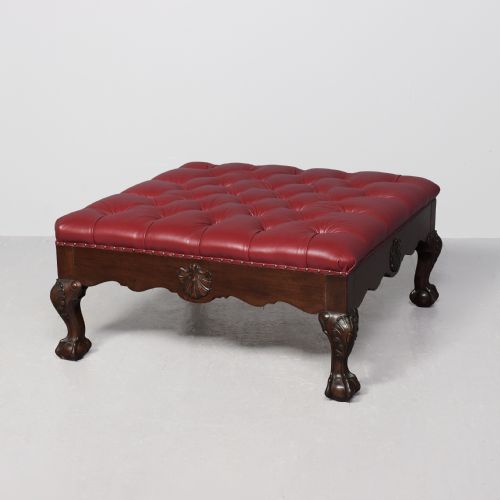
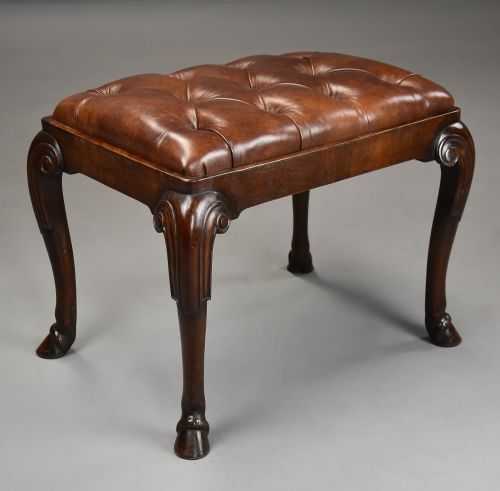
A buttoned footstool takes many forms across the selection, appearing as compact low stools, grand country house ottomans, and long window seats designed to sit before armchairs or centre tables.
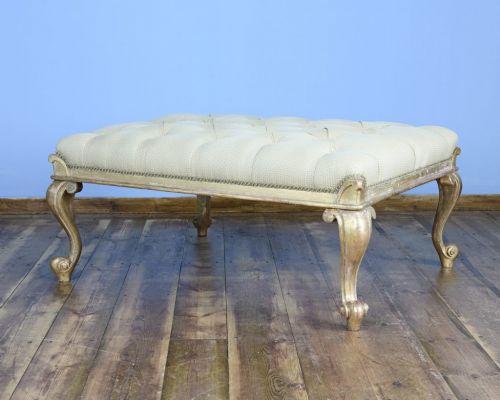
Victorian and Regency examples dominate the grouping, frequently pairing turned or cabriole wooden legs with generously stuffed tops that show deep tufting.
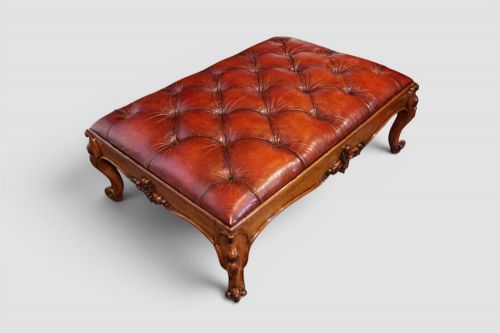
Makers adapted these pieces for various domestic uses, ranging from modest footrests to large upholstered coffee tables covered in hand-dyed leather or ticking stripe.
How They Were Made
Frames rely on dense hardwoods such as mahogany, walnut, rosewood, and oak, joined to support the downward pressure of daily use.
Upholstery techniques involve securing fabric, silk, velvet, or hide over internal stuffing, anchored tightly with recessed tufting buttons and occasionally bordered with brass studs.
Several pieces arrive covered in ticking stripe, originally designed to keep mattress feathers from poking through.
What Varies in Quality
Quality rests in the timber selection and the precision of the frame carving, where finely turned cabriole legs or parcel-gilt details elevate standard forms.
The standard of the upholstery work and the depth of the buttoning dictate the visual weight, separating simple workshop pieces from grand salon items.
James Shoolbred·A.M.E. Fournier
The Buttoned Footstool Glossary
- Buttoned
- An upholstery technique where twine pulls the fabric inward at regular intervals to create sunken tufts and firm padding. This secures the internal stuffing against shifting.
- Cabriole leg
- A furniture leg that curves outward at the knee and tapers inward toward the foot, often ending in a scroll or pad. It is frequently seen on walnut and mahogany pieces.
- Ottoman
- A low, fully upholstered seat without arms or a back, frequently built on a grand scale for central room placement. These pieces often double as low tables.
- Ticking stripe
- A sturdy, tightly woven cotton or linen textile featuring linear patterns, historically used for mattress covers and now found on country house seating.
Buttoned Footstool: Frequently Asked Questions
How were buttoned footstools used?
These pieces served primarily as footrests before armchairs or as secondary seating in libraries, drawing rooms, and large country houses.
Their substantial padded tops also allowed them to function as centre tables or low ottomans for resting trays and books.
What woods are common?
Mahogany, walnut, and rosewood appear frequently across the frames, selected for their strength and rich grain patterns.
Light oak and parcel gilt frames also emerge in specific Regency and Victorian examples.
How do I spot a Victorian piece?
Victorian examples often feature walnut or rosewood frames with cabriole legs, deep buttoning, and occasionally castors for mobility.
They span from compact parlour stools to grand leather-upholstered centre ottomans.
Can these be used as coffee tables?
Large rectangular leather or fabric ottomans provide a stable, cushioned surface that functions well in place of a rigid wooden table.
Their firm buttoned upholstery supports trays while maintaining a soft profile in a room.