
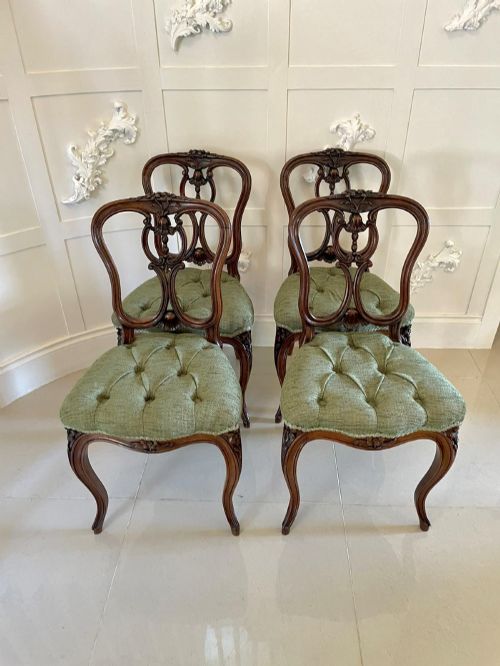
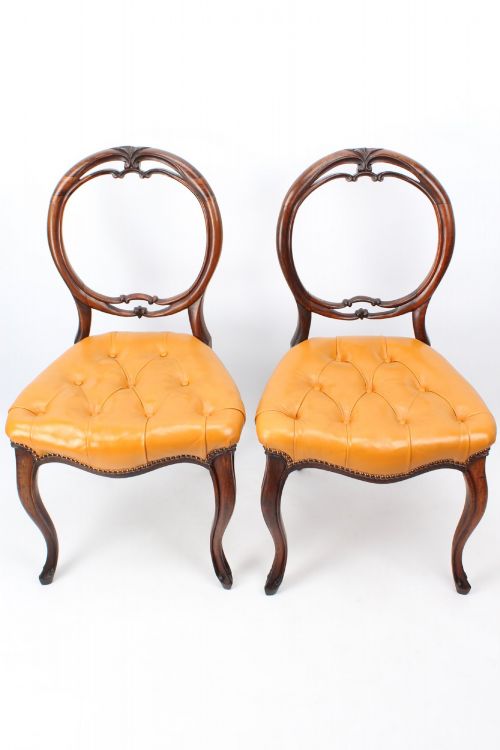


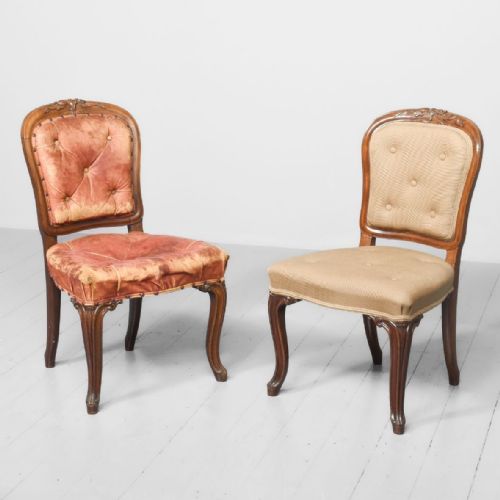


Buttoned Back Dining Chairs
Buttoned back dining chairs combine deep-buttoned upholstery with sturdy timber frames, offering enduring comfort and formal elegance around the dining table.
Buttoned Back Dining Chairs
Buttoned back dining chairs are seated forms designed primarily for dining rooms and formal parlours, appearing predominantly in Victorian and nineteenth-century inventories. These pieces emerge in sets ranging from pairs to groups of twelve, serving both practical seating needs and decorative roles within domestic interiors.
The versions most frequently encountered on this page belong to the Victorian era and the broader nineteenth century, utilising timber structures paired with upholstered backs. Examples span single chairs, pairs, matched sets, and larger suites incorporating side chairs alongside seating for dining tables.
Makers and workshops of the period utilised distinct regional styles, ranging from robust William IV mahogany to refined walnut frames influenced by French Rococo and Louis XV revival tastes. Buyers encounter variations in back shapes, including balloon backs and fully upholstered buttoned panels supported by carved woodwork.
How they were made
Frames were constructed from dense hardwoods such as mahogany, walnut, and rosewood, selected for their structural strength and capacity to hold intricate carved details. Workshops shaped these timbers into curved stiles, cabriole legs, and supportive back rails using traditional joinery methods.
Upholstery involved securing internal padding and buttoning through layers of textile, velvet, fabric, or leather to create the characteristic indented surface. Brass tacks and careful stitching finished the edges, securing the covering material firmly to the timber frame.
The inventory includes matched sets of dining chairs alongside larger multi-piece drawing room suites.
What varies in quality
Quality rests upon the selection of timber and the depth of carving executed on the chair frame, distinguishing standard production from exceptional workshop output. Denser hardwoods and crisper hand-carved ornamentation separate finer examples from simpler provincial pieces.
The execution of the upholstery work, including the symmetry of the buttoning and the choice of covering material such as leather or velvet, dictates the refinement of the piece. Matching sets that survive intact demonstrate greater coherence than assembled groups gathered over time.
Gillows·Blyth & Sons·H. Samuel, London
The Buttoned Back Dining Chairs Glossary
- Button back
- A style of upholstery where the padding is pulled tight and secured with recessed buttons, creating a quilted geometric pattern. This technique provides both structural tension and lumbar support.
- Side chair
- A chair without arms, designed to be used at a dining table or placed against a wall when not in use. These pieces form the majority of standard dining sets.
- Rococo Revival
- A nineteenth-century design movement drawing inspiration from eighteenth-century French style, characterised by C-scrolls, asymmetrical ornament, and naturalistic floral carvings. Walnut frames frequently display these characteristics.
- William IV
- A transitional design period spanning the early nineteenth century, bridging Regency and early Victorian tastes. Furniture from this era typically employs heavy mahogany with bold architectural proportions.
Buttoned Back Dining Chairs: Frequently Asked Questions
How do I date buttoned back dining chairs?
Dating relies on examining the timber species, joinery techniques, and stylistic markers such as balloon backs or revival motifs. Nineteenth-century examples often display specific regional characteristics tied to the Victorian era.
Changes in upholstery construction methods and wood turning also provide reliable indicators of age. Comparing the piece against documented sets helps narrow down the period of manufacture.
Are these chairs suitable for daily use?
These pieces were built for formal dining and withstand regular domestic use provided the timber frames remain solid. Many survive in sturdy condition.
Buyers should ensure the internal upholstery foundation and joints are stable. Proper care preserves both the structural integrity and the surface finish over time.
What woods were used for these chairs?
Workshops primarily utilised mahogany, walnut, and rosewood for their durability and attractive grain patterns. These hardwoods allowed craftsmen to carve intricate details without compromising strength.
Darker mahogany dominates earlier nineteenth-century examples, while walnut and rosewood appear frequently in mid-Victorian and revival pieces. Each timber imparts a distinct colour and visual weight to the furniture.
How do I clean leather upholstery?
Leather surfaces require gentle cleaning with specialised saddle soap or leather conditioner to prevent drying and cracking. Avoiding harsh chemicals maintains the natural patina.
Regular dusting and occasional treatment keep the material supple. Proper maintenance protects the leather buttoning from excessive wear.
What is the difference between a side chair and a salon chair?
Side chairs are scaled for dining tables and lack arms, whereas salon chairs form part of larger seating suites for drawing rooms. Salon pieces often feature more elaborate carving and lighter proportions.
Dining chairs prioritise uniform height and sturdy frames for seating around a table. Parlour suites focus on decorative upholstery and coordinated design.