
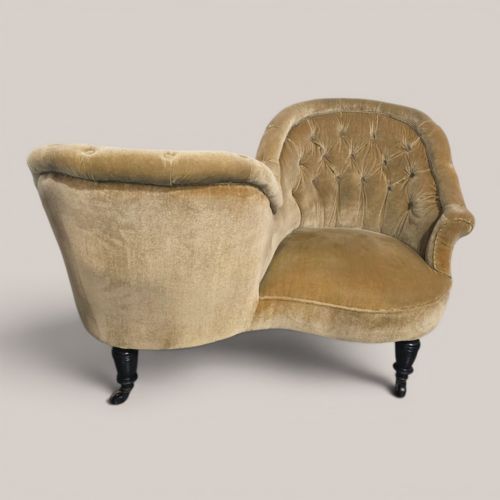


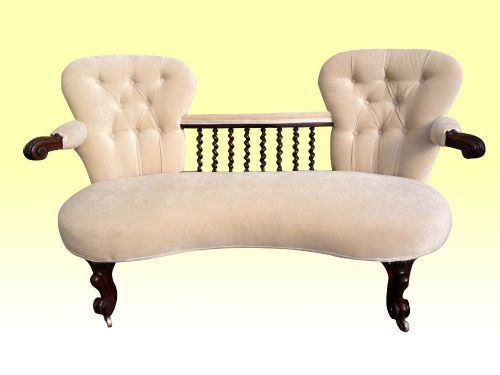
Button Backed Conversation Sofa
A button backed conversation sofa brings Victorian social seating into a modern interior, offering circular or curved forms designed for intimate dialogue.
Button Backed Conversation Sofa
A button backed conversation sofa represents a specific Victorian seating form designed to allow two or more people to converse while facing different directions. The examples appearing on this page date predominantly from the nineteenth century, spanning periods such as the eighteen-fifties and eighteen-eighties.
Forms within this category include conversation seats, double end settees, and double spoon-back sofas. Walnut and mahogany provide the primary wooden frames, paired with upholstered finishes in leather, velvet, and various textiles.
Makers of these nineteenth-century pieces utilised styles ranging from early Victorian designs to Victorian Rococo revival. Buyers searching this phrase encounter showwood frames, barley twist supports, and occasional swivel mechanisms built into the seating architecture.
Materials and construction methods
Cabinet makers of the nineteenth century constructed the structural frames of these settees using dense hardwoods such as mahogany, walnut, and rosewood. These timbers were carved to form exposed showwood surrounds, serpentine rails, and barley twist uprights.
Upholstery techniques relied on deep buttoning through fabrics, leather, and velvet to secure the interior padding and create the characteristic tufted surface. Brass elements and hardwood sub-frames provided the necessary mechanical stability for multi-directional seating arrangements.
Listings show nineteenth-century pieces employing rosewood, mahogany, and walnut alongside leather and velvet upholstery.
Markers of distinction
Quality in a button backed conversation sofa rests upon the proportion of the wooden framework and the precision of the deep button upholstery. Dense timbers like rosewood and walnut indicate higher ambition than simpler secondary woods.
The sophistication of the carving on showwood frames and the inclusion of complex functional elements, such as a swivel mechanism, separate standard production from more elaborate examples of nineteenth-century seating.
The Button Backed Conversation Sofa Glossary
- Showwood
- Timber framing left visible around the upholstered portions of a seat. This allows the polished grain of mahogany, walnut, or rosewood to contribute to the visual design.
- Deep buttoning
- An upholstery method where stitches pull the fabric tight against the padding into recessed tufts. This secures the filling and creates a patterned, tactile surface.
- Barley twist
- A turned wooden furniture leg or support shaped like a spiral rope. It appears frequently on nineteenth-century frames to add textural detail.
- Serpentine
- A furniture front or edge shaped in a double curve resembling a snake, curving outward in the centre and inward at the sides.
Button Backed Conversation Sofa: Frequently Asked Questions
What is a conversation sofa?
A conversation sofa is a multi-directional Victorian seating form designed to accommodate sitters facing away from one another while maintaining proximity for talk.
These pieces typically feature curved or circular frames constructed from hardwoods like mahogany and rosewood.
How do I date a conversation sofa?
Dating relies on stylistic markers such as early Victorian rosewood frames or later Victorian Rococo revival details.
Materials like brass fittings, leather upholstery, and specific timber choices help align pieces with the nineteenth century.
Where should I place this sofa?
These seats suit large rooms where they can sit freestanding rather than against a wall, owing to their multi-directional design.
They function effectively as central focal points in drawing rooms or large studies.
What woods were used?
Victorian makers utilised durable hardwoods including mahogany, walnut, and rosewood for the structural frames.
These timbers provided the strength required for complex curved shapes and exposed showwood finishes.