
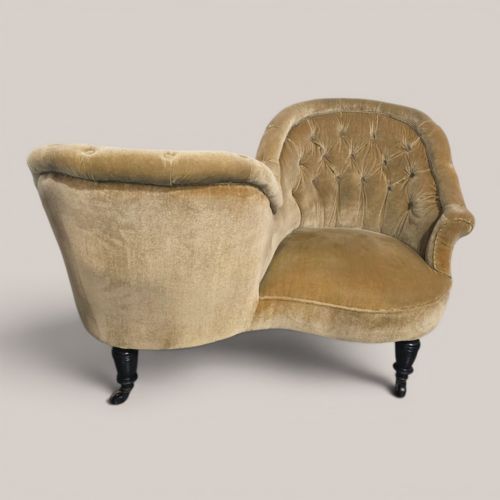


S Shaped Sofa
When you want an s shaped sofa, you are looking at nineteenth and twentieth century seating designed to turn conversation into an art.
S Shaped Sofa
An s shaped sofa groups people into a serpentine curve, encouraging intimate dialogue without awkward turns. The pieces here span the Victorian era into the Art Deco period, taking forms such as conversation seats, crescent settees, and kidney shapes.
Victorian examples often feature walnut frames with carved details, while later twentieth century interpretations lean towards smooth scroll shapes upholstered in leather or velvet. These seats occupy a room centre or a generous corner, functioning as both furniture and sculpture.
Materials and Construction
Makers built the structural frames from hardwoods including walnut, mahogany, and rosewood, often choosing burr veneers for decorative surfaces. These woods provided the rigid strength required to support curved outlines and complex joinery.
Upholstery relied on traditional stuffing techniques paired with fabrics such as velvet, leather, and patterned textiles, secured with brass tacks or piping. Turnings, castors, and occasionally gilt mounts finished the lower sections of the frames.
The selection includes Victorian conversation seats, Art Deco cloud sofas, and Regency lyre shaped designs.
Judging Quality
Quality rests in the fluidity of the timber curve and the integrity of the underlying frame construction. A superior piece maintains balanced proportions across its serpentine sweep without stiffness.
The finesse of the carving and the quality of the timber veneers distinguish finer examples from standard production. Original castors and well-preserved upholstery methods also elevate a piece.
Howard & Sons·Harry and Lou Epstein
The S Shaped Sofa Glossary
- Conversation seat
- A multi-seated upholstered furniture piece designed so occupants sit facing opposite directions in an S-configuration. This arrangement allows intimate talk without straining necks.
- Serpentine
- A line or edge that curves outward then inward in a gentle wave. It adds visual movement to wooden framing and upholstered borders.
- Kidney shaped
- A curved furniture profile resembling a bean or kidney. It provides an ergonomic curve suited for tight spaces or centre placement.
- Burr walnut
- Timber taken from walnut tree growths, yielding intricate swirling grain patterns. Cabinet makers prized this wood for decorative table tops and cabinet fronts.
- Castor
- A small wheel mounted on a swivel attached to furniture legs. It permitted heavy Victorian seating to move across carpets with ease.
S Shaped Sofa: Frequently Asked Questions
Where should I place an s shaped sofa?
These pieces work best floating in the middle of a spacious room rather than pushed against a wall. Their curves invite viewing and sitting from multiple angles.
Positioning them away from boundaries lets the serpentine lines define a distinct conversation area within a larger interior.
How do I care for antique upholstery?
Protect delicate fabrics like velvet and antique leather from direct sunlight to prevent fading and drying. Gentle vacuuming with a soft brush attachment removes surface dust.
Professional cleaning is advisable for historic textiles to maintain the integrity of the underlying stuffing and springs.
Are these sofas comfortable for daily lounging?
Many conversation seats and curved settees were built for upright Victorian socialising rather than slouching. Their firm padding supports structured posture during gatherings.
Later Art Deco and upholstered versions often offer a softer sit, depending on the restoration work carried out.