


Burr Wood Etagere
A burr wood etagere brings figured grain and open tiers to a room, offering display space for treasured objects.
Burr Wood Etagere
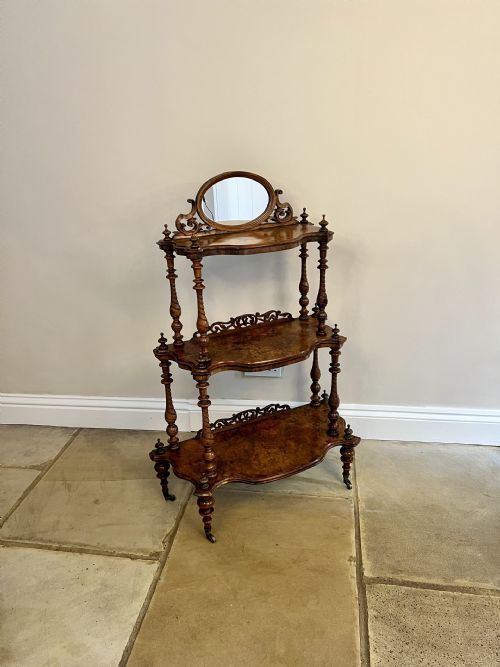
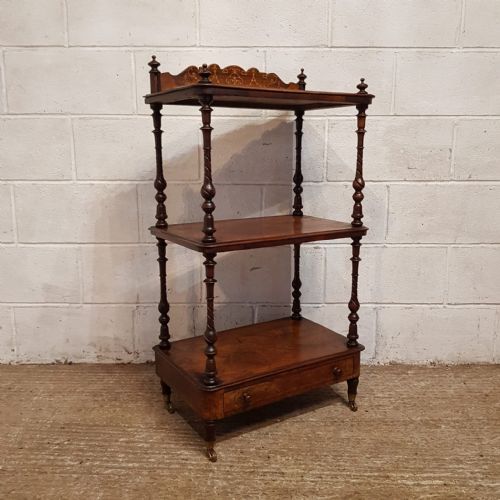
When you search for a burr wood etagere, you find multi-tiered open furniture designed for display, commonly known in the trade as whatnots. These pieces mostly date from the Victorian period, alongside a few Regency examples.
The versions you meet on this page take various forms, including freestanding three-tier and four-tier pieces, corner designs, and marquetry inlaid variants. Walnut and elm provide the figured surfaces, while amboyna also appears among the listings.
Origins stretch from Irish workshops to broader nineteenth-century production, spanning the 1850s and 1860s alongside broader nineteenth-century dating. Each example relies on tiered shelving supported by uprights to create a vertical display structure.
How they were made
Cabinet makers utilised burr walnut and burr elm veneers to cover primary structures, highlighting the swirling grain patterns of the wood. Marquetry inlay added further ornamentation to the surfaces of selected pieces.
Structural integrity depended on turned or carved uprights supporting multiple wooden shelves, sometimes augmented with brass components and mirror glass. Metal and glass elements integrated into the tiered framework to complete the construction.
Some nineteenth-century makers built corner whatnots simply because awkward empty angles troubled tidy Victorian parlor owners.
What varies in quality
Exhibition quality pieces display superior carving, intricate marquetry inlay, and carefully selected burr walnut veneers with deep figuring. Lesser examples rely on simpler turned supports and plain timber surfaces without decorative inlay.
The number of tiers and the complexity of the silhouette alter the visual weight of the furniture. Corner configurations and multi-tier freestanding formats require precise joinery to remain stable across their height.
The Burr Wood Etagere Glossary
- Etagere
- An open piece of furniture with multiple shelves for displaying small objects. These pieces often feature three or four tiers.
- Whatnot
- A nineteenth-century term for a multi-tiered display stand used for ornaments and books. It appears interchangeably with etagere in the evidence.
- Burr wood
- Timber taken from a tree growth where the grain has swirled in a deformed manner. Walnut and elm are the primary burr varieties seen here.
- Marquetry
- Decorative veneer work arranged in patterns on the surface of the wood. It frequently incorporates floral or geometric motifs.
- Tier
- An individual shelf arranged horizontally within the vertical framework of the stand. Pieces typically contain three to four tiers.
Burr Wood Etagere: Frequently Asked Questions
What is a burr wood etagere used for?
These tiered stands served historically to display ornaments, decorative ceramics, and small household items within principal rooms. Their open shelving allowed owners to exhibit collections of curiosities in a structured manner.
Today, they function similarly in domestic interiors, holding books, plants, and decorative objects while adding warmth through their figured wood surfaces.
Are corner versions common?
Corner etageres form part of the selection, specifically designed to fit into room angles while providing multiple levels of shelving. They utilise the same tiered construction as freestanding models.
These shaped variants often feature four tiers and maintain the characteristic burr walnut finish seen across the wider category.
What woods appear in these listings?
Burr walnut dominates the selection, accompanied by burr elm and amboyna. These timbers are chosen for their highly figured grain patterns rather than straight lines.
Inlayers added contrasting materials to the surfaces, while structural elements occasionally incorporated brass and mirror glass alongside the primary wood.