



Burr Walnut Splat
Burr walnut splat chairs bring warmth and striking grain patterns to a room, offering classic seating shaped across centuries of British and continental design.
Burr Walnut Splat
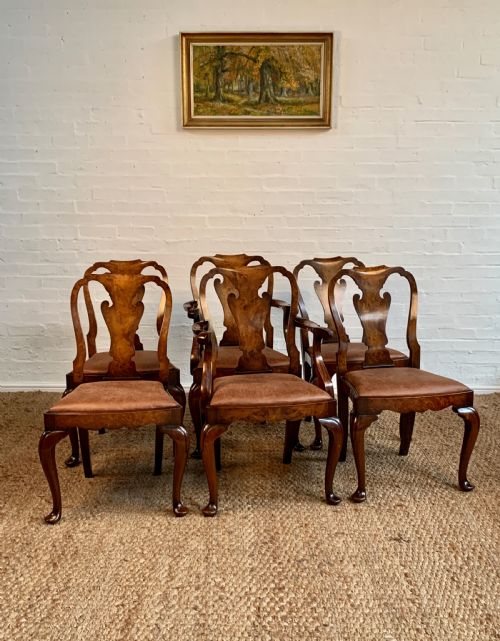
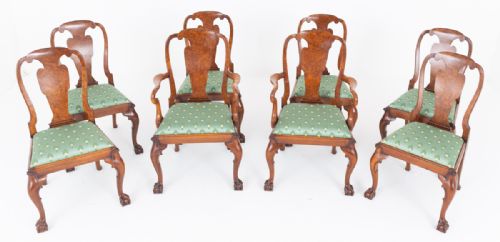
When you search for burr walnut splat, you are looking at chairs and settees featuring shaped central back supports made from highly figured timber. These pieces span from the 18th century through to the 1930s, encompassing formal dining sets, single side chairs, nursery chairs, and childs chairs.
The most common examples you will meet on this page belong to the Queen Anne style and Queen Anne Revival periods. These designs showcase distinct upright forms with decorative splats, often constructed during the Victorian era or the early decades of the 20th century.
Makers and manufacturers drew heavily on historical precedents, producing walnut and burr walnut seating influenced by Queen Anne, George II, and French Louis XV aesthetics. You will also find pairs and sets ranging from smaller dining groups to large sets of twelve chairs.
How they were made
Cabinet makers utilised solid walnut frames combined with burr walnut veneers to achieve rich, swirling grain patterns across the splats and backs. Carved details frequently adorn the knees and frames of Victorian and revival pieces, reflecting traditional woodworking techniques.
Seating portions incorporate various support methods recorded in the listings, including cane panels, leather, tapestry, and contemporary upholstery fabrics. These materials were selected to complement the dark tones and complex figures of the underlying walnut timber.
Even nursery chairs received the grand burr walnut treatment, letting toddlers sit in miniature Queen Anne splendor.
What varies in quality
The visual impact of the burr walnut veneer dictates much of the distinction between pieces, with densely figured grain patterns commanding greater attention than plain timber. Carving depth and precision across the frame and splat also separate standard production from finer workshop outputs.
Completeness of sets and matching pairs alters the character of the seating, as larger uniform dining groups require consistent timber selection across numerous chairs. Original elements such as cane work or period upholstery further distinguish individual examples.
Charles Tozer
The Burr Walnut Splat Glossary
- Burr walnut
- A veneer taken from the warted growths of a walnut tree, producing intricate, swirling grain patterns. It is prized for decorative furniture surfaces.
- Queen Anne style
- A design movement characterised by curved lines, cabriole legs, and splat-back chairs. Revival versions reappeared strongly in the 19th and early 20th centuries.
- Cane
- Woven rattan material used for chair seats and backs. It offers a lightweight, patterned texture contrasting with solid wood.
Burr Walnut Splat: Frequently Asked Questions
What periods do these chairs come from?
The pieces span from the 18th century up to the 1930s, with strong representation from the Victorian era and early 20th-century revival periods.
Craftsmen across these different eras frequently revisited earlier walnut designs, adapting traditional forms for contemporary dining rooms.
Are large dining sets available?
Listings include various set sizes, ranging from pairs and small groups of six up to larger sets of eight or twelve dining chairs.
Finding matched sets of twelve or eight from the same period is less common than single chairs or smaller pairs.
What seat materials are used?
Seating surfaces vary widely between examples, featuring woven cane panels, leather, tapestry, and modern upholstery fabrics.
Many chairs retain traditional padding and textile coverings, while others have received newly updated upholstery.
How do I identify a splat back?
The splat is the central vertical wooden board running up the middle of the chair back, situated between the stiles.
In burr walnut pieces, this central panel typically displays the most decorative and figured grain pattern on the chair.