






Burr Walnut Accent Chairs
Burr walnut accent chairs bring rich grain and compact seating to a room, drawing the eye instantly through their figured timber.
Burr Walnut Accent Chairs
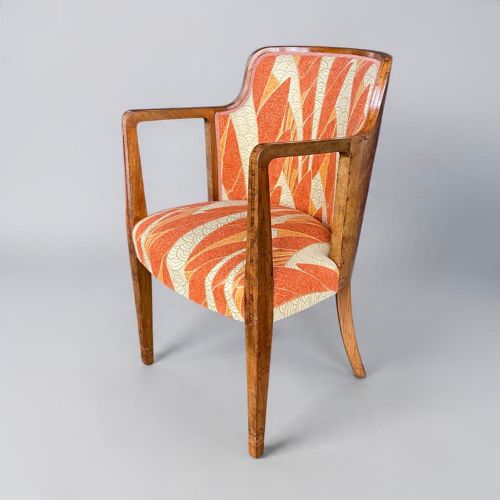
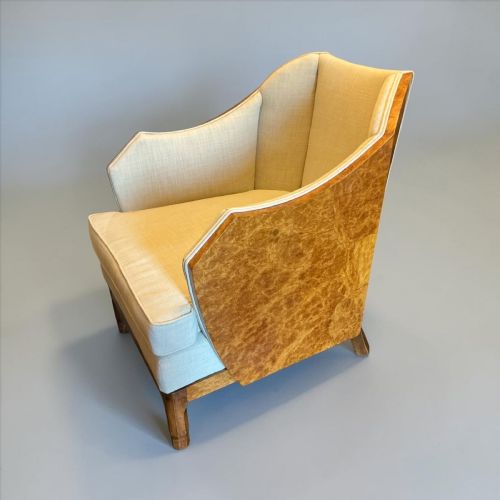
Burr walnut accent chairs comprise compact seating options designed to stand out within a room, spanning forms such as side chairs, occasional chairs, armchairs, nursery chairs, and child's chairs. These pieces emerge primarily from the early decades of the twentieth century, specifically appearing across the nineteen-hundreds, nineteen-tens, nineteen-twenties, and nineteen-thirties.
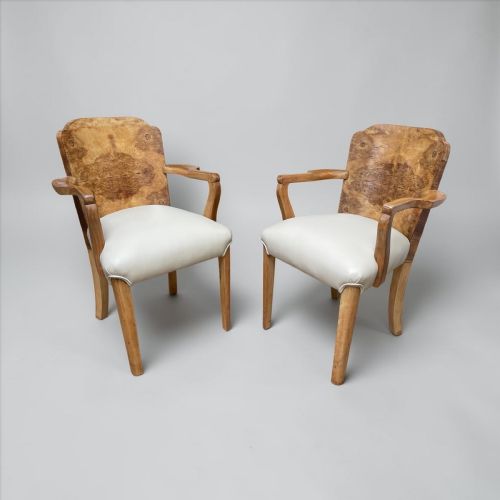
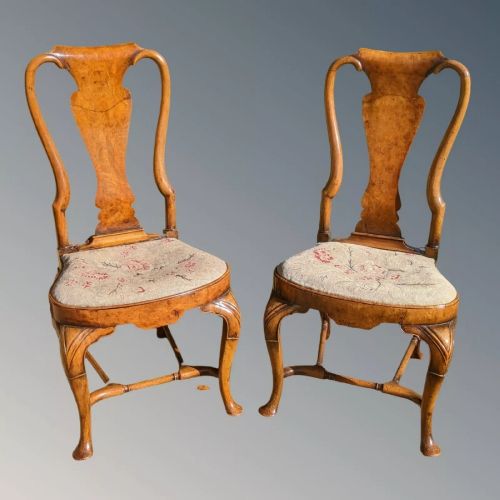
Buyers encountering this selection will most frequently find pairs rather than single items, alongside occasional individual pieces. The designs bridge differing aesthetic movements, moving from earlier revival forms toward modernist lines.
Origins and makers span notable cabinet makers and London workshops of the early twentieth century. The forms range from traditional Queen Anne styling with distinct silhouette curves to the geometric streams of Art Deco.
How they were made
The primary material centres upon walnut and burr walnut veneer, laid over sturdy hardwood frames to showcase the intricate, swirling knot formations of the timber. Upholstery employs traditional textile fabric and leather finishes fixed to the seat pads.
Cabinet makers utilised expert veneering techniques to wrap complex curves, matching the grain symmetrically across chair backs and rails. Joinery relied on traditional framing methods suited to supporting daily use while maintaining decorative integrity.
Burr Walnut Accent Chairs Retail Price Guide 2026
Typical asking prices for burr walnut accent chairs among the pieces listed under this phrase on Sellingantiques today, from the lower quarter to the upper quarter. They describe what is for sale here now, not the wider market.
The listings span four distinct decades, moving from the nineteen-hundreds through the Art Deco movement of the nineteen-thirties.
What varies in quality
Excellence in these chairs rests upon the choice and book-matching of the burr walnut veneer across prominent surfaces. Finer examples display lively, unbroken grain patterns that follow the contours of the timber frame seamlessly.
The distinction between standard production and superior work involves the precision of the carving, especially on revival pieces, alongside the crispness of the joinery. Maker attribution also elevates certain pieces, marking out workshops known for exceptional finish.
Charles Tozer·Harry and Lou Epstein·Hille
The Burr Walnut Accent Chairs Glossary
- Burr walnut
- A veneer sliced from the knotty growth of a walnut tree, prized for its swirling, highly figured grain patterns. It creates a decorative surface used on prominent parts of the furniture.
- Occasional chair
- A light, movable seat designed to be brought into use when extra seating is required in a room. These pieces double as decorative items when set against a wall.
- Queen Anne style
- A traditional design movement defined by curved lines, spooned backs, and cabriole legs ending in pad feet. Twentieth-century makers often revived these classic eighteenth-century shapes.
- Art Deco
- A modernist design style emerging in the interwar period, characterised by sleek geometric shapes, streamlined forms, and minimal ornamentation. It prioritised clean visual impact.
- Side chair
- A small, armless chair intended primarily for dining or placement against a wall. They offer compact proportions while maintaining decorative presence.
Burr Walnut Accent Chairs: Frequently Asked Questions
What is a burr walnut accent chair?
These pieces are small-scale seats finished with highly figured burr walnut veneer, designed to provide both seating and visual interest.
They appear in various twentieth-century styles, ranging from revival forms to modernist designs.
How do I date a walnut chair?
Dating relies on stylistic clues, construction methods, and materials recorded from specific historical periods.
Early twentieth-century pieces often combine traditional wood frames with the aesthetic movements of their decade of manufacture.
Where should I place an occasional chair?
Occasional chairs fit well in corners, bedrooms, or living spaces where extra seating is needed without cluttering the floor plan.
Their decorative burr walnut surfaces allow them to stand alone as focal points.
Are these chairs comfortable for daily use?
Most pieces feature upholstered pads in leather or textile fabric designed for sitting.
Their primary function historically combined utility with decorative presence in reception rooms.