




Burgundy Leather Desk Chair
A burgundy leather desk chair brings working timber and rich hide together for the study, built across periods from the eighteenth century onward.
Burgundy Leather Desk Chair
A burgundy leather desk chair is a sturdy seat designed for study or office work, combining timber frames with deep red leather upholstery. The selection spans forms such as library chairs, captain's chairs, and revolving office armchairs.
The prevailing styles on this page run from Georgian and Victorian periods through Edwardian and later revivals like Queen Anne and Chippendale. Buyers encounter everything from fixed mahogany frames to swivel office models mounted on timber or metal bases.
How they were made
Frames rely on dense hardwoods including mahogany, oak, walnut, rosewood, and beech, shaped into arms, legs, and supportive backrests. Woodwork often involves turning, carving, and joinery suited to daily seating.
Upholstery uses leather dyed in deep red or burgundy shades, fixed to the frame with brass tacks or studs. Swivel variants incorporate metal and steel swivel mechanisms to allow rotation and movement.
The archive records pieces built with swivel and revolving mechanisms dating back to the late nineteenth century.
What varies in quality
Quality rests in the timber selection and the precision of the frame's construction. Dense mahogany and walnut framing with hand-carved details or sturdy cockfighting and Gainsborough forms sit at the upper end of the range.
The finish of the leather and the integration of revolving mechanisms also separate standard production from finer workshop pieces. Heavier framing and consistent patination on the hide indicate superior craftsmanship.
Phillips & Sons of Bristol
The Burgundy Leather Desk Chair Glossary
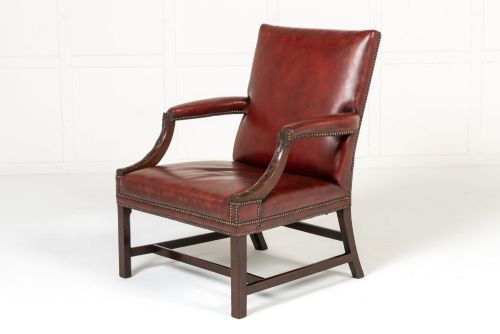
- Gainsborough chair
- A wide-seated armchair with an upholstered back and arms, dating from the eighteenth century onwards. These pieces provide comfortable seating for studies and libraries.
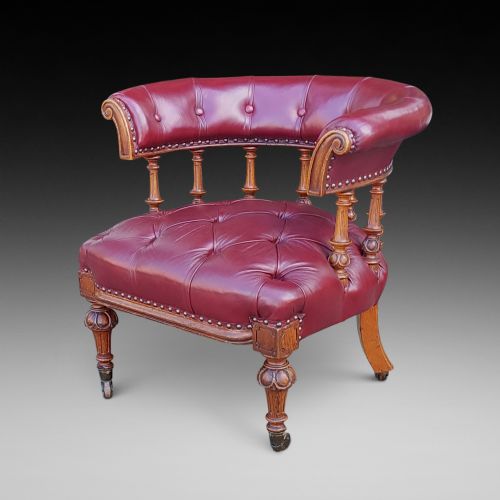
- Captain's chair
- A sturdy timber armchair, often featuring a rounded backrest supported by vertical spindles above a solid wooden or leather-upholstered seat. They were historically utilised in offices and ships.
- Cockfighting chair
- A low, specialised armchair designed with a padded rest on the upper back lean, allowing a seated person to straddle the seat facing backward. Surviving examples date to the nineteenth century.
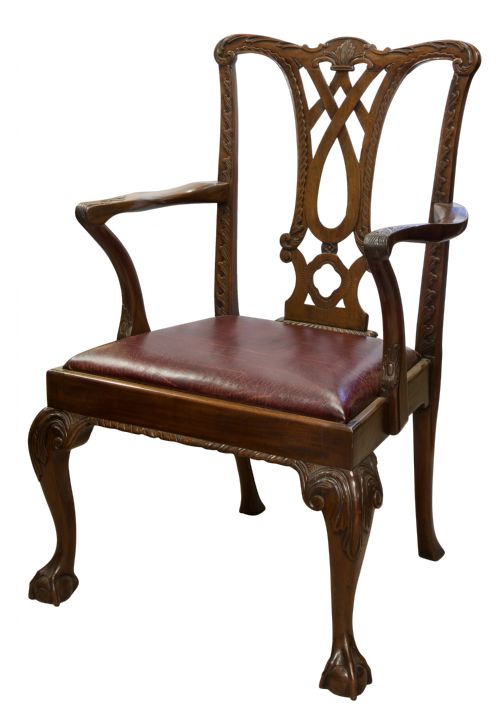
- Carver armchair
- A principal chair with arms, historically placed at the head of a dining table or used as a desk seat. They match simpler side chairs in a set.
- Revolving office desk chair
- A swivel seat mounted on a central pivot, frequently produced during the Victorian and Edwardian periods in oak, mahogany, and beech. These allowed movement for clerks working at large desks.
Burgundy Leather Desk Chair: Frequently Asked Questions
What periods do these desk chairs come from?
The pieces span several centuries, starting from eighteenth-century examples through nineteenth-century Victorian designs up to Edwardian and early twentieth-century creations.
Craftsmanship and timber choices evolved across these eras, moving from fixed mahogany frames to revolving office seating.
How do I care for the leather upholstery?
Keep the burgundy leather clean using a dry or slightly damp cloth, avoiding harsh chemicals that strip the natural finish.
Applying a suitable leather conditioner periodically helps maintain the suppleness of the hide.
Are these chairs suitable for daily computer work?
Many of these chairs provide supportive backrests and sturdy wooden frames for regular study use.
Revolving models offer movement, while fixed armchairs suit traditional writing desks.
What is the difference between a library chair and a captain's chair?
Library chairs generally feature fully upholstered seats and armrests designed for extended reading comfort.
Captain's chairs typically showcase exposed wooden spindles and a rounded back rail above the seat.