



Bureau Plat Partners
Bureau plat partners desks are grand freestanding writing tables designed for two people to work face to face with elegance.
Bureau Plat Partners
Bureau plat partners desks are large writing tables conceived for shared use, appearing in nineteenth century revival forms influenced by French court tastes. Buyers searching for bureau plat partners encounter sophisticated desks designed to sit in the centre of a room rather than against a wall.
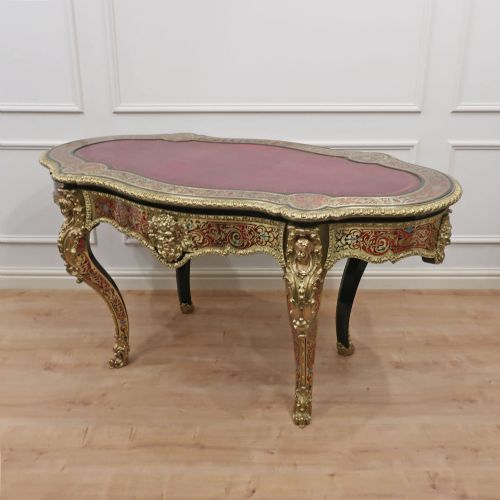
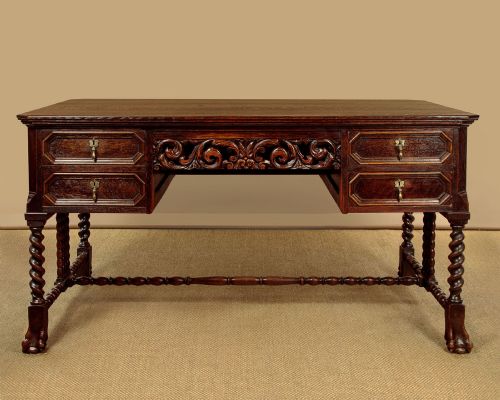
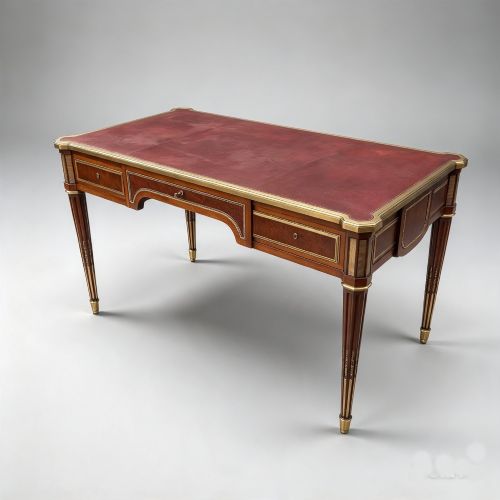
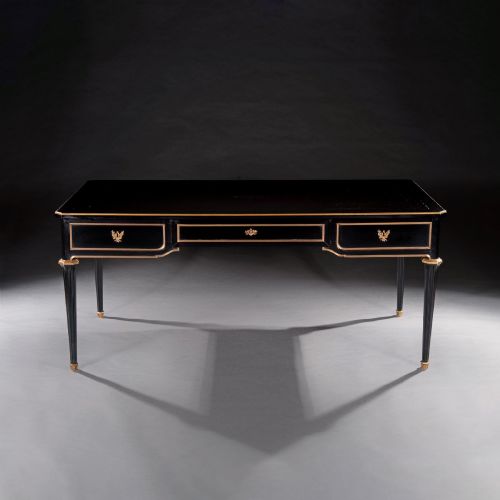
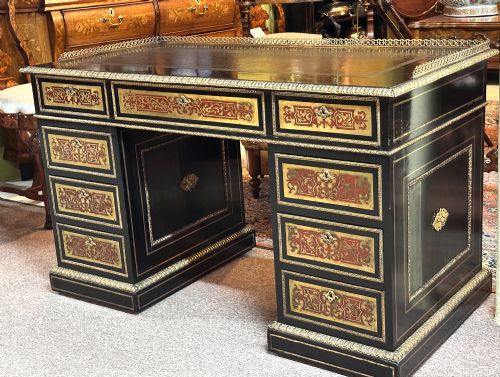
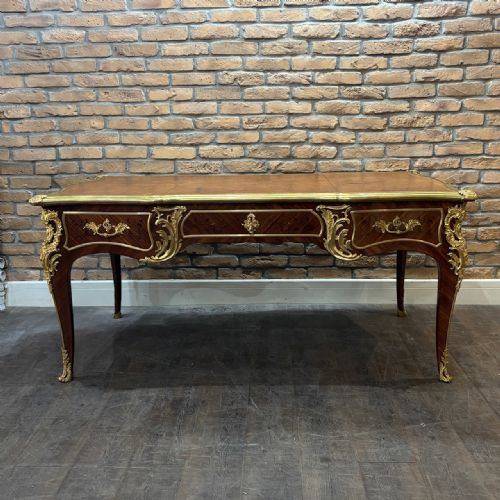
The pieces on this page span the nineteenth century and the early twentieth century, showing strong French Louis XV and Louis XVI revival influences. Mahogany, kingwood, and ebonised wood dominate the construction, often enhanced by decorative metal mounts.
Desks and writing tables form the core of the available types, showcasing detailed marquetry and classical proportions. Many examples display distinct period characteristics such as curved cabriole legs or restrained neoclassical lines.
How they were made
Cabinetmakers utilised timber carcasses of mahogany, oak, and kingwood, frequently overlaying them with intricate veneers or ebonised finishes. Brass and ormolu mounts were cast and applied to corners, legs, and drawer edges to accentuate the structural lines.
Leather inserts traditionally form the writing surface, providing a durable and refined panel framed by gilt tooling. Metalwork details such as gilt bronze handles and escutcheons secured functional drawers while enhancing the decorative scheme.
Bureau Plat Partners Retail Price Guide 2026
Typical asking prices for bureau plat partners among the pieces listed under this phrase on Sellingantiques today, from the lower quarter to the upper quarter. They describe what is for sale here now, not the wider market.
Listings feature nineteenth-century and early twentieth-century pieces, incorporating materials such as leather, ormolu, kingwood, and ebonised wood.
What varies in quality
The refinement of the ormolu and gilt bronze mounts dictates the visual success of the piece, with crisper chasing separating superior examples from simpler ones. Cabinetmaking execution shows in the precision of the veneer matching and the fluidity of carved details on revival frames.
Material selection alters the character of the desk, as dense kingwood and rich mahogany demand greater skill in handling than painted or ebonised surfaces. The integration of traditional leather writing surfaces and the proportion of the mounts relative to the timber determine overall harmony.
Zweiner
The Bureau Plat Partners Glossary
- Bureau plat
- A freestanding writing table fitted with drawers, originating in France and designed to stand in the middle of a room. These desks typically feature leather inset tops and decorative metal mounts.
- Ormolu
- Gilt bronze ornamentation applied to furniture, popular in French revival pieces. The technique involves creating finely chased bronze details finished with gold leaf or mercury gilding.
- Kingwood
- A dense, richly figured exotic timber utilised for high-end cabinetmaking and decorative veneers. Its characteristic dark grain patterns contrast effectively with metallic mounts.
- Ebonised wood
- Timber treated to imitate ebony, creating a dark, uniform finish. This technique was frequently applied during the nineteenth century to highlight gilt bronze details.
- Marquetry
- The art of applying pieces of veneer to a structure to form decorative patterns and pictures. Craftsmen used various woods to create geometric or floral designs across the desktop.
Bureau Plat Partners: Frequently Asked Questions
What is a bureau plat partners desk?
A bureau plat partners desk is a large freestanding writing table designed to accommodate two users facing each other. These tables typically feature finished backs and multiple drawers accessible from both sides.
Originating from French traditions, they serve as central statement pieces within a study or library rather than sitting flush against a wall.
How do I identify Louis XV style?
Louis XV style furniture is characterised by curved lines, asymmetry, and naturalistic motifs such as foliage and scrolls. Tables from this revival period often display cabriole legs and elaborate ormolu mounts.
The overall aesthetic prioritises grace and fluidity over rigid symmetry, distinguishing it from earlier classical periods.
Where should I place a partners desk?
Partners desks are designed to float in the centre of a room rather than be pushed against a wall. Because they are finished on all sides, they allow two people to work opposite one another.
Positioning the desk in an open space highlights the detailed woodwork and decorative mounts visible from every angle.
What woods were used in these desks?
Cabinetmakers utilised a variety of timbers including mahogany, oak, and exotic kingwood for the primary structure and decorative veneers. Ebonised finishes were also employed to achieve a dark, dramatic surface.
These woods provided a sturdy foundation for intricate marquetry patterns and supported heavy cast metal mounts.