

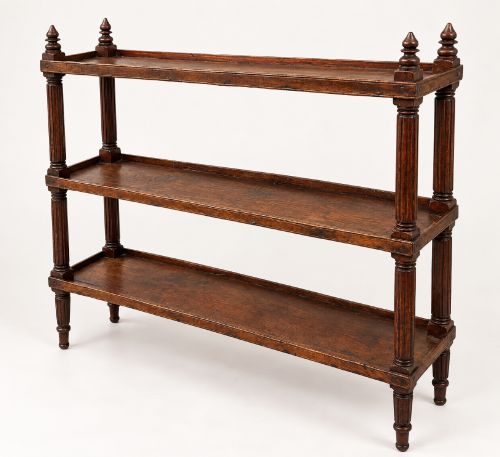
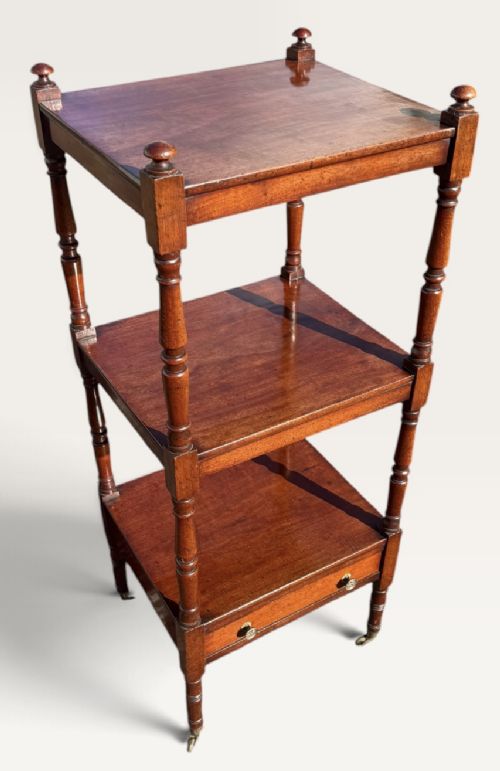
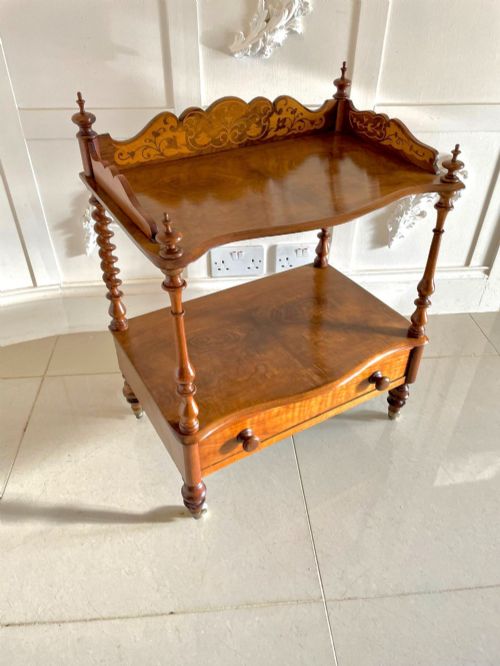
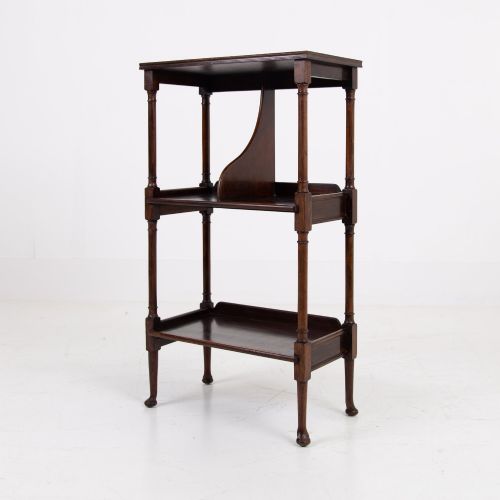


Brown Wooden Whatnot
These brown wooden whatnot pieces are tiered open shelves built for display and storage, bringing practical vertical display to any room.
Brown Wooden Whatnot
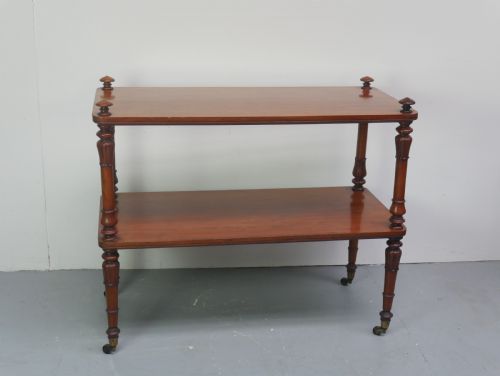
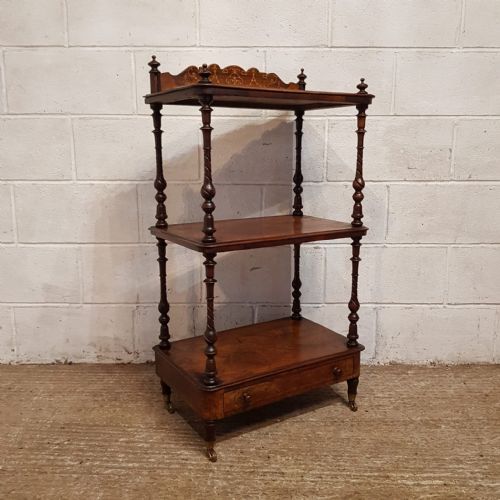
A brown wooden whatnot is a piece of tiered shelving designed for holding books, ornaments, and domestic objects within Georgian, Regency, and Victorian interiors. These items range from compact three-tier stands to taller architectural units featuring cupboard bases, drawers, or mirrored backs.
The versions most commonly met on this page are constructed from mahogany and walnut, spanning periods from the late Georgian era through the nineteenth century. Forms include corner stands, waterfall fronted shelves, and multi-functional designs combined with music cabinets or serving buffets.
Materials and construction
Cabinet makers built these pieces using timbers such as mahogany, walnut, burr walnut, and hardwood, often incorporating boxwood inlay for decorative contrast. Structural supports include turned columns and A-frame designs that securely separate the individual tiers.
Fine joinery methods unite the shelves with the uprights, while auxiliary elements like brass casters, glass panels, and small drawers enhance the utility of the furniture. Selected examples utilise specialised woods like Burmese teak or feature elaborate carving characteristic of Victorian revivals.
Brown Wooden Whatnot Retail Price Guide 2026
Typical asking prices for brown wooden whatnot among the pieces listed under this phrase on Sellingantiques today, from the lower quarter to the upper quarter. They describe what is for sale here now, not the wider market.
Distinctions in quality
The distinction between standard examples and superior pieces rests upon the choice of timber and the precision of the cabinet work. Richly figured burr walnut and carefully selected mahogany with deep, warm tones indicate higher workshop standards.
The Brown Wooden Whatnot Glossary
- Whatnot
- A piece of furniture consisting of a set of open shelves for holding books, ornaments, or other small objects. They became particularly popular during the Georgian and Victorian periods.
- Etagere
- A piece of furniture with a set of open shelves for displaying ornaments, essentially synonymous with a whatnot in many nineteenth-century contexts. These pieces often feature three or more tiers.
- Canterbury
- A low, open-partitioned stand used originally for holding sheet music or books, occasionally incorporated into the lower section of a whatnot. They share the same timber construction vocabulary.
- Buffet
- A sideboard or set of serving shelves, sometimes combined with the tiered structure of a whatnot to provide enclosed cupboard space below the open shelves.
Brown Wooden Whatnot: Frequently Asked Questions
What is a brown wooden whatnot used for?
These pieces served historically for holding books, ceramics, and decorative ornaments in principal rooms. Their tiered structure allowed owners to display varied collections within a compact floor footprint.
Today, they function well in modern interiors for similar display purposes, fitting neatly into corners or against walls to hold plants, books, and small possessions.
How do I tell Georgian and Victorian pieces apart?
Georgian examples often show restrained lines, lighter proportions, and simpler mahogany framing associated with the late eighteenth and early nineteenth centuries. They favour clean architectural forms.
Victorian pieces frequently introduce darker timbers, burr walnut veneers, boxwood inlay, mirrors, and lower cupboard bases. The ornamentation tends to be heavier and more varied.
Where should I place a whatnot at home?
Corner whatnot variants suit unused angles in living rooms or studies, turning dead space into functional display areas. Standard rectangular three-tier versions sit easily against flat walls.
Due to their open shelving, they work effectively in hallways, libraries, or reception rooms where vertical storage is required without blocking light.
What woods were used for these pieces?
Mahogany forms the primary timber for the majority of examples across both the Georgian and Victorian eras. Walnut and burr walnut gain prominence in mid-to-late nineteenth-century pieces.
Auxiliary woods like boxwood appear in linear stringing and inlay work, while occasional items utilise specialised materials such as Burmese teak.