


Brown Oak Weather Instrument
These brown oak weather instruments combine practical meteorological reading with the rich grain of Victorian and Edwardian timber.
Brown Oak Weather Instrument
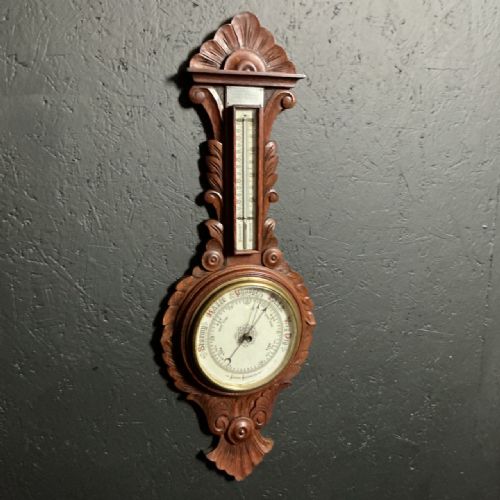
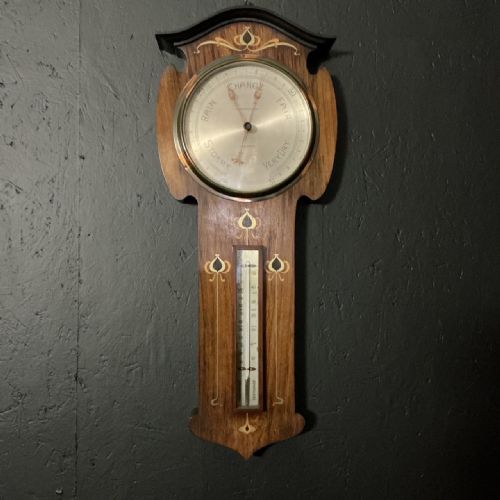
A brown oak weather instrument is a functional domestic device designed to measure atmospheric changes, encompassing aneroid barometers, stick barometers, wheel barometers, and barographs. These instruments record meteorological shifts through mechanical dials, mercury columns, or drum-wound paper charts, housed in architectural timber cases.
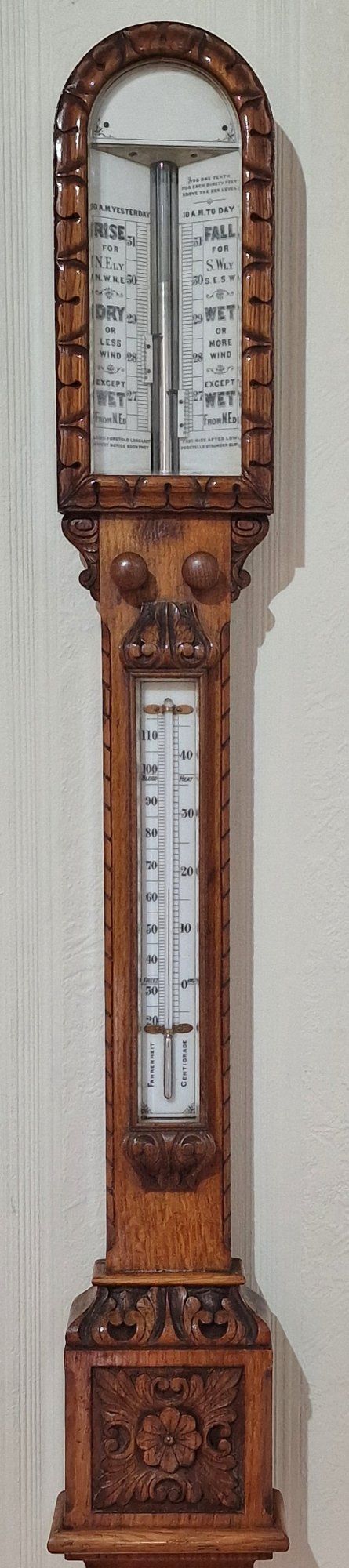
The selections encountered here span the nineteenth century into the early twentieth century, taking distinct forms such as wall-mounted banjo barometers, geometric cased designs, and Admiral Fitzroy storm barometers. Examples range from simple oak barometer bodies to elaborate carved Black Forest specimens and multi-instrument weather stations.
Makers such as Negretti & Zambra, J Hicks of London, Short & Mason, and Maple & Co appear among these pieces, alongside Dutch and Black Forest regional variants. Most specimens rely on oak as a primary cabinet material, supported by brass bezels, glass dials, and paper recording scales.
What varies in quality
Quality rests in the depth and execution of the timber carving, particularly on Black Forest and Victorian banjo cases where relief work defines the visual weight. The crispness of the engraved paper or silvered brass dial scales also marks the distinction between standard production and finer workshops.
The integration of multiple meteorological functions into a single weather station or cased barograph alters the complexity of the piece. Maker attribution, through signed dials or plates by established firms like Negretti & Zambra or Short & Mason, elevates the standing of the instrument.
Listings feature oak alongside walnut and mahogany cases, housing mercury and aneroid mechanisms across the nineteenth and twentieth centuries.
Negretti & Zambra·Short & Mason·J Hicks of London·Maple & Co
The Brown Oak Weather Instrument Glossary
- Aneroid barometer
- An instrument that measures atmospheric pressure using a flexible metal box called an aneroid cell, without employing liquid mercury. This mechanism expands and contracts with air pressure changes to move an indicator needle.
- Stick barometer
- A tall, vertical barometer housing a long glass tube filled with mercury to display barometric pressure directly on a scaled board. These instruments often feature exposed cistern covers and vernier scales.
- Wheel barometer
- A barometer design where changes in pressure move a float in a siphon tube, turning a pulley wheel and a pointer around a circular dial face. These are frequently mounted in decorative banjo-shaped wooden cases.
- Barograph
- A recording meteorological instrument that draws a continuous line of atmospheric pressure onto a revolving paper chart secured to a clockwork drum. The graph is typically housed inside a multi-glass oak or mahogany case.
- Admiral Fitzroy barometer
- A storm glass and barometer combination developed to help fishermen and mariners anticipate weather changes based on chemical reactions in liquid and traditional barometric pressure. These units incorporate multiple display tubes and thermometers.
Brown Oak Weather Instrument: Frequently Asked Questions
What is an aneroid barometer?
An aneroid barometer measures atmospheric pressure through the expansion and contraction of a sealed metal vacuum capsule inside the case.
This design removes the need for liquid mercury, allowing the instrument to be housed compactly in carved oak wall mountings.
How do I read a stick barometer?
A stick barometer displays air pressure by showing the height of a mercury column within a vertical glass tube against a marked scale.
Changes in weather push the mercury up or down, which can be measured precisely using the attached sliding vernier scale.
Where were these weather instruments placed?
These instruments were typically hung on interior walls in hallways, libraries, or drawing rooms where domestic temperature remained relatively stable.
Their prominent placement allowed households to check approaching weather shifts before stepping outside.
How do I tell an Edwardian piece from a Victorian one?
Victorian instruments often feature heavier carved ornamentation, deep mouldings, and elaborate geometric or Black Forest motifs.
Edwardian examples tend towards simpler lines, cleaner oak grain presentation, and restrained proportions influenced by Arts and Crafts ideals.