



Brown Mahogany Kidney Desk
A brown mahogany kidney desk brings curved elegance and practical writing space to a room, shaped to fit the user.
Brown Mahogany Kidney Desk
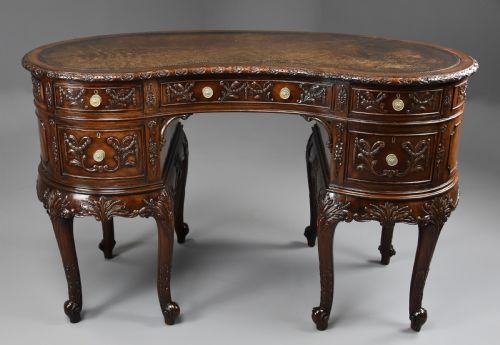
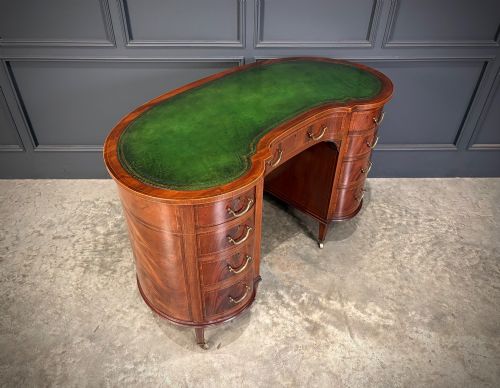
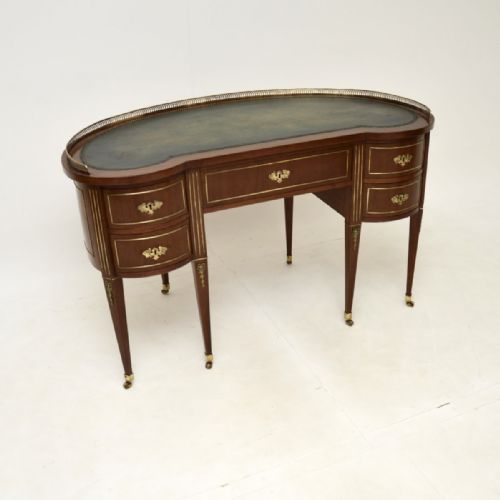
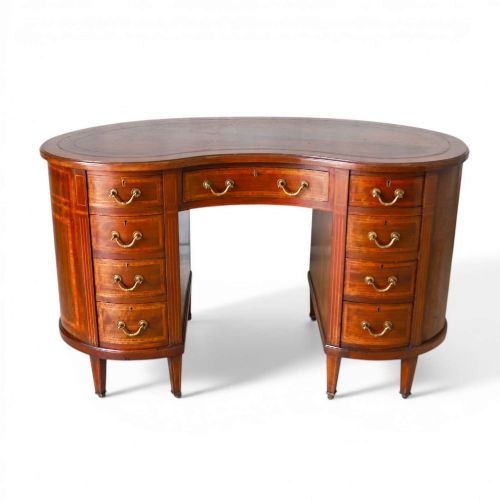
A brown mahogany kidney desk is a distinctive writing surface defined by its curved, bean-shaped outline, which wraps around the seated user. Most examples on this page date from the Edwardian period and the nineteenth century, reflecting the popularity of revival styles during those eras.
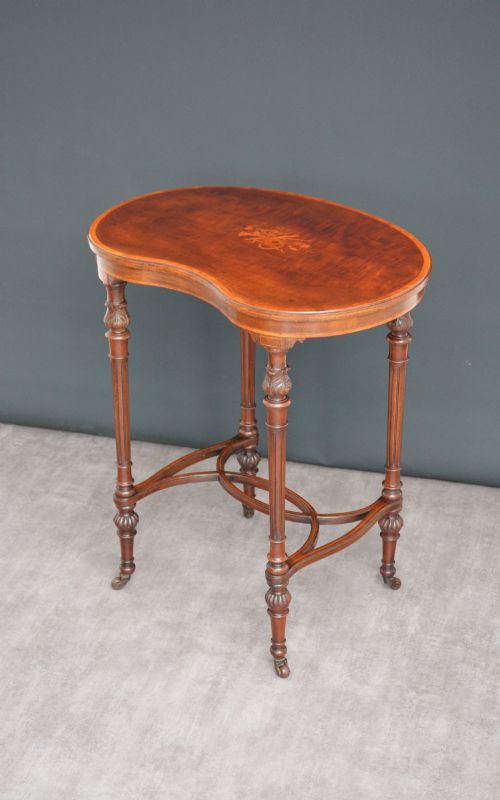
These pieces function as writing desks, side tables, occasional tables, and dressing tables. The form accommodates a seated writer comfortably while presenting a finished back suitable for freestanding placement in the centre of a room.
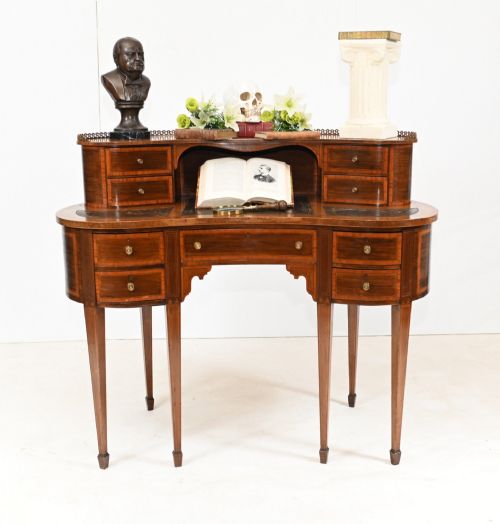
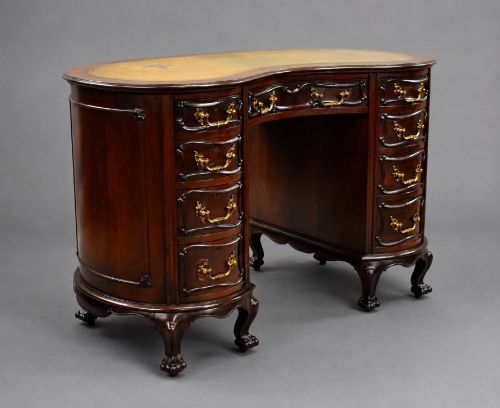
Makers utilised various stylistic influences for these desks, including Sheraton Revival, Victorian, Austrian Empire, and Louis XV Revival. The proportions range from compact ladies writing desks to larger freestanding library pieces.
Materials and construction
Construction relies heavily on solid mahogany and mahogany veneers applied to secondary timbers. Cabinetmakers shaped the complex curved apron and top to form the characteristic kidney silhouette.
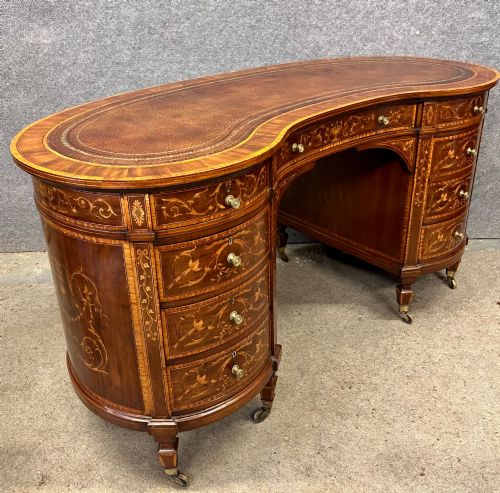
Surfaces frequently incorporate inset leather writing panels, often tooled with gold leaf borders. Inlaid decoration appears in satinwood, boxwood, and marquetry, alongside cast brass mounts and ormolu details.
Brown Mahogany Kidney Desk Retail Price Guide 2026
Typical asking prices for brown mahogany kidney desk among the pieces listed under this phrase on Sellingantiques today, from the lower quarter to the upper quarter. They describe what is for sale here now, not the wider market.
Listings span the nineteenth century through the Edwardian era, including Victorian, Regency, and 1930s examples.
Judging quality
Quality reveals itself in the crispness of the marquetry and the precision of the satinwood or boxwood inlay. Finer pieces display carefully selected mahogany grain patterns that follow the difficult curves of the kidney shape without buckling.
The degree of finishing on the reverse side separates standard examples from better pieces intended to stand away from a wall. Substantial brass hardware, well-fitted drawers, and original leather writing surfaces further distinguish superior execution.
Shapland and Petter·Edwards and Roberts
The Brown Mahogany Kidney Desk Glossary
- Kidney desk
- A writing table constructed with a concave front curve that wraps around the user. The distinctive shape requires precise curved joinery.
- Marquetry
- Decorative veneer work arranged in pictorial or geometric patterns using various coloured woods. Craftsmen cut contrasting timbers to form intricate motifs on the desktop.
- Ormolu
- Gilded bronze mounts applied as decorative ornaments to furniture. This technique adds metallic highlights to the woodwork.
- Satinwood inlay
- Contrasting light-coloured wood inserted into recesses within the darker mahogany surface. This linear banding defines the edges and curves of the desk.
- Sheraton Revival
- A late nineteenth and early twentieth century design movement copying eighteenth century neoclassical forms. These pieces often incorporate delicate inlay and classical proportions.
Brown Mahogany Kidney Desk: Frequently Asked Questions
What is a kidney desk?
A kidney desk is a writing table featuring a curved top shaped like a bean, designed to wrap around the person sitting at it.
This form provides an intimate workspace that allows easy access to drawers while occupying a relatively compact footprint in a room.
Where should I place a kidney desk?
Because many examples feature finished backs and polished mahogany all round, these desks sit well in the middle of a study or drawing room.
They also function against a wall or in a corner where the curved front softens the geometry of the space.
How do I date an Edwardian desk?
Edwardian desks from the early twentieth century often show Sheraton Revival influence through lighter mahogany tones and delicate satinwood stringing.
Construction methods, drawer linings, and secondary woods help confirm the manufacturing period when compared to nineteenth century pieces.
What are the common materials used?
Mahogany serves as the primary timber for both solid sections and veneers, providing a rich brown foundation.
Inlaysia, brass handles, ormolu mounts, and leather writing surfaces appear frequently across these pieces.