
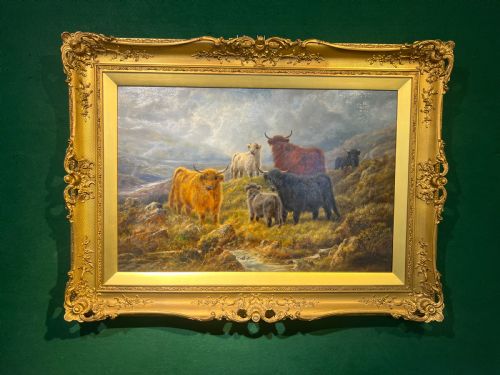


Brown Highland Cattle Artwork
Brown highland cattle artwork captures the rugged charm of Scottish landscapes through nineteenth-century oil paintings and watercolours.
Brown Highland Cattle Artwork
Brown highland cattle artwork centres on nineteenth-century oil paintings and watercolours depicting Scottish pastoral scenes. These works capture the dramatic landscapes of lochs and moors alongside herds of cattle and sheep.
Buyers will most frequently encounter Victorian oil paintings on canvas framed in giltwood. These pieces often record specific locations such as Ben Lawers and Loch Tay.
The selection ranges from works dated precisely to eighteen seventy through to nineteen ten. Each piece reflects the nineteenth-century fascination with Scottish scenery and agricultural life.
How they were made
Artists applied oil paint to canvas or watercolour to paper, capturing the texture of cattle hides and the atmospheric mist of highland landscapes. Canvases are frequently housed in ornate giltwood and wood frames accented with gold leaf.
The foundational support relies on stretched canvas and heavy paper, protected beneath glass in some instances. Traditional framing methods utilise carved wood and gold leaf to complement the fine art paintings.
Materials across these listings include oil paint, canvas, giltwood, wood, gold leaf, paper and glass.
What varies in quality
Quality separates through the artist's ability to render the anatomy of longhorn cattle and the atmospheric depth of the Scottish moor. Named nineteenth-century painters command greater attention than anonymous works.
The preservation of the oil paint and canvas alongside the original giltwood frame influences the overall integrity of the piece. Subtle handling of morning mist and light distinguishes finer Victorian pastoral works.
Robert Watson·Henry Robinson Hall·John W Morris·Gustave De Brianski·Henry Birtles·Charles Jones·Louis Bosworth Hurt·Aster Richard Chilton Corbould·James Kay
The Brown Highland Cattle Artwork Glossary
- Oil on canvas
- A traditional painting technique using pigments bound in a drying oil medium applied to a stretched fabric surface. This method allows for rich texture and blending.
- Giltwood
- Wood that has been treated with a thin layer of gold leaf or gold paint. It frequently appears on traditional Victorian frames.
- Victorian pastoral
- An artistic style celebrating rural and agricultural subjects during the nineteenth century. These scenes emphasise tranquil or dramatic rural life.
- Watercolour
- A painting method where paints are made of pigments suspended in a water-based solution. It is typically executed on paper.
- Scottish impressionism
- A regional painting approach focusing on light, atmosphere and landscape. It captures the shifting weather of the Scottish highlands.
Brown Highland Cattle Artwork: Frequently Asked Questions
What periods do these paintings come from?
The works span the nineteenth century and the early twentieth century, with a strong representation of the Victorian era. Dates recorded in the titles range from eighteen seventy to nineteen ten.
These pieces reflect the Victorian appetite for romanticised Scottish landscape art and pastoral scenes.
Are the frames original?
Many pieces are preserved in period frames constructed from wood and giltwood. These surrounds often feature gold leaf details appropriate to the Victorian era.
Framing varies from piece to piece, so examination of the physical housing is recommended for each specific artwork.
What subjects appear alongside the cattle?
Paintings frequently incorporate dramatic Scottish backdrops including lochs, moors and mountains such as Ben Lawers. Herdsmen, sheep and rural farming landscapes also populate the scenes.
These elements combine to create a comprehensive picture of nineteenth-century highland life.
How should I display these paintings?
These works suit traditional interiors where their giltwood frames and oil on canvas mediums can be highlighted. Placement should avoid direct sunlight to protect the pigments and paper.
Ensuring stable room conditions helps preserve both the canvas and the historical frame.