
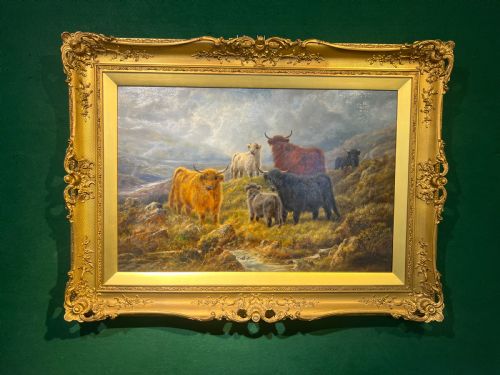


Brown Highland Cattle Art
These brown highland cattle art pieces capture the rugged majesty of Scottish landscapes through oil and watercolour, bringing historic pastoral atmosphere straight to your walls.
Brown Highland Cattle Art
When you search for brown highland cattle art, you encounter Victorian and Edwardian depictions of cattle and sheep roaming misty Scottish lochs, moorlands and highland landscapes. The works on this page predominantly take the form of framed oil paintings on canvas alongside porcelain wall plaques, charting the nineteenth and early twentieth centuries.
The subjects are captured in pastoral settings ranging from early morning mist near Ben Lawers to expansive moorland scenes. Most examples adhere to Victorian fine art and Scottish impressionism, reflecting a sustained fascination with rural British and Scottish topography during the period.
Makers and artists working in this genre recorded the distinct long horns and heavy coats of the cattle against atmospheric backdrops. These framed works function primarily as wall art, bringing the historical Scottish landscape tradition directly into domestic interiors.
Materials and methods
The works rely upon oil paint applied to canvas, capturing the texture of the cattle coats and the dampness of the highland air. Painters built up rich layers of pigment to render the varied tones of brown hair against grey rock and heather.
Many of the paintings are housed in original giltwood frames ornamented with gold leaf, adding a reflective border that contrasts with the dark earth tones of the landscape. Certain pieces utilise paper supports or present the imagery upon large porcelain wall plaques.
Artists employed careful brushwork to delineate the atmospheric effects of morning mist and water reflections, particularly in scenes set beside Scottish lochs. The physical construction combines sturdy wooden stretchers, canvas, and protective glass where watercolours are concerned.
Even the sheep manage to look stoic while sharing the Scottish mist with massive longhorn cattle.
Evaluating the pieces
Quality rests in the fidelity and nuance of the animal rendering, where skilled painters capture the anatomical weight and shaggy texture of the cattle rather than treating them as generic shapes. The surrounding landscape receives equal attention, with atmospheric depth in the depiction of lochs, hills and weather conditions.
The handling of light separates standard works from accomplished ones, particularly in how the artist manages morning mist or sunlight breaking across a moor. The preservation of the original canvas, paint surface and giltwood frame also dictates the overall integrity of the piece.
Robert Watson·Henry Robinson Hall·John W Morris·Gustave De Brianski·Henry Birtles·Charles Jones·Louis Bosworth Hurt·Aster Richard Chilton Corbould·J Stinton·James Kay
The Brown Highland Cattle Art Glossary
- Oil on Canvas
- Pigment mixed with drying oil applied to a stretched woven fabric support. This combination permits deep blending of earth tones and rich textural build-up.
- Giltwood
- Wood carved and covered with a thin layer of gold leaf or metallic gilt. It provides traditional ornamental framing for Victorian and Edwardian paintings.
- Wall Plaques
- Decorative panels designed for suspension on a vertical surface. In this context, they carry finely painted pastoral scenes executed on porcelain.
- Victorian Fine Art
- Creative works produced during the reign of Queen Victoria that adhere to academic standards of draughtsmanship and composition. These pieces often emphasise narrative, pastoral realism and detailed observation.
Brown Highland Cattle Art: Frequently Asked Questions
How should I hang a heavy giltwood frame?
These frames require secure wall fixings distributed evenly to support the combined weight of the wood, canvas and glass.
Ensure you screw directly into wall studs or utilise heavy-duty plaster anchors to maintain stability over time.
Where were these pastoral scenes painted?
The settings generally draw from actual Scottish topography, including Loch Tay, Ben Lawers and surrounding highland moorlands.
Artists frequently travelled to Scotland to sketch cattle and herdsmen directly in their native environment before completing the final compositions in the studio.
How do I care for an antique oil painting?
Keep the canvas away from direct sunlight and sudden shifts in temperature to prevent the paint surface from cracking or warping.
Dust the surface very gently with a soft, dry brush and avoid using any liquid cleaners on either the canvas or the giltwood frame.
What distinguishes Victorian pastoral art?
This genre focuses on idealized rural life, livestock farming and untamed British landscapes rendered with high realism.
The works reflect a nineteenth-century cultural appreciation for wilderness and agricultural tradition.