
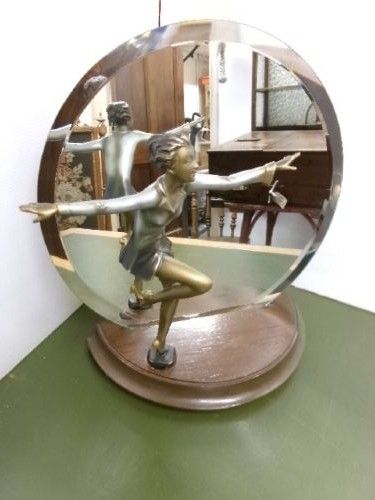
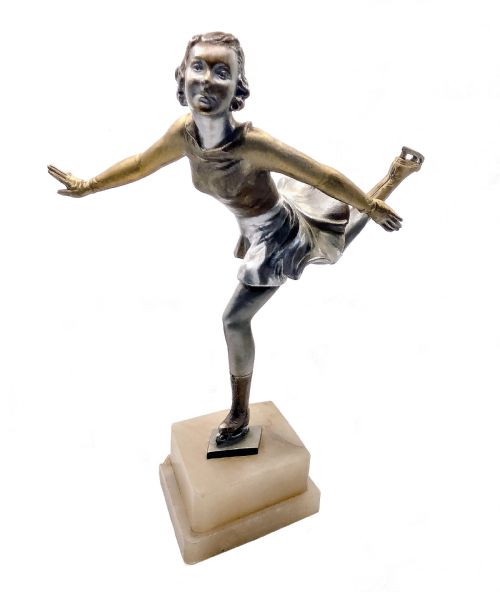


Bronzed Spelter Female Statue
A bronzed spelter female statue brings sculptural grace to a room through affordable metalwork shaped into elegant human forms.
Bronzed Spelter Female Statue
A bronzed spelter female statue represents human figures modelled in alloy and finished with a dark metallic coating that mimics solid bronze. You will most frequently meet pieces created during the Art Deco and Art Nouveau periods, capturing dancers, ladies, and allegorical characters in characteristic poses.
The objects take several practical and decorative forms, ranging from standalone sculptures and figurines to functional items like table lamps, table lighters, and figural groups. Many examples integrate structural bases made from contrasting mineral materials to support the main metal figure.
French workshops produced a significant proportion of these works across the late nineteenth and early twentieth centuries. The listings show a strong concentration of nineteen-thirties items alongside earlier nineteenth-century French models.
Factors that define quality
The crispness of the casting defines the upper tier of these pieces, where facial expressions, drapery folds, and fingers remain sharp and well-defined. Weaker examples show softening in the details and smoothing from worn moulds.
The integration of the supporting base heavily influences the overall execution. Superior items use carefully fitted marble, onyx, or alabaster slabs that complement the proportions of the metal figure rather than serving as simple supports.
Listings span periods from the eighteen-eighties through to nineteen-thirty, uniting Art Nouveau and Art Deco aesthetics.
Josef Lorenzl
The Bronzed Spelter Female Statue Glossary
- Spelter
- A zinc-based metal alloy utilised as a cheaper alternative to bronze for casting decorative figures and statues. It takes patination and detail well despite being softer than copper alloys.
- Art Deco
- A design style spanning the interwar years characterised by stylised geometric forms, streamlined silhouettes, and depictions of modern dancers and athletes. It dominates the nineteen-thirties pieces found in this category.
- Art Nouveau
- A decorative movement from the late nineteenth and early twentieth centuries defined by fluid, organic lines and floral motifs. Figures from this era often feature flowing hair and sinuous drapery.
- Torchere shade
- A lighting accessory or upward-pointing shade often integrated into tall figural lamps. It directs light upward to illuminate the room.
Bronzed Spelter Female Statue: Frequently Asked Questions
What is spelter metal?
Spelter is a zinc alloy that sculptors and foundries utilised to produce decorative figures at a lower cost than bronze.
It takes surface treatments like bronzing or cold painting effectively, making it popular for domestic ornaments throughout the late nineteenth and early twentieth centuries.
How do I date a spelter figure?
Dating relies on stylistic markers such as the geometric shapes of Art Deco or the flowing lines of Art Nouveau.
Base materials also offer clues, as nineteen-thirties pieces frequently employ onyx or marble plinths, whereas older nineteenth-century examples often feature simpler mounts.
Are these figures solid bronze?
No, these pieces are made from spelter, which is a softer zinc alloy rather than copper-based bronze.
Manufacturers applied a bronzed finish to give the metal the appearance of heavier bronze sculpture while keeping production costs accessible.
Where were most figures made?
A large proportion of these decorative statues and lamps originated in France during the late nineteenth and early twentieth centuries.
French foundries dominated the production of spelter figures, exporting them widely across Europe and beyond.