



Bronze Ormolu Clock Set
A bronze ormolu clock set brings commanding presence to a mantelpiece, combining a striking timepiece with matching decorative garnitures.
Bronze Ormolu Clock Set
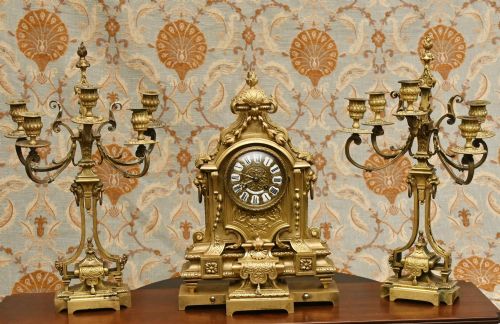
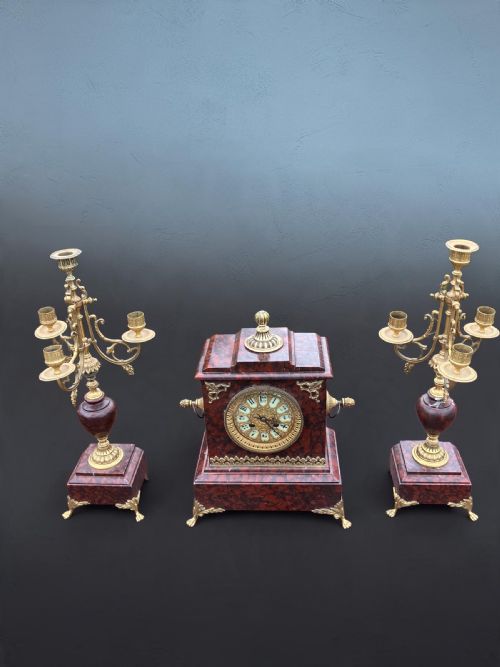
A bronze ormolu clock set comprises a central mantel clock accompanied by matching side pieces such as candelabras, urns, or vases, creating a unified decorative arrangement for a room. These suites predominantly date from the nineteenth century, spanning Victorian periods and decades characterised by elaborate revivals of French court styles.
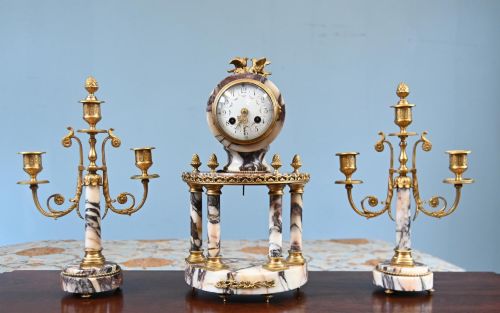
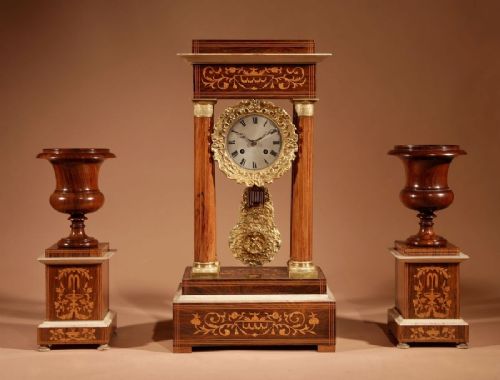
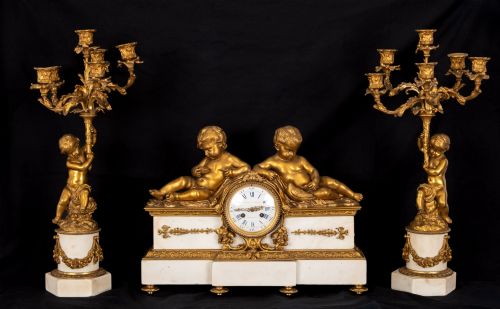
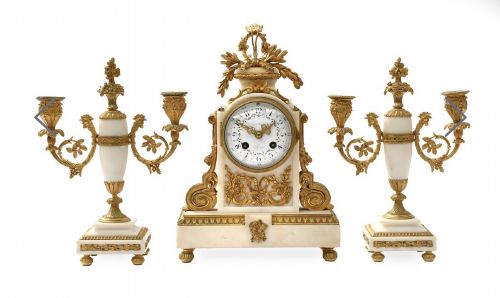
The configurations on this page include portico clocks, lyre clocks, and heavy architectural mantle pieces paired with matching candelabras or urns, frequently housed beneath glass domes. Most examples originate from French workshops adhering to Louis XVI, Rococo, or Empire aesthetics, utilising substantial stone bases to anchor the gilt metalwork.
How They Were Made
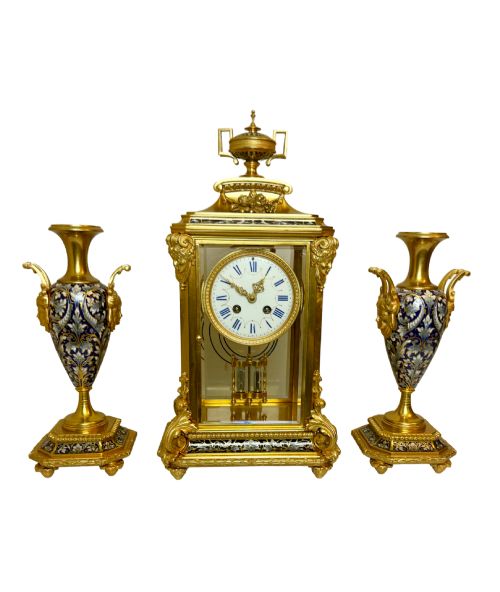
The foundations of these suites rely on cast bronze and gilt ormolu, paired with white or coloured marble, onyx, and occasionally porcelain panels or champlevé enamel. Artisans cast the bronze components in detailed sections before applying fire gilding or gold leaf to achieve the characteristic bright ormolu surface.
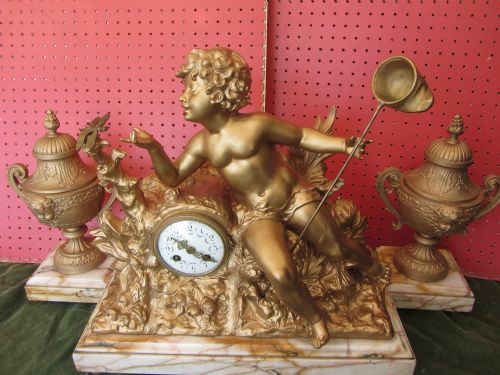
Clock movements are housed within these heavy metal and stone cases, often featuring eight-day striking mechanisms produced by specialist makers. Dial faces frequently utilise painted enamel numerals protected beneath glazed bezels, while associated garnitures repeat the cast motifs of cherubs, urns, and floral scrolls found on the main clock body.
Bronze Ormolu Clock Set Retail Price Guide 2026
Typical asking prices for bronze ormolu clock set among the pieces listed under this phrase on Sellingantiques today, from the lower quarter to the upper quarter. They describe what is for sale here now, not the wider market.
Cupid occasionally oversees the mantelpiece from a gilded perch, keeping watch over the ticking hours with a tiny bronze bow.
What Varies in Quality
Movement execution also dictates the tier of the piece, with renowned makers employing superior escapements and robust gearing that maintain reliability over centuries. The harmony between the central clock and its matching garnitures determines whether the ensemble was conceived as a single unified commission or assembled later.
Henry Dasson·A.D Mougin·H Luppens Paris·Vincenti of Paris·Moser
The Bronze Ormolu Clock Set Glossary
- Ormolu
- Finely chopped gold or gold amalgam applied to a bronze base through mercury gilding, creating a rich golden surface finish. This technique was widely practiced by French metalworkers during the eighteenth and nineteenth centuries.
- Garniture
- A set of matching decorative ornaments, typically comprising a central clock flanked by two matching candelabras or vases designed for a mantelpiece. These matched suites create a balanced visual display across a surface.
- Champlevé
- An enamelling technique where troughs or cells are hollowed out in the metal surface and filled with vitreous enamel paste before firing. The resulting coloured patterns sit flush with the surrounding metal borders.
- Portico
- A clock case architecture featuring vertical columns supporting an upper entablature, framing the suspended pendulum swinging in the open central space. This classical architectural style gained immense popularity during the nineteenth century.
- Escapement
- The mechanical linkage within a clock movement that controls the release of power from the mainspring to regulate timekeeping accurately. Different escapement designs offer varying levels of precision and durability.
Bronze Ormolu Clock Set: Frequently Asked Questions
What is a clock garniture?
A clock garniture is a matched set consisting of a central mantel clock accompanied by side pieces such as candelabras, urns, or vases. These items share identical decorative motifs, materials, and stylistic periods to create a cohesive arrangement.
Historically, these suites were placed on drawing room mantelpieces beneath large mirrors, providing both a functional timekeeper and a balanced decorative display for the interior.
Are these clocks eight day movements?
Many nineteenth-century French clock sets feature eight-day striking movements that require winding approximately once a week using a matching key. These mechanical systems drive both the timekeeping hands and the bell or gong striking train.
Checking the winding arbours and ensuring the presence of a pendulum and key helps confirm whether a movement remains complete and operational.
How do I identify Louis XVI style?
Louis XVI style pieces exhibit neoclassical restraint, featuring straight lines, symmetrical proportions, architectural columns, and classical motifs such as urns, laurel wreaths, and ribbons. This aesthetic contrasts sharply with the earlier asymmetrical curves of the Rococo revival.
Materials such as white marble and gilt bronze frequently anchor these neoclassical designs, emphasised by crisp geometric framing and formal decorative balance.