
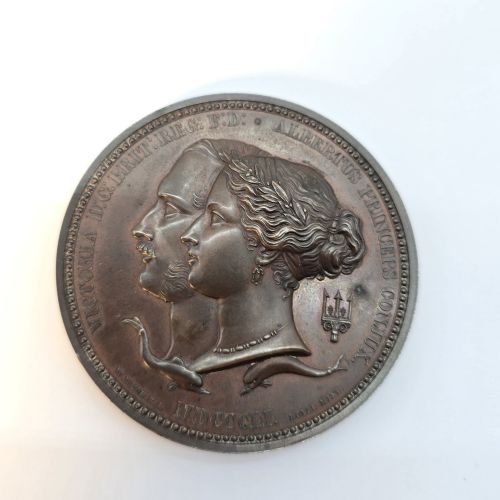


Bronze Commemorative Medallion
A bronze commemorative medallion marks an exhibition, a monarch or an individual, offering a tangible piece of history designed to be handled or displayed.
Bronze Commemorative Medallion
A bronze commemorative medallion stands as a portable record of international exhibitions, royal jubilees, and historical personages from the nineteenth and early twentieth centuries. These pieces appear as exhibition prize medals, cased presentation items, and framed wall plaques.
The selections span Victorian commemorations alongside French Historicism and Art Deco wall plaques. Most examples connect directly to major nineteenth-century industrial fairs or specific historical figures like Queen Victoria and William Shakespeare.
Buyers encounter both loose medals and framed portrait plaques housed in brass and mahogany surrounds. Several pieces retain original fitted cases or designated recipient naming along the edge.
Materials and construction methods
Struck and cast techniques dominate the production of these objects, utilising patinated bronze, copper, and brass. Metalworkers poured molten alloy into intricate dies or sand moulds to achieve sharp relief details.
Many wall panels integrate wood components such as mahogany surrounds alongside velvet backings to frame the metal relief. Makers often applied a deliberate dark patina to highlight the sculptural depth of the portraiture and lettering.
Distinctions in craftsmanship and preservation
Quality rests upon the crispness of the strike and the depth of the relief work across the figures and lettering. Superior items retain unblemished patination and sharp edges without surface wear.
The presence of original fitted cases or contemporary named inscriptions elevates an object by preserving its historical context. Finer wall plaques demonstrate secure mounting within original brass and wooden frames.
George Shaw·Smith Beck and Beck·Waterlow and Sons·Carl Ranch·De Grave Short and Fanner
The Bronze Commemorative Medallion Glossary
- Patinated bronze
- A bronze alloy treated with chemical solutions to produce a specific surface colour and finish. This layer protects the underlying metal while enhancing visual contrast on relief designs.
- Exhibition medal
- An award issued to participants or jurors at international industrial fairs. These objects typically feature detailed allegorical imagery on the obverse and specific recipient data on the reverse.
- Obverse
- The front face of a medallion bearing the primary portrait or emblematic design. It usually carries the strongest artistic detail.
- Relief
- Sculptural projection from a flat background surface. High relief requires greater technical skill in casting or striking.
- Wall plaque
- A decorative panel designed for hanging rather than handling. These items often incorporate structural frames of wood or brass.
Bronze Commemorative Medallion: Frequently Asked Questions
What events do these medals commemorate?
These objects record significant industrial exhibitions, royal jubilees, and cultural tributes from the nineteenth and early twentieth centuries. Specific pieces celebrate international fairs held in London during the Victorian era.
Other examples honour historical figures, monarchs, and literary icons through portraiture and dedicated inscriptions.
How were exhibition medals originally used?
Exhibition medals served as official awards presented to successful manufacturers, inventors, and event jurors. They functioned as tangible proof of industrial and artistic achievement.
Recipients often stored them in custom velvet-lined cases or displayed them within domestic and commercial settings.
How do I display a bronze plaque?
Wall-mounted plaques usually feature integrated hanging loops or sit within dedicated brass and mahogany frames. They require stable wall fixings away from direct moisture to protect the metal and wooden elements.
Items without frames can rest on specialised display stands designed for heavy medallions.
How do I identify the period of a medallion?
Stylistic clues such as Victorian lettering, Art Deco framing, and French Historicism motifs help determine the date of manufacture. The depicted subject matter, such as Queen Victoria or specific international exhibitions, provides a clear chronological anchor.
Named inscriptions and maker marks on the rim or field offer further documentary evidence for dating.