



Bronze Clock and Candelabra
These heavy bronze clock and candelabra sets anchor a room with layered metalwork and matching side lights, offering the full symmetry of nineteenth-century drawing-room display.
Bronze Clock and Candelabra
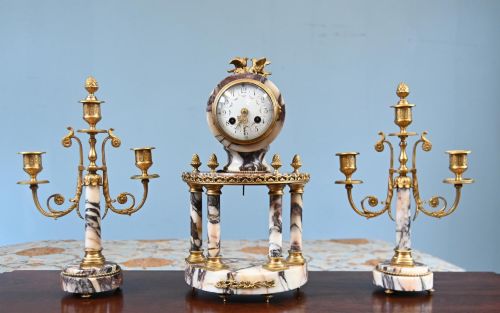
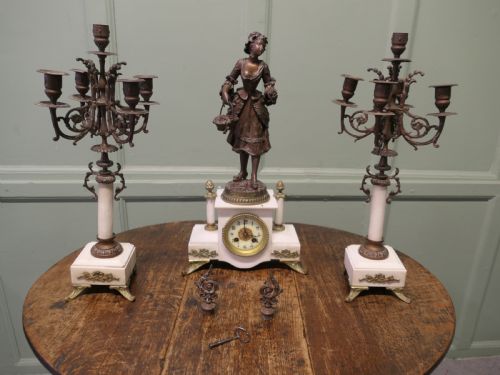
A bronze clock and candelabra set consists of a central mantel timepiece flanked by a matching pair of candle-holders, forming an integrated garniture for a fireplace or sideboard. These decorative ensembles originate predominantly from nineteenth-century French workshops, spanning periods from the Second Empire to the Edwardian era.
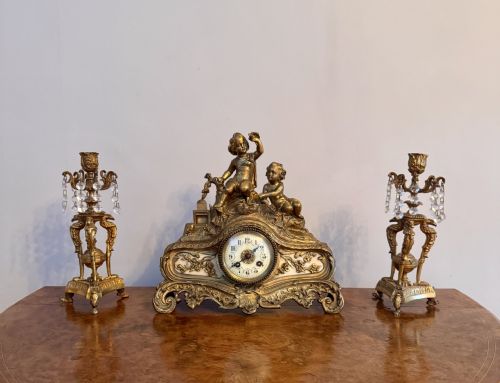
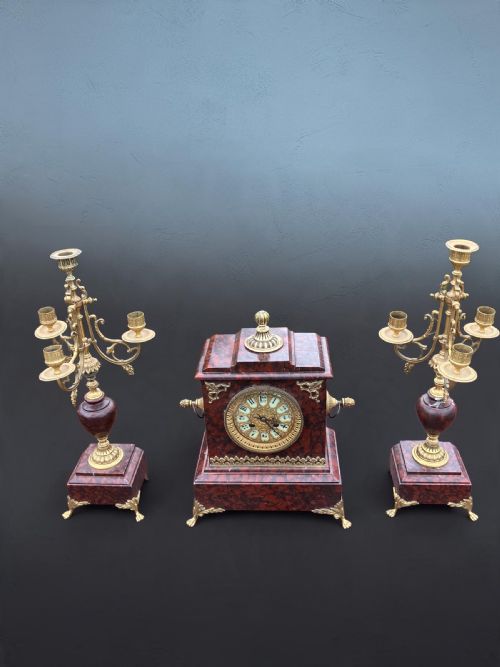
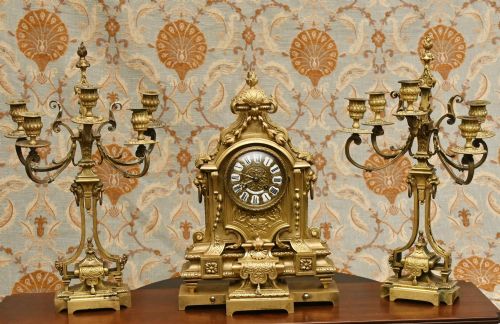
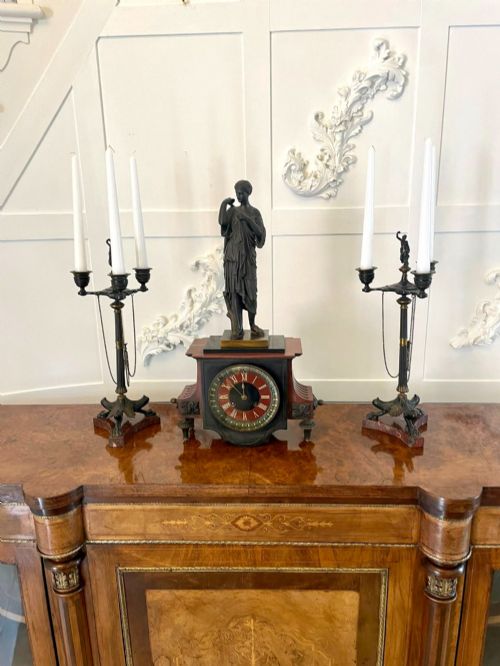
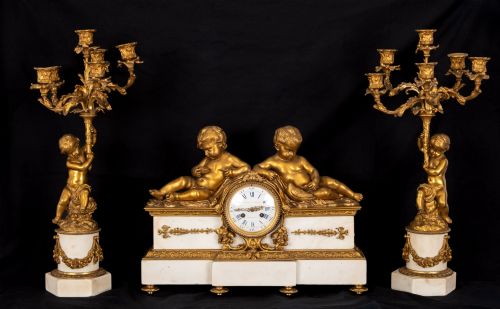
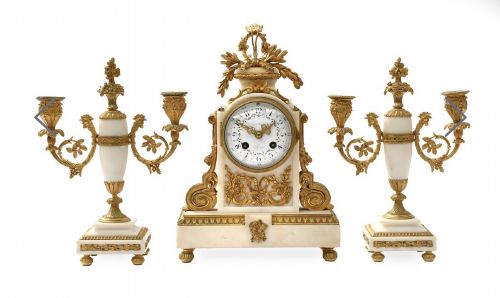
The prevailing form on this page pairs a substantial marble or gilt-bronze clock with twin candelabras, often following Louis XVI or French Empire design vocabularies. Buyers encounter complete three-piece or multi-light configurations designed to create visual balance on a mantelpiece.
Makers integrated sculptural figures into these assemblies, frequently depicting cherubs, classical deities, or romantic motifs in bronze and ormolu. The matching candelabras echo the materials and ornamentation of the central clock to establish a unified decorative scheme.
Materials and Construction
Foundries cast bronze and brass components before applying mercury gilding or ormolu finishes to create the characteristic golden lustre. Stonework foundations utilise white, red, or black marble, alongside onyx and porcelain inserts such as Sevres-style plaques or Bleu de Roi dials.
Clock movements rely on mechanical eight-day gear trains, often striking on bells or gongs, housed behind glazed bezels and enamelled numeral dials. Artisans mounted cast metal ornamentation onto stone bodies using threaded pins and securing nuts, combining foundry work with precision horology.
Bronze Clock and Candelabra Retail Price Guide 2026
Typical asking prices for bronze clock and candelabra among the pieces listed under this phrase on Sellingantiques today, from the lower quarter to the upper quarter. They describe what is for sale here now, not the wider market.
Many cherubs on these clocks hold extinguished torches upside down, quietly reminding nineteenth-century guests about the fleeting nature of time.
Distinctions in Quality
The selection and density of the supporting materials dictate the piece's stature, with dense coloured marbles and heavy fire-gilded ormolu outperforming lighter brass and patinated metal bases. Complete surviving sets with matching numbers and original mercury gilding command greater architectural presence.
Henry Dasson·H Luppens Paris·Raingo Fres Paris·AD Mougin Paris·Deniere Paris
The Bronze Clock and Candelabra Glossary
- Garniture
- A set of ornamental objects designed to match and display together on a mantelpiece. A bronze clock and candelabra set forms the standard three-piece arrangement.
- Ormolu
- Gilded bronze produced by applying a mercury-gold amalgam to a bronze base and heating it to vaporise the mercury. This technique creates a durable golden finish characteristic of French decorative metalwork.
- Louis XVI Style
- A neoclassical design revival drawing on eighteenth-century French symmetry, straight lines, and classical motifs. Pieces in this style often incorporate urns, ribbons, and fluted columns.
- Bleu de Roi
- A deep rich cobalt blue ceramic glaze used on porcelain panels and clock dials. It provides a strong contrast against gilded ormolu mounts.
Bronze Clock and Candelabra: Frequently Asked Questions
How do I maintain the clock movement?
Mechanical movements require professional cleaning and oiling every few years to keep the gear trains running smoothly. Avoid adjusting the hands backwards past the hour or half-hour strike points.
Ensure the clock sits on a completely level surface to prevent the pendulum from catching or stopping. Winding should be done gently using the correct key for the arbors.
How do I identify Louis XVI Revival pieces?
Look for symmetrical framing, architectural columns, swags, and classical urn motifs that mimic eighteenth-century French design. These pieces often feature white or coloured marble bases paired with bright ormolu mounts.
Maker signatures or movement stamps on the backplate often confirm the nineteenth-century manufacturing date despite the earlier stylistic influence.
What does a clock garniture set include?
A standard garniture centres on a mantel clock flanked by two matching ornamental pieces, such as candelabras, urns, or vases. These accompanying items share the exact materials and decorative motifs of the clock.
Displaying the complete set together creates the balanced visual symmetry intended by nineteenth-century interior designers.