
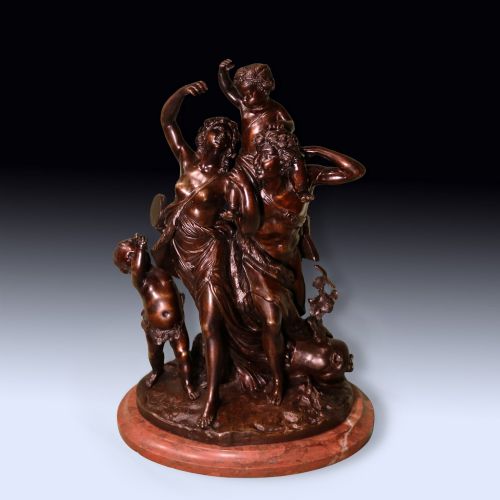


Bronze Bacchanalian Sculpture
These bronze bacchanalian sculpture pieces capture the riotous spirit of classical revelry through figures of Bacchus, maidens, and putti.
Bronze Bacchanalian Sculpture
A bronze bacchanalian sculpture brings the mythological revels of Bacchus into the nineteenth-century interior through figural groups of dancing maidens and grape-harvesting children. Buyers seeking these works encounter French Neoclassical and Rococo Revival interpretations that draw heavily on classical antiquity and the models of Clodion.
The pieces appearing on this page range from mantel clocks and wall plaques to decorative vessels and ornamental urns alongside distinct statues and figural groups. Many utilise marble bases to elevate the patinated bronze figures and provide a stable foundation for intricate compositions involving putti playing with grapes.
Materials and Making
Foundries produced these works using bronze, often applying a deliberate patination to accentuate the musculature and drapery of the figures. Ormolu mounts and gilt plaster enrich certain decorative vessels and mantel clocks while enamel adds contrasting detail to specific surfaces.
Sculptors and metalworkers combined bronze with green marble bases to support heavier figural groups and urns. Paint and gilt plaster appear alongside cast bronze to achieve the varied polychromatic effects seen in French classical revival pieces.
Putti caught in the act of playing with grapes remind viewers that classical deities certainly knew how to throw a lively party.
Assessing Quality
The distinction between standard production and exceptional execution rests in the crispness of the chase work and the subtlety of the bronze patination. Finer examples display meticulous attention to facial expressions, vine leaves, and the delicate limbs of dancing maidens.
Superior pieces often exhibit clear signatures or bear a direct stylistic relationship to renowned makers such as Clodion or Auguste Cain. The integration of high-grade marble bases and ormolu accents further separates workshop output of the highest order from ordinary domestic ornaments.
Clodion·Remond·Auguste Cain
The Bronze Bacchanalian Sculpture Glossary
- Patinated bronze
- Bronze treated with chemicals to produce a specific surface colour and finish. This layer protects the metal while enhancing the definition of the sculptural forms.
- Ormolu
- Gilt bronze created by applying a mercury-gilt finish to a bronze base. It provides a bright golden surface frequently utilised in French clock cases and decorative mounts.
- Putti
- Depictions of chubby male toddlers, often winged, derived from classical art. They populate bacchanalian scenes alongside Bacchus and dancing maidens.
- Neoclassical
- A style drawing inspiration from the classical art and culture of ancient Greece and Rome. It emphasises symmetry, restraint, and mythological themes.
- Grand Tour
- A cultural trip undertaken by wealthy young Europeans to view continental antiquities. Souvenirs from these journeys included small-scale bronze reductions of famous ancient sculptures.
Bronze Bacchanalian Sculpture: Frequently Asked Questions
What is a bacchanalian sculpture?
A bacchanalian sculpture depicts scenes dedicated to Bacchus, the Roman god of wine, featuring revelers, dancing maidens, and putti.
These subjects celebrate wine, harvest, and mythological merrymaking through dynamic figural groupings.
Who was Clodion?
Clodion was an eighteenth-century French sculptor known for his terracotta and bronze works depicting nymphs, satyrs, and putti.
Nineteenth-century foundries frequently cast works after his celebrated models of dancing groups.
How should I display a bronze group?
These sculptures require stable surfaces such as sideboards, mantelpieces, or dedicated pedestals due to their weight.
Positioning them away from direct heat sources helps preserve the bronze patina and any accompanying marble bases.
What periods do these bronzes date from?
The listings on this page predominantly date from the nineteenth century, including specific years from the eighteen-seventies to the eighteen-nineties.
They reflect Victorian and French revivalist revivals of earlier classical and Rococo aesthetics.