


British Naval Artwork
British naval artwork captures centuries of maritime history through oil paintings, watercolours, and portrait miniatures.
British Naval Artwork
British naval artwork encompasses paintings, watercolours, drawings, and portrait miniatures depicting warships, sea battles, and commanding officers. These pieces span from the eighteenth century through the mid-twentieth century, recording engagements, vessels, and portraits of admirals in naval uniform.
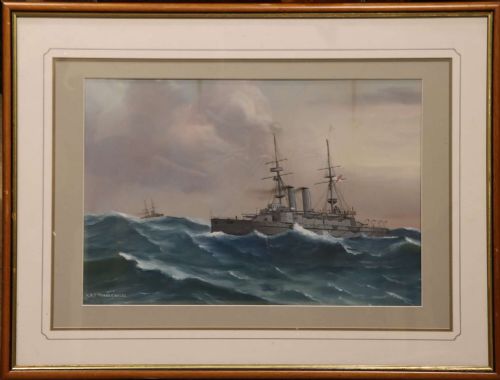
The version most commonly met on this page is the maritime oil painting or watercolour on paper or canvas, alongside framed portrait miniatures and reverse glass prints. Subjects range from named ships like HMS Prince of Wales and HMS Swift to commanders such as Admiral Sir Graham Moore and Lord Howe.
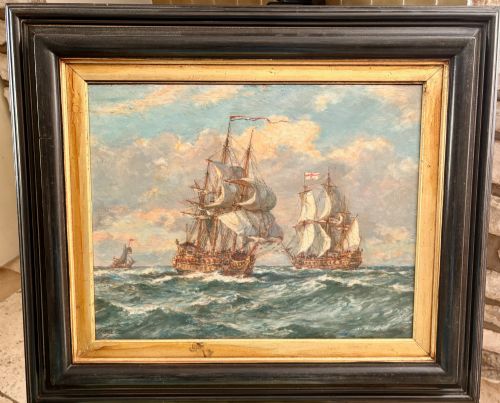
Works originate across Georgian, Victorian, Edwardian, and later periods, employing traditional maritime art styles to document naval history. Collectors encounter depictions of frigates, barques, galleons, and coastal shipping alongside formal portraiture of royalty and naval officers.
How these works were made
Artists painted primarily with oil paint on canvas or watercolour and gouache on paper, capturing maritime scenes and military uniforms with fine detail. Some portraits utilised delicate miniature painting on agate panels or paper, mounted in gold or maple frames.
Framing played an integral role in presentation, utilising wood, glass, and gold to protect and display canvases, watercolours, and reverse glass prints. Materials reflect the period of creation, from eighteenth-century wooden stretchers to Victorian maple frames.
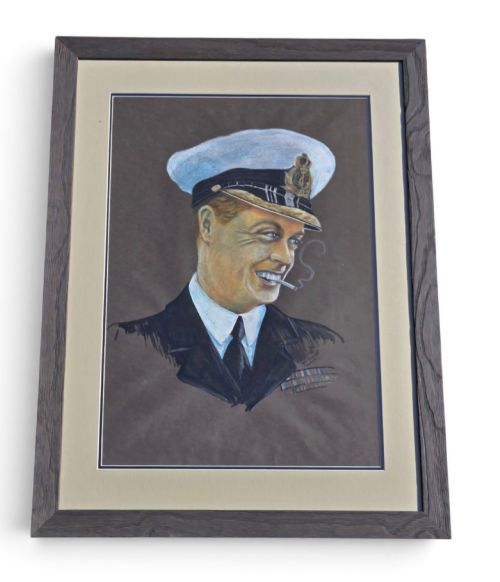
A pastel portrait of the Prince of Wales comes with the notation that it was presented to him by repute.
What varies in quality
Quality rests upon the precision of the draughtsmanship and the artist's ability to render naval architecture, rigging, and atmospheric conditions accurately. Works by documented artists and portraitists demonstrate superior handling of light, shadow, and subject likeness compared to anonymous school pieces.
The preservation of the medium, whether oil on canvas, watercolour, or miniature on agate, dictates the enduring clarity of the composition. Original period framing and the documented identity of the ship, officer, or artist elevate the historical significance of the piece.
Bernard Gribble·Charles William Adderton·Sir Thomas Lawrence·George Frederick Clarke·John Laviers Wheatley·Maurice Codner·Sir William Charles Ross·Francis Holman·Robert Ker Porter·Ambrosini Jerome·Richard Hall
The British Naval Artwork Glossary
- Gouache
- An opaque watercolour paint consisting of pigment, water, and a binding agent such as gum arabic. It dries to a matte finish and allows for layered, detailed highlights in maritime works.
- Reverse glass print
- An image painted or printed directly onto the back of a piece of glass and viewed from the front. This technique protects the pigments and creates a glossy surface reflection.
- Portrait miniature
- A small, highly detailed painting, often executed on materials like paper or agate. These intimate works frequently depicted officers and nobility.
- Frigate
- A fast, medium-sized warship with three masts used extensively in the eighteenth and nineteenth centuries. They appear frequently in naval engagements and coastal shipping scenes.
- Agate
- A fine-grained quartz mineral used as a stable, polished substrate for portrait miniature paintings. Its smooth surface allowed artists to achieve remarkable detail.
British Naval Artwork: Frequently Asked Questions
What periods do these artworks cover?
The listings span from the eighteenth century through the Victorian and Edwardian eras up to the mid-twentieth century.
Pieces reflect Georgian, Regency, Victorian, Edwardian, and Art Deco stylistic influences across various painting media.
Who is usually depicted in the portraits?
Subjects include notable naval figures such as Admiral Sir Graham Moore, Lord Howe, and Admiral Sir William Sidney Smith.
Royalty also appears, including portraits of the Prince of Wales and Prince Philip in naval uniform.
What materials were used for these paintings?
Artists utilised oil paint on canvas, watercolour, gouache on paper, and pastel.
Miniatures were occasionally painted on agate panels, housed in gold or maple frames with glass.