



British Needlework
British antique needlework brings home centuries of domestic patience, framing maps, sailor woolies and commemorative silks behind glass in their original wood.
British Needlework
When you search for british antique needlework, you encounter framed textile art, wall art and paintings executed in wool, silk thread and linen across the Georgian, Regency and Victorian eras.
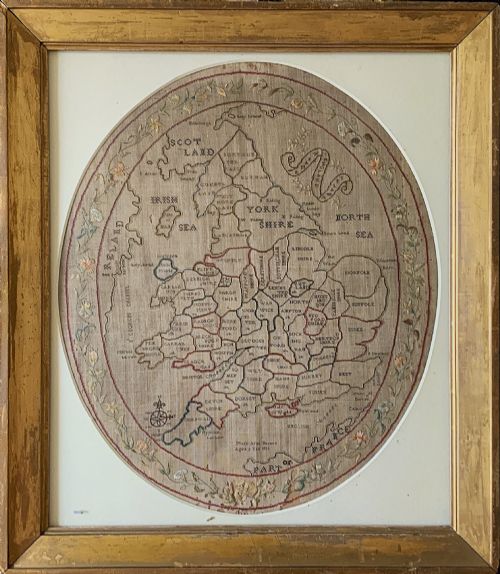
The most common pieces on this page are nineteenth-century sailors' woolwork embroideries, often called woolies, alongside detailed schoolgirl map samplers stitched by young makers like Mary Banion and Mary Pinfold.
You also find commemorative military pieces, such as Royal Artillery silk work, representing both maritime labour and patriotic devotion.
These works bridge domestic craft and fine art, preserved in period frames of wood and gilt wood.
Materials and construction
Maker execution relies on wool, silk and silk thread stitched meticulously onto a foundational linen or paper ground.
Finished pieces are then secured within timber frames, frequently utilising glass to protect the delicate textile fibres from atmospheric dust and handling.
Gilt wood framing appears on finer commemorative works and maps, elevating domestic craft to formal wall art.
British Needlework Retail Price Guide 2026
Typical asking prices for british needlework among the pieces listed under this phrase on Sellingantiques today, from the lower quarter to the upper quarter. They describe what is for sale here now, not the wider market.
Listings feature works from the eighteenth century, Georgian, Regency, and Victorian periods, utilising wool, silk, linen, paper, glass, and wood.
Judging quality in early stitchwork
Quality rests upon the intricacy of the stitch technique, the complexity of the subject matter, and the clarity of the design, such as the geographical lettering on map samplers.
The survival of vibrant colour in the wool and silk thread, combined with the integrity of the original wood or gilt wood frame, separates master examples from simpler vernacular pieces.
Dated works and those bearing the stitched name and age of the maker carry greater documentary weight than anonymous pieces.
The British Needlework Glossary
- Sampler
- A piece of needlework produced as a demonstration or test of skill in various stitches, often featuring alphabets, numbers and maps.
- Woolie
- A nineteenth-century embroidered picture created by sailors using coloured wools, frequently depicting naval ships and maritime scenes.
- Gilt wood
- Wood that has been coated with a thin layer of gold leaf or gilt paint, commonly used for premium nineteenth-century picture frames.
- Silk work
- Embroidery executed primarily with fine silk thread, noted for its smooth lustre and capacity for delicate shading.
- Linen
- A strong, durable fabric woven from flax fibres that serves as the traditional foundation ground for antique needlepoint.
British Needlework: Frequently Asked Questions
How old are these samplers?
The pieces listed span from the eighteenth century through the Regency period and into the Victorian era. Many carry precise dates stitched directly into the fabric by the maker.
Schoolgirl map samplers from the early nineteenth century frequently record both the year of creation and the age of the child who stitched them.
How should I hang antique needlework?
Antique textiles require careful placement away from direct sunlight to prevent the wool and silk threads from fading. Maintaining stable indoor humidity protects both the fabric ground and the original wood framing.
Most pieces are already preserved behind glass, which shields the delicate stitches from dust and ambient moisture in the room.
What subjects appear in this needlework?
Common subjects include geographical maps of England and Wales, military commemorations for regiments like the Royal Artillery, and maritime scenes.
Domestic makers focused on educational map samplers, while sailors created detailed depictions of ships and patriotic naval motifs.