

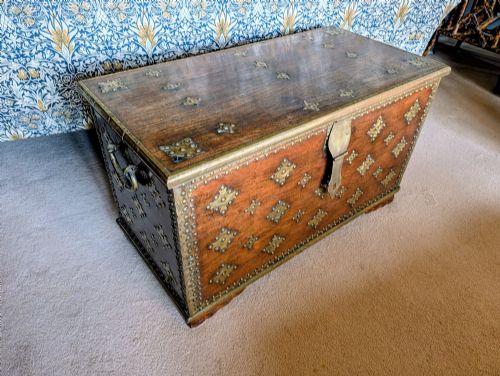
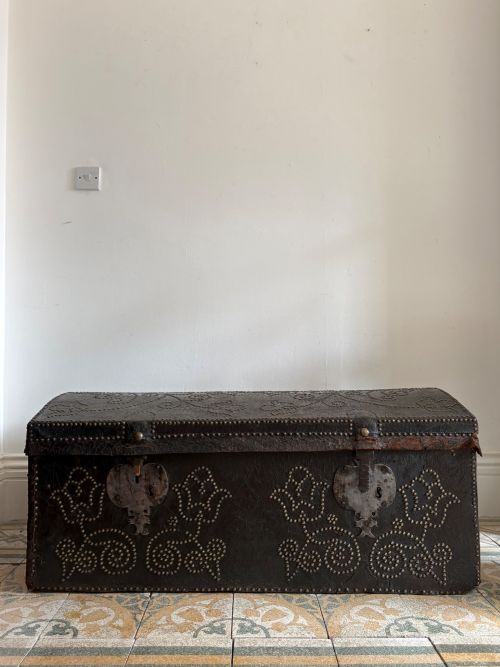
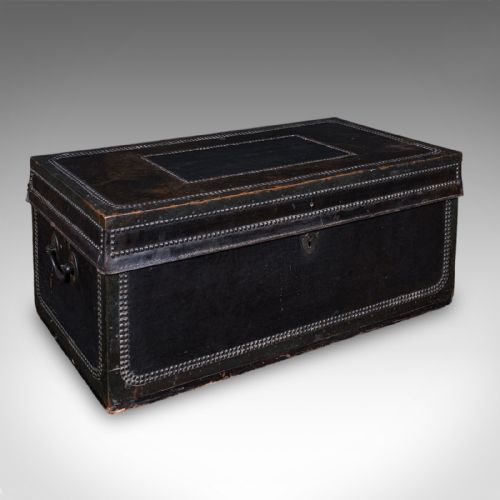
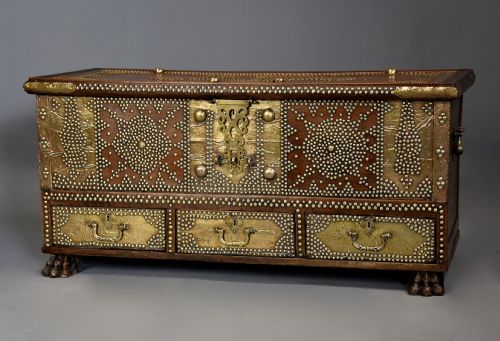




Brass Stud Blanket Box
A brass stud blanket box brings tactile warmth and robust utility to a room through dense metal work and time-worn leather or timber.
Brass Stud Blanket Box
When you search for a brass stud blanket box, you enter a field of heavy storage trunks, chests, and ottomans spanning the eighteenth, nineteenth, and early twentieth centuries. These forms served originally as travel luggage, campaign chests, or domestic storage containers, built to endure transit by coach, ship, or carriage.
The versions most commonly met on this page include nineteenth-century Victorian pieces, Regency examples, and exotic forms such as Zanzibar and China Trade chests. They appear in regional styles ranging from Anglo-Indian and Chinese Export to Spanish Baroque and English country house varieties.
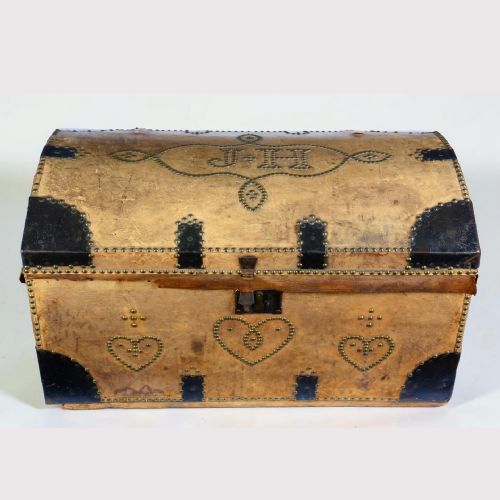
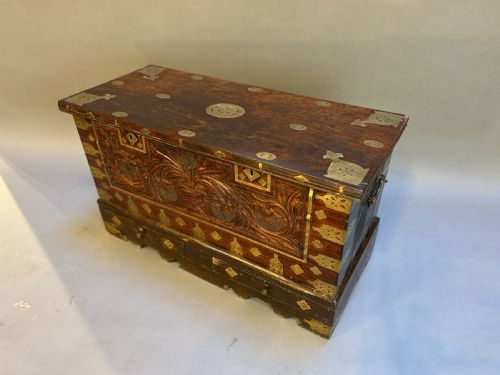
Makers utilised resilient timbers such as padouk, camphor wood, teak, mahogany, and rosewood, often clad in leather, hide, or metal bindings. The defining characteristic across these forms remains the meticulous application of brass studs, pins, and nailhead details framing lids, panels, and corners.
How they were made
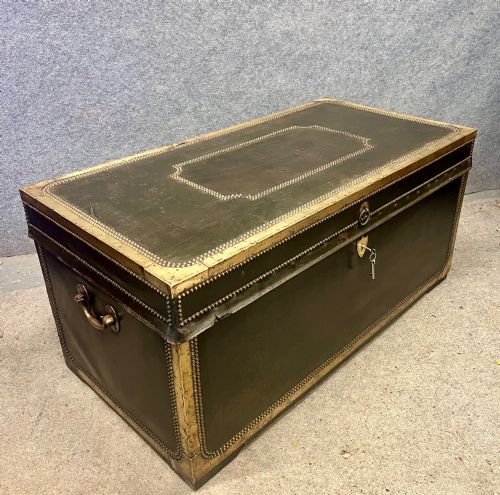
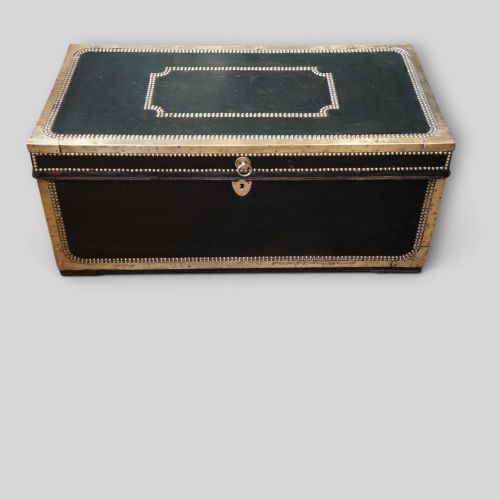
Cabinet makers and trunk builders constructed these pieces using dense hardwoods like mahogany, teak, padouk, and camphor wood, frequently mounting them with iron and brass for structural strength. Surfaces were then wrapped in leather, hide, or fabric, secured tightly to the wooden carcase with rows of individual brass studs and metal banding.
The decorative brass studwork was hammered in by hand, tracing geometric patterns, borders, and panel outlines across domed lids and flat-topped surfaces. Iron carrying handles, lock plates, and corner brackets were integrated to withstand the rigours of travel.
Listings feature woods including mahogany, teak, rosewood, camphor wood, and padouk, paired with brass, iron, and leather.
What varies in quality
The distinction between standard utility luggage and finer pieces rests on the choice of timber and the complexity of the brass studwork. Dense exotic hardwoods like camphor wood and padouk, combined with intricate hand-punched stud patterns and original leather cladding, elevate a piece significantly.
Integrity of construction and the retention of original hardware, such as side carrying handles and working locks, separate utilitarian travel boxes from decorative domestic ottomans and coaching trunks.
Samuel Pratt·Wm Insall of Bristol·Arthur Wannop·Seabrook of St Pauls London
The Brass Stud Blanket Box Glossary
- Zanzibar chest
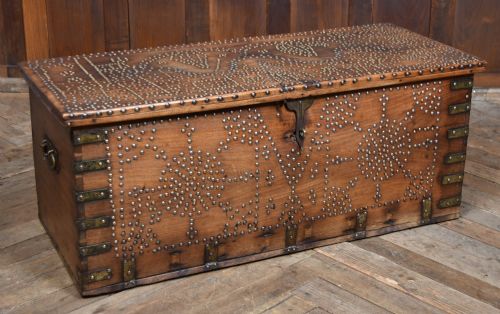
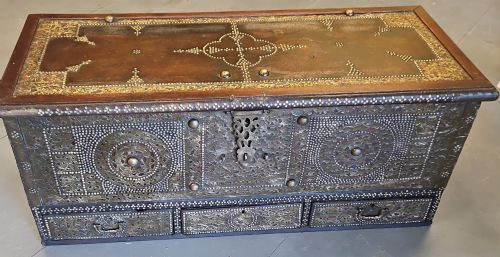
- A heavy hardwood storage chest originating from East Africa and trade routes, typically decorated with elaborate brass studwork and strapwork.
- Campaign trunk
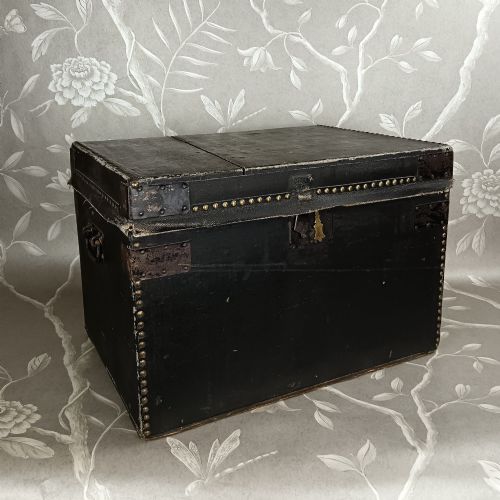
- A portable chest or box built in sections or with robust handles for military officers or travellers on the move during the Georgian and Victorian eras.
- Camphor wood
- An aromatic hardwood frequently used for trunk interiors to repel insects and protect stored blankets and textiles.
- Nailhead details
- Small decorative brass studs hammered along seams and edges to secure leather coverings and reinforce structural joins.
- Coffer
- A heavy wooden box or chest traditionally used for holding valuables, linens, or blankets.
Brass Stud Blanket Box: Frequently Asked Questions
What were brass stud blanket boxes used for?
These boxes primarily served as travel luggage for officers, merchants, and travellers navigating coaching routes, sea voyages, and military campaigns. Their sturdy wooden carcases and metal bindings protected garments and personal belongings from dust, moisture, and rough handling.
Over time, many transitioned into domestic spaces as static storage chests, blanket boxes, or footstools positioned at the foot of beds or in hallways.
How do I tell a Zanzibar chest apart from other trunks?
Zanzibar chests are distinguished by their specific regional construction, typically utilising dense tropical hardwoods like padouk, teak, or rosewood. They feature heavy brass studding arranged in intricate geometric patterns alongside elaborate brass corner plates and centralhasp fastenings.
Unlike standard European travel trunks, their form is rooted in East African and Indian Ocean trade, often incorporating distinct compartment layouts inside.
Are these trunks suitable for daily use at home?
These pieces function exceptionally well for everyday domestic storage, offering robust cavities for blankets, cushions, and winter textiles. Their flat or domed lids allow them to double as occasional tables, ottomans, or window seats depending on the specific form.
Placing them in a room adds a tactile layer of history, provided the leather or wood surfaces are kept away from direct heat sources.
How can I distinguish a Regency trunk from a Victorian one?
Regency trunks generally date from the early nineteenth century, exhibiting neoclassical restraint, cleaner lines, and often simpler leather or dark wood finishes with disciplined brass stud placement. Victorian examples tend to be heavier, sometimes featuring more exuberant domed lids, complex hardware, and varied upholstery.
Examining the underlying timber, locking mechanisms, and style of the brass bindings usually clarifies the period of manufacture.