
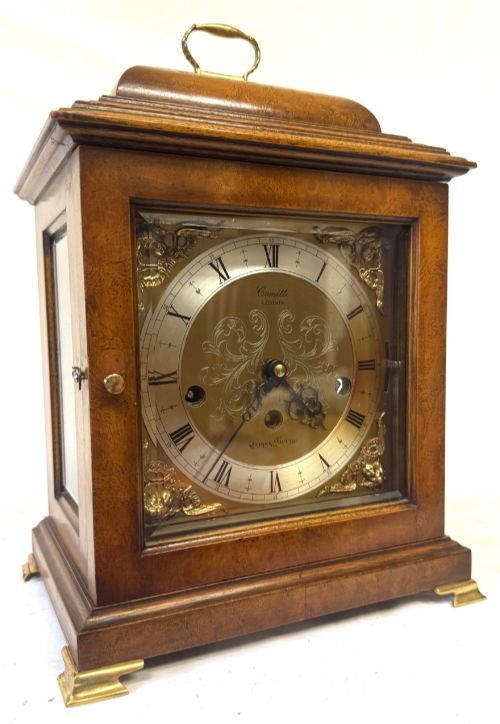
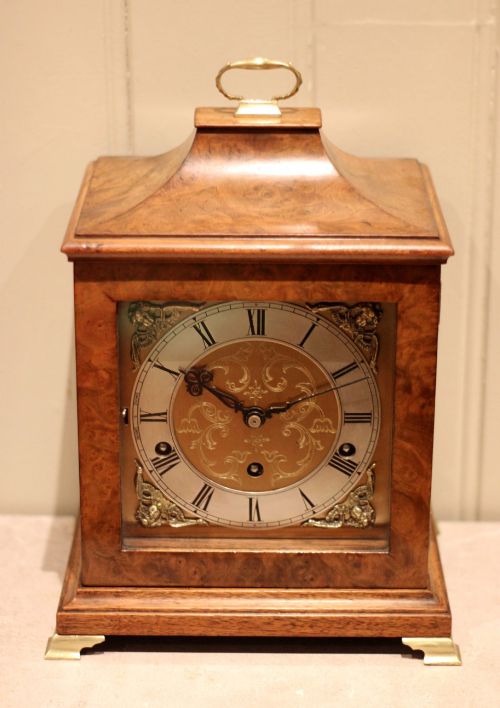
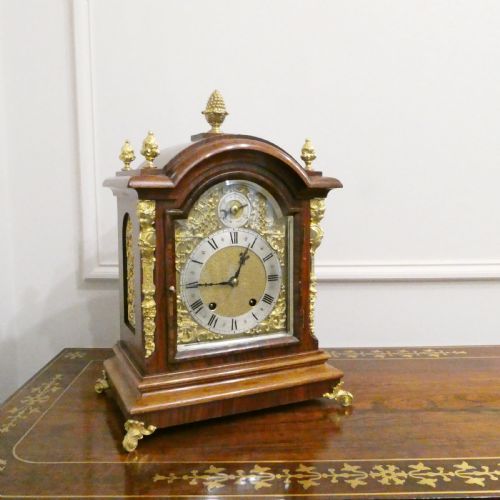


Brass Spandrel Table Clock
A brass spandrel table clock is a timepiece of architectural presence and mechanical complexity, bringing centuries of skilled horology straight into a room.
Brass Spandrel Table Clock
When you search for a brass spandrel table clock, you encounter timepieces that span from the eighteenth century through to the mid-twentieth century, encompassing mantel, bracket and desk clocks. These pieces frequently appear in traditional English, Georgian, Victorian and revival styles, reflecting shifts in interior taste over hundreds of years.
The form is most commonly represented on this page by bracket clocks and mantel clocks housed in rich timber cases such as mahogany, walnut, oak and ebonised wood. London makers of the eighteenth century feature alongside later nineteenth-century German workshops and twentieth-century English firms.
Objects range from simple striking movements to complex triple-tune mechanisms with automata, silvered metal dials and decorative brass spandrels in the corners. Every piece combines timekeeping with cabinetry, uniting the work of the clockmaker and the cabinet maker.
What varies in quality
Quality rests in the ambition of the movement and the integrity of the materials, separating standard production from masterwork horology. Eighteenth-century fusee movements by known London makers sit at a different level from later twentieth-century mass-produced chime mechanisms.
Cabinetry execution dictates value just as much as the internal mechanics. Finely figured burr walnut and rich mahogany veneers show superior timber selection compared to plain secondary woods, while hand-engraved brass spandrels and silvered dials demonstrate superior workshop skill.
Listings feature movements ranging from simple timepieces to triple-tune mechanisms and automated figures.
Comitti Of London·Mappin & Webb·Schneckenburger·Garrards·SOMERSALL LONDON·Winterhalder & Hofmeier·WILLIAM WITHERS·JAMES SMITH·CHATER & SON·JOHN TAYLOR OF LONDON
The Brass Spandrel Table Clock Glossary
- Spandrel
- The decorative corner piece set between the circular dial and the rectangular frame of the clock face. These are typically cast in brass and often chased or pierced.
- Fusee
- A conical pulley used in mechanical clocks to maintain an even pull on the gear train as the mainspring unwinds. This device ensures consistent timekeeping accuracy.
- Bracket clock
- A portable spring-driven clock originally designed to sit on a wall bracket or a table. Many feature distinctive arched bell tops and carrying handles.
- Striking
- A mechanism that sounds the hours or quarters on a bell or gong. Complex versions include ting tang strikes or multiple tune options.
- Automation
- Moving mechanical figures incorporated into the dial of a clock. These animations operate in time with the striking mechanism.
Brass Spandrel Table Clock: Frequently Asked Questions
What is a brass spandrel table clock?
A brass spandrel table clock is a mechanical timepiece housed in a timber case, featuring decorative metal corner ornaments around the dial. These pieces range from eighteenth-century London fusee bracket clocks to twentieth-century chime mantel clocks.
They combine intricate gear movements with fine cabinet making, serving both as functional timekeepers and decorative objects for surfaces around the home.
Where should I place a bracket clock?
These clocks are designed for stable, level surfaces such as mantelpieces, sideboards, desks or dedicated wall brackets. Keeping them away from direct sunlight and drafts protects the wood and internal mechanics.
Because many feature rear doors and glazed side panels to display the movement, positioning them where light can pass through enhances their visual appeal.
How do I wind a mechanical table clock?
Winding requires a matching key inserted into the winding holes on the dial face, turned gently until resistance is felt. Care must be taken not to overwind the spring, which can cause damage to the internal mechanism.
Different movements require different winding intervals, ranging from daily eight-day fuses to monthly or seasonal setups depending on the gear train.
How do I tell an 18th-century clock from a later revival?
Eighteenth-century examples typically display hand-engraved brass backplates, distinct maker signatures, and fusee movements built by individual craftsmen. Revival pieces from the Victorian and Edwardian eras often use stamped plates and standardised mass-produced movements.
Examining the construction of the timber case, the fixing screws, and the dial layout reveals the manufacturing era and workshop origin.