






Brass Scientific Level
These brass scientific level pieces are precision instruments designed for surveying and measurement, combining engineering utility with handsome materials.
Brass Scientific Level
When you search for a brass scientific level, you are looking at precision surveying tools designed to measure heights and angles in the field or the workshop. The examples on this page span from the Georgian era through to the Edwardian period, capturing more than a century of scientific instrument manufacture.
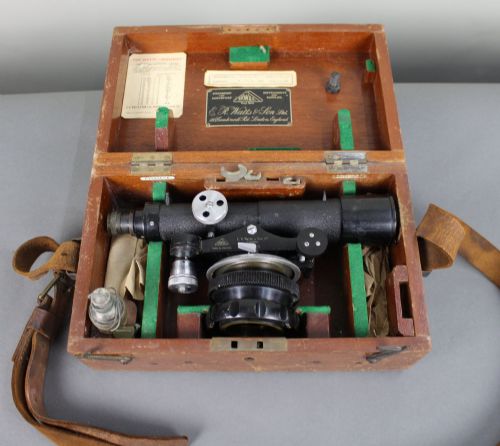
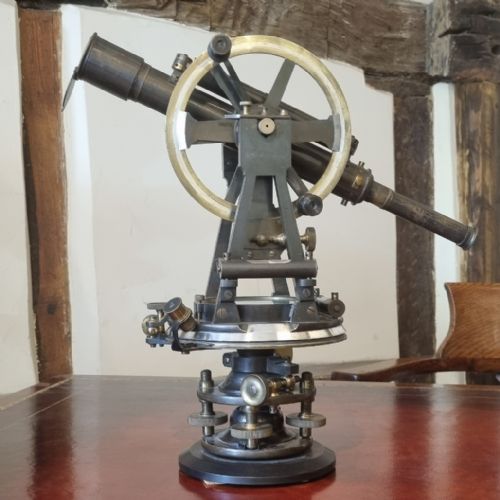
You will most frequently meet instruments mounted in polished wood cases, often retaining their original silvered metal dials and glass vial bubbles. The forms range from portable transits and dumpy levels to complex theodolites signed by notable makers.
Makers such as W&S Jones, L Casella, and Cooke Troughton & Simms dominate the heritage of these pieces. They represent a period when British optical and mechanical engineering set the standard for global exploration and construction.
Materials and construction methods
The primary material visible across these listings is heavy cast and turned brass, chosen for its durability and resistance to corrosion in field conditions. This is paired with silvered metal for legible degree scales and glass for delicate spirit levels.
Enclosing wooden cases are typically constructed from mahogany or boxwood, fitted with brass hinges and locks to protect the sensitive internal optics during transport. Steel and bronze components are also integrated selectively where greater tensile strength is required for leveling screws and sighting arms.
Brass Scientific Level Retail Price Guide 2026
Typical asking prices for brass scientific level among the pieces listed under this phrase on Sellingantiques today, from the lower quarter to the upper quarter. They describe what is for sale here now, not the wider market.
Some folding boxwood pocket levels were tucked into waistcoats, ready to settle a Victorian argument over a wall's plumb.
Factors that define the grade
Quality in these instruments is determined by the crispness of the engraved markings on the silvered dials and the precision of the mechanical movements. Finer examples exhibit smooth rotation in the vernier plates and retain their original optics without clouding in the glass.
The presence of a matching, maker-stamped fitted mahogany case elevates an instrument, particularly when the original retail label remains intact inside the lid. Furthermore, signatures from recognised London and Edinburgh firms indicate a higher tier of workshop output.
W&S Jones·L Casella & Co·Cooke Troughton & Simms·Elliott Bros·Alexander Adie·W. H. Harling·WF STANLEY·Negretti & Zambra
The Brass Scientific Level Glossary
- Theodolite
- A precision instrument for measuring horizontal and vertical angles, mounted on a base with a rotating telescope. These are among the most complex surveying tools from the period.
- Clinometer
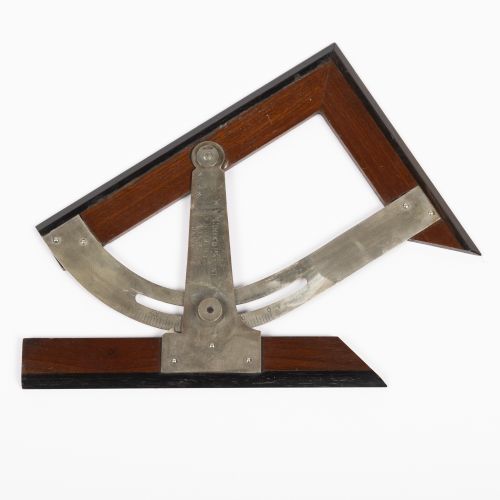
- An instrument used for measuring angles of slope or tilt relative to gravity, often integrated into folding boxwood or brass pocket tools.
- Vernier
- A secondary sliding scale that allows readings to be taken with greater precision than the main graduated dial permits. It relies on human visual alignment against primary markings.
- Transit
- A surveying instrument where the telescope can be rotated through a complete vertical circle. This allows both direct and reverse sights to be taken.
- Spirit level
- A sealed glass vial containing liquid and an air bubble, used to determine whether a surface is horizontal. The position of the bubble indicates exact levelness.
Brass Scientific Level: Frequently Asked Questions
What is a brass scientific level used for?
These instruments were utilised by surveyors, architects, and engineers to establish horizontal planes and measure elevations during construction and mapping.
Today, they serve primarily as decorative objects or desktop study pieces that celebrate historical precision engineering.
How do I date a brass level?
Dating relies heavily on engraved maker signatures, patent dates, and stylistic shifts in the brass casting and lettering.
Listings spanning the Georgian, Victorian, and Edwardian periods show distinct evolutions in how cases and leveling screws were engineered.
How should I clean brass instruments?
Historic brass instruments benefit from gentle dusting with a soft, dry brush rather than aggressive chemical polishing.
Preserving the aged patina maintains the historical integrity and character developed over more than a century.
Are these instruments still accurate?
While many retain their moving parts and functional spirit bubbles, they are collected today as historical artefacts rather than for modern surveying.
Calibration may drift over time, so they are best appreciated for their mechanical beauty and craftsmanship.