






Surveying Level Instrument
These surveying level instrument examples are precision brass and mahogany tools built to measure angles and elevations.
Surveying Level Instrument
A surveying level instrument serves to measure heights, angles and elevations across land and building sites. When you search for a surveying level instrument, you encounter various brass and glass devices housed in fitted wooden cases.
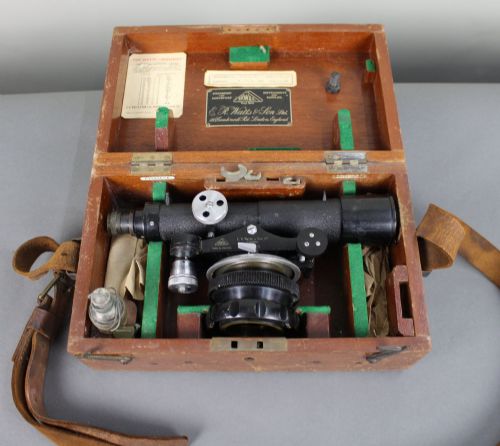
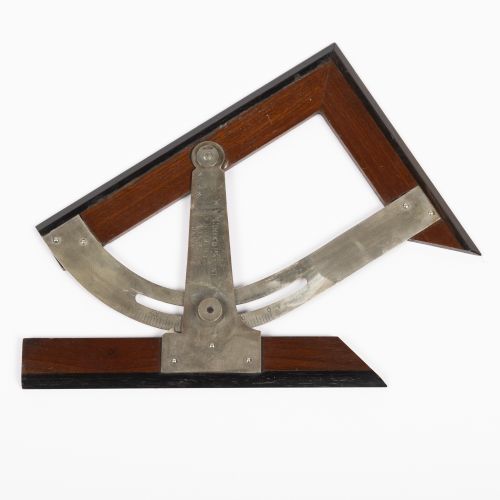
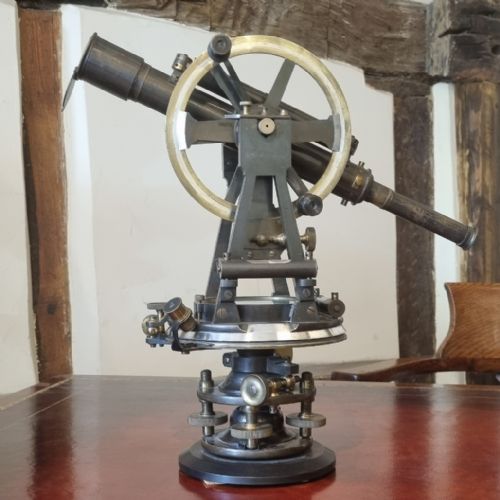
The pieces on this page span from the Georgian period through the Victorian era and into the early twentieth century. Most examples take the form of theodolites, drainage levels, transit instruments and clinometers.
Makers from London and Edinburgh signed these brass and silvered metal devices. Many retain their original mahogany boxes and boxwood folding components.
How they were made
Workshops utilised heavy cast brass to form the rigid frames and telescopic mounts required for accurate sighting. Glass lenses provided the optical magnification, while silvered metal dials allowed precise angle readings.
Cabinetmakers constructed fitted boxes from solid mahogany to protect the delicate instruments during transport. Boxwood and steel components added durability to folding sights and internal mechanisms.
Surveying Level Instrument Retail Price Guide 2026
Typical asking prices for surveying level instrument among the pieces listed under this phrase on Sellingantiques today, from the lower quarter to the upper quarter. They describe what is for sale here now, not the wider market.
Listings span the nineteenth and early twentieth centuries, featuring materials such as brass, mahogany, glass and boxwood.
What varies in quality
Quality rests in the crispness of the engraved silvered metal scales and the smooth movement of the brass focusing gears. Maker signatures from established firms like W&S Jones or Elliott Bros elevate the standing of a piece.
The presence of an original mahogany case and matching accessories distinguishes a well-preserved instrument from a partial survival. Finer examples maintain clear optics and untouched patination on the brass surfaces.
W&S Jones·L Casella & Co·Cooke Troughton & Simms·Negretti & Zambra·Elliott Bros·Alexander Adie·W. H. Harling·WF Stanley
The Surveying Level Instrument Glossary
- Theodolite
- A precision instrument for measuring horizontal and vertical angles on a rotating base. It utilises a telescope mounted on a tripod head.
- Clinometer
- A tool used for measuring angles of slope, elevation or depression of an object with respect to gravity. Many incorporate folding sights.
- Transit instrument
- A telescope mounted on an axis designed primarily for observing celestial bodies passing the meridian. These often include precise leveling bubbles.
- Vernier
- A auxiliary scale that allows readings to a fraction of the main graduated scale. It provides greater precision in angle measurement.
- Silvered metal
- A metallic dial or plate coated with a thin layer of silver to receive fine engraved markings. This surface offers high contrast for reading graduations.
Surveying Level Instrument: Frequently Asked Questions
What is a surveying level instrument used for?
These instruments were utilised by engineers, architects and surveyors to establish horizontal planes and measure vertical elevations. They guided the construction of infrastructure and mapping.
Today, collectors appreciate them as triumphs of nineteenth-century mechanical engineering and optical design.
How do I identify the period?
Georgian and early Victorian examples often feature hand-engraved cursive signatures and robust mahogany housing. Later pieces incorporate standardised industrial scientific styling.
Materials also shift over the decades, moving from heavy Georgian brass castings to early twentieth-century precision alloys.
Are these instruments still accurate?
While many retain functional optics and moving parts, they serve primarily as decorative and historic objects. Calibration can degrade over centuries of storage.
Collectors handle them with care to preserve the delicate silvered metal dials and glass lenses.
Why do they come in wooden cases?
Fitted mahogany boxes protected the sensitive brass levels and glass optics from dust and impact during transport in the field. Custom wooden blocks held each component firmly in place.
These cases frequently bear trade labels or retailer stamps from the original scientific instrument makers.