


Brass Repeating Mantel Clock
A brass repeating mantel clock brings precision engineering and mechanical chime to a desk or shelf, rooted firmly in nineteenth-century French and English workshops.
Brass Repeating Mantel Clock
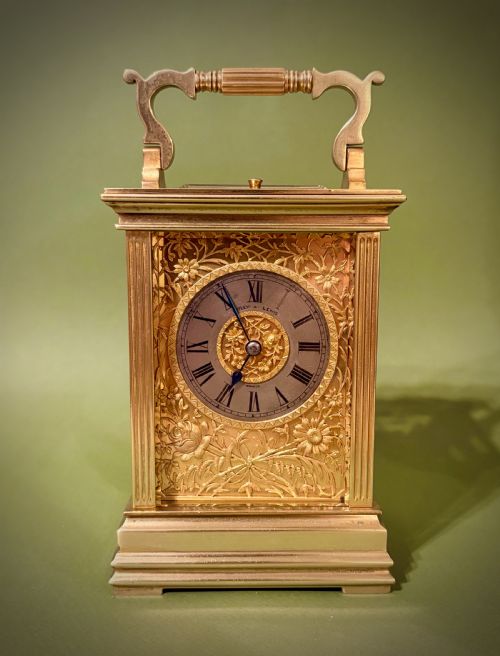
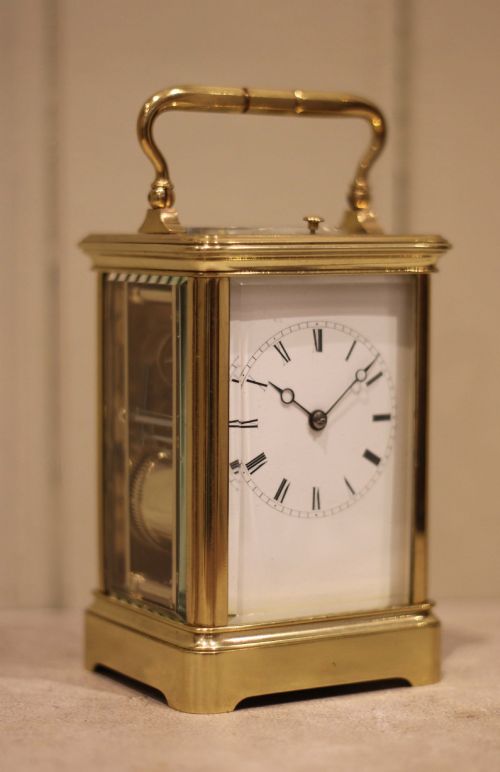
When you search for a brass repeating mantel clock, you are looking at heavy, portable timepieces designed to sound the hours and quarters on demand. The pieces listed on this page span the Victorian era, the Regency period, and the nineteenth century, with French carriage clocks and English bracket clocks forming the core of the selection.
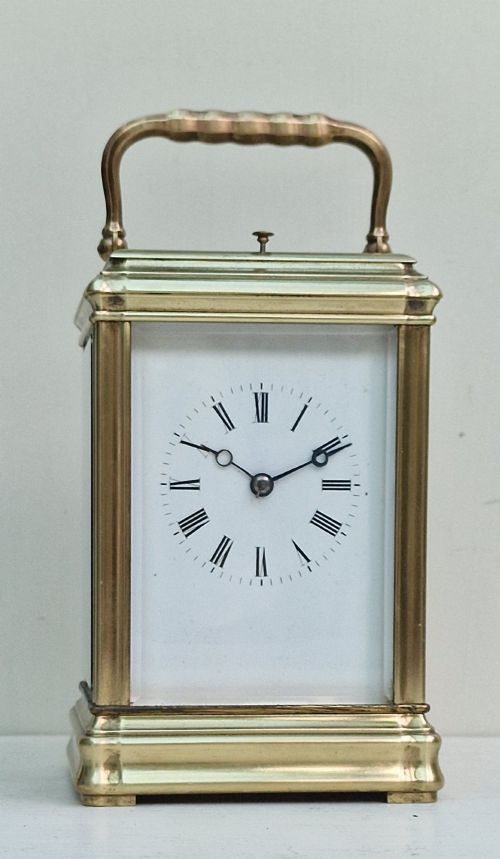
Carriage clocks dominate the evidence, housed in brass frames with glass panels that display the escapement and movement within. You will also find bracket clocks in mahogany, ebonised wood, and steel, showing architectural cases intended for table or mantel placement.
Materials and movement
The construction relies heavily on polished brass and gilt brass plates, joined to form rigid cases that protect intricate gear trains. Glass panels allow light into the movement and provide a view of the enamel dials, steel hands, and oscillating balances.
Movements utilise brass wheels, steel pinions, and balance springs, often mounted with platforms. Cases incorporate leather travelling outer boxes in some instances, alongside enamel bandings, paintings, and engraved masks around the dials.
Quality and craftsmanship
The distinction between tiers of work rests on the complexity of the striking train and the finish of the case. Grand sonnerie and petit sonnerie movements, which chime automatically on the quarters, demand higher skill than simple hour-striking variants.
Engraving depth on the brass mask, the presence of fully gilded or gorge-style cases, and the crispness of enamel dials separate standard production items from master-level horology.
Joseph Windmills·Drocourt·Dwerrihouse and Bell·Andrew Marchant·Henry Jacot·Moser·J.W. Benson
The Brass Repeating Mantel Clock Glossary
- Repeating movement
- A mechanism that sounds the last hour or quarter when a plunger or pendant is pressed. This complication allowed owners to check the time in the dark.
- Gorge case
- A stepped brass carriage clock case with characteristic moulded top and base sections. It represents a standard housing style for fine nineteenth-century examples.
- Grand Sonnerie
- A striking train that sounds both the hours and the passing quarters automatically. It is a more complex movement than a standard repeater.
- Verge escapement
- An early type of escapement using a crown wheel and a vertical rod with pallets. It appears in earlier bracket clocks on this page.
- Enamel dial
- A fused glass-on-copper face providing a smooth white background for painted numerals. These dials maintain their colour and legibility over centuries.
Brass Repeating Mantel Clock: Frequently Asked Questions
How do I wind a carriage clock?
Wind the mainspring using the dedicated key via the arbors located on the backplate of the movement. Take care not to over-wind the springs.
Ensure you match the key size correctly to the winding squares to avoid damaging the delicate brass components inside.
What is the difference between a carriage clock and a bracket clock?
Carriage clocks are smaller, portable brass and glass timepieces originally made for travel. Bracket clocks are larger wooden or metal clocks designed to sit on furniture.
Bracket clocks often use fusee movements housed in mahogany or ebonised cases, whereas carriage clocks rely on platform escapements.
How does the repeater function work?
Pressing the button on top of the case triggers a rack and snail mechanism that strikes gongs or bells to indicate the time. This mechanical memory allows the clock to repeat the last hour and quarters.
It operates independently of the running train, deriving its power from a separate spring within the repeating mechanism.
How do I date these clocks?
Dating relies on stylistic clues such as case architecture, dial signatures, and the evolution of escapements from verge to lever platforms. Nineteenth-century French pieces often feature engraved serial numbers or maker marks on the backplate.
English bracket clocks from the seventeenth and eighteenth centuries show distinct wood veneers, basket tops, and signature plates on the dial.