

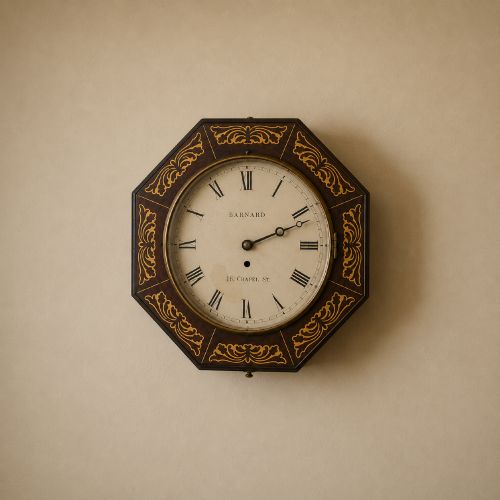


Brass Octagonal Clock
A brass octagonal clock combines precise timekeeping with striking geometric form, making it a sophisticated centrepiece for any interior.
Brass Octagonal Clock
A brass octagonal clock brings together geometric symmetry and functional timekeeping, appearing most frequently in wall-hung formats with fusee movements housed in timber cases. These pieces span the Regency, Victorian, and late nineteenth-century periods, capturing the shift from grand Georgian precision to ornate nineteenth-century domestic design.
The dominant material combination pairs warm rosewood or mahogany with polished brass bezels, often enhanced by brass inlay or metal wire work. You will encounter both wall-mounted dial clocks and mantel clocks, each exhibiting the characteristic eight-sided frame that sets them apart from standard circular or square designs.
Originating predominantly from English and French makers, these clocks range from simple tavern timepieces to intricate brass-inlaid rosewood regulators. The selection reflects a rich variety of nineteenth-century craftsmanship, uniting structural rigidity with decorative refinement.
Materials and construction
Cabinetmakers constructed the distinctive eight-sided cases using dense hardwoods such as mahogany and rosewood, frequently incorporating ebonised wood for contrast. These timbers provided the structural stability required to support heavy brass bezels and glass dial covers.
Surface decoration relied on precision metalwork, featuring brass inlay, mother-of-pearl accents, and delicate metal wire marquetry set directly into the timber grain. Inside, mechanical timekeeping was driven by fusee movements designed to maintain steady tension across the power reserve.
Brass Octagonal Clock Retail Price Guide 2026
Typical asking prices for brass octagonal clock among the pieces listed under this phrase on Sellingantiques today, from the lower quarter to the upper quarter. They describe what is for sale here now, not the wider market.
Formats span wall-hung dial clocks, drop-dial regulators, and mantel clocks originating from English and French makers.
Assessing quality and execution
The standard of a brass octagonal clock rests heavily on the crispness of the timber case joinery and the precision of the brass inlay work. Superior examples display seamless integration between the metal elements and the rosewood or mahogany ground, showing no gaps or crude adhesives.
Movement sophistication also dictates value, with fusee mechanisms representing a higher tier of horological engineering compared to standard spring-driven alternatives. Furthermore, the clarity of the dial numerals and the weight of the cast brass bezel distinguish standard production pieces from finer studio output.
Barnard·Halliday & Rich·Kleyser of London·Walker and Hall·Webb of Frome
The Brass Octagonal Clock Glossary
- Fusee
- A conical pulley used in mechanical clocks to equalise the torque of the mainspring as it unwinds. This mechanism ensures consistent force is delivered to the escapement for accurate timekeeping.
- Dial clock
- A wall-mounted timepiece featuring a prominent circular face framed by a secondary wooden or metal surround. They were widely used in public spaces, railway stations, and domestic hallways.
- Tavern clock
- A large pendulum-driven timepiece with an extended trunk and a prominent dial, traditionally positioned in communal gathering spaces. They emerged during the eighteenth century and remained popular well into the Victorian era.
- Regulator
- A high-precision clock designed to keep exceptionally accurate time, often utilised as a reference standard in workshops. They typically feature refined mechanical movements and clear, uncluttered dials.
- Marquetry
- The art of applying decorative veneer pieces to a structural wooden surface to create pictorial or geometric patterns. In these clocks, brass and mother-of-pearl are frequently integrated into the wood veneer.
Brass Octagonal Clock: Frequently Asked Questions
Where were these clocks hung?
These timepieces were typically positioned in prominent communal areas such as hallways, offices, and dining rooms where their clear dials could be easily consulted by household members.
Their robust construction and wall-mounted formats made them practical fixtures for daily time management in busy domestic environments.
How do I wind a fusee clock?
Winding requires inserting a key into the dial aperture and turning it gently in the designated direction until resistance is met. Care must be taken not to overwind the mechanism, as this can strain the mainspring.
Consulting the specific movement layout ensures the key engages properly with the winding arbor without damaging the surrounding dial face.
How do I date a brass octagonal clock?
Dating relies on examining the timber species, the style of the brass inlay, and the mechanical characteristics of the fusee movement. Regency examples often feature clean mahogany cases with understated brass stringing, whereas later Victorian pieces embrace rosewood and more elaborate mother-of-pearl decoration.
Maker signatures inscribed on the dial or movement plates also provide reliable chronological markers.
Can these clocks run daily?
Most fusee movements are designed to run for eight days on a single wind, requiring periodic attention to maintain accurate timekeeping. Regular professional servicing keeps the mechanical components functioning smoothly.
Placing the clock on a stable interior wall away from direct heat sources helps preserve both the wooden case and the delicate brass internal gears.