
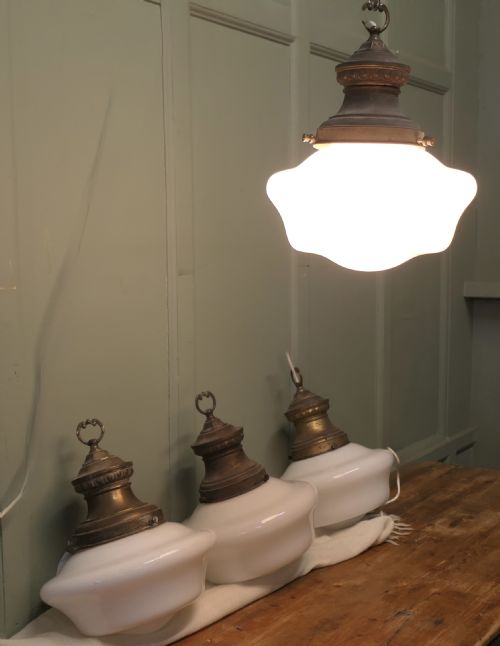
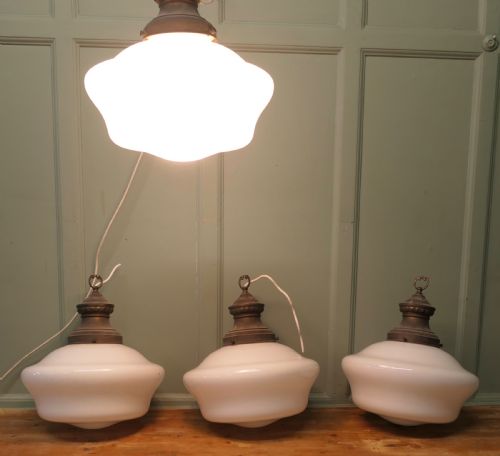
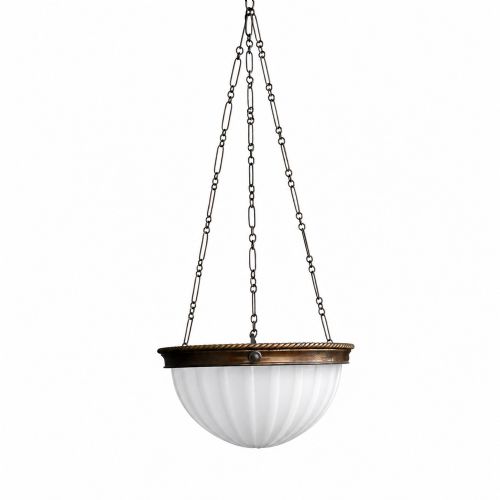


Brass Milk Glass Light
These brass milk glass light fixtures combine metalwork and opaque glass to illuminate period interiors with functional warmth.
Brass Milk Glass Light
Buyers meet variations ranging from large chapel lights and pharmacy pendants to pear-shaped opaline shades and star lanterns. These pieces originate across the nineteenth and twentieth centuries, utilising milk glass, opaline, and brass fittings.
Materials and Manufacture
Makers utilised brass for structural elements, galleries, rings, and lamp bases, pairing the metal with glass shades. Glass varieties include milk glass, opaline glass, moonstone, and opaque glass, sometimes combined with ceramic components or black glass bases.
Forming techniques produced conical, pear-shaped, and spherical globes, alongside hand-painted decoration and crimped glass edges. Components such as brass galleries secure the glass shades to ceiling plates and hanging pendants.
Listings span the Victorian era, Edwardian period, 1930s, and mid-century modern design, utilising brass, opaline, moonstone, and ceramic.
Quality Variations
Quality appears in the weight of the brass castings, the uniformity of the glass blowing, and the refinement of decorative details. Finer pieces demonstrate careful hand-painted work or specialised glass forms like moonstone and opaline rather than plain opaque glass.
The integration between the original brass gallery and the glass shade distinguishes superior surviving examples. Proportion also dictates quality, particularly in large industrial pendant lights and substantial oil lamps.
The Brass Milk Glass Light Glossary
- Milk glass
- An opaque or translucent white glass, blown or pressed into tableware and lamp shades during the nineteenth and twentieth centuries.
- Opaline glass
- A slightly translucent glass type with a milky appearance, frequently tinted in pale shades for decorative lighting.
- Brass gallery
- A metal collar or rim that holds a glass lamp shade in place and connects it to the hanging mechanism.
- Moonstone glass
- A type of mottled, translucent glass resembling the gemstone, seen on early twentieth century English pendants.
- Pendant light
- A hanging light fixture suspended from the ceiling by a chain, cord, or metal rod.
Brass Milk Glass Light: Frequently Asked Questions
How do I date a brass milk glass light?
Dating relies on stylistic markers such as Victorian oil lamp bases, Edwardian enamelling, and 1930s industrial pendant forms. Materials like opaline and brass fittings further indicate specific manufacturing decades.
Construction methods and glass types align with historical periods, helping differentiate nineteenth century oil lamps from twentieth century electric ceiling fixtures.
Were these lights originally electric or oil?
Many early pieces began as oil or paraffin lamps utilising burners and glass globes before later conversion to electricity. Ceiling lights and pendant fixtures were designed for gas or early electrical systems.
Examining the original brass gallery and wiring components reveals whether a fitting held an oil burner or an early lamp holder.
How do I clean milk glass shades?
Cleaning milk glass requires warm soapy water and a soft cloth to remove dust without scratching the opaque surface. Harsh abrasives should be avoided to protect hand-painted details.
Brass components benefit from gentle cleaning to maintain their metal finish without stripping the patination accumulated over decades.
What is the difference between milk glass and opaline?
Milk glass is typically dense and opaque white, while opaline glass possesses a translucent quality that diffuses light softly. Both materials were utilised across Victorian and Edwardian lighting.
Opaline glass often displays subtle variations in thickness and tone when illuminated, distinguishing it from denser opaque white glass.