
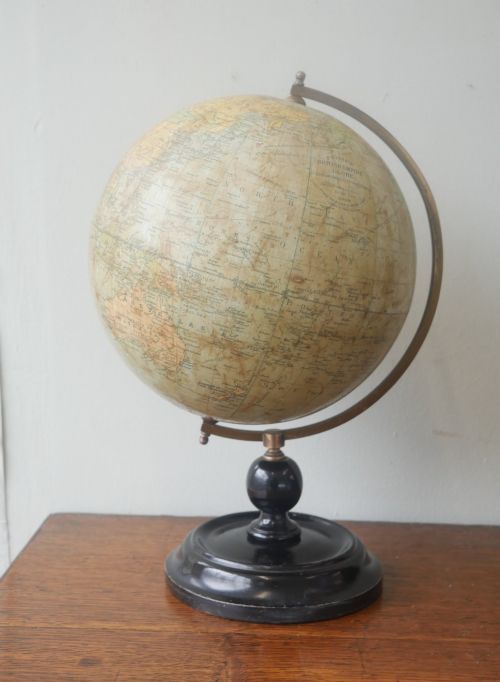
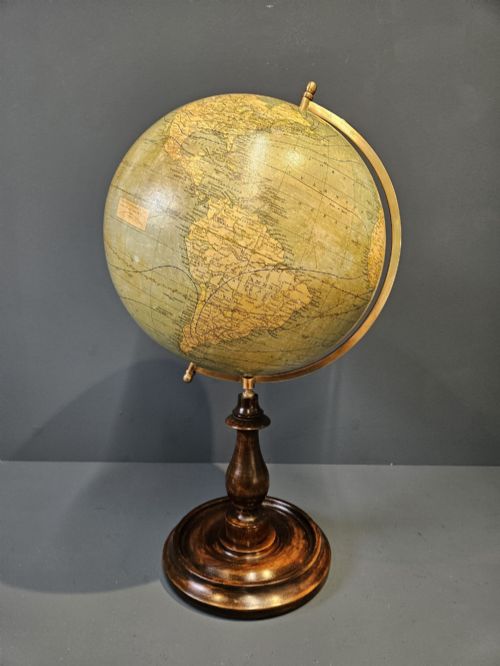


Brass Meridian World Globe
A brass meridian world globe brings geographical history into your room, offering mounted terrestrial spheres from past centuries mounted on graduated metal rings.
Brass Meridian World Globe
When you search for a brass meridian world globe, you encounter scientific instruments and library furnishings designed to chart the earth. These pieces range from compact desk models to large floor-standing library globes spanning multiple eras.
You are most likely to meet Victorian and 1930s examples on this page. These versions appear in various sizes, often supported by wooden feet or turned pedestals.
The form encompasses terrestrial globes and library globes created by noted cartographers and mapmakers. They serve as historical reference points as much as decorative objects for studies and libraries.
How they were made
Maker construction relied on papier-mâché or plaster spheres applied over a core, then covered with printed paper gores depicting the map details. These spheres rotate within a graduated brass meridian ring that permits tilting.
Supporting structures utilise turned timbers such as mahogany, walnut, and ebonised wood. Bases range from simple table stands to substantial floor-standing frames with compasses or additional tiers.
Listings span the nineteenth century through the interwar period, utilising materials such as walnut, brass, paper, and plaster.
What varies in quality
The division between standard examples and superior ones lies in the crispness of the cartography and the complexity of the mounting. Finer pieces feature detailed map gores by established makers mounted within heavy, well-cast brass rings.
The calibre of the secondary wood and the joinery of the stand also distinguish the work. Robust pedestals with well-turned woodwork and original surface finishes elevate the presence of the instrument.
G and J Cary·Malby's·Crunchley·Bacon's·Geographia·Chandy Charan and Co
The Brass Meridian World Globe Glossary
- Meridian ring
- The graduated brass ring that encircles the globe and allows it to spin on an axis. This component measures degrees of latitude.
- Gores
- The printed paper segments shaped like lutes that are pasted onto the sphere to form the map. Accurate gores align precisely at the poles.
- Terrestrial globe
- A spherical map representing the earth rather than the celestial sphere. These show countries, oceans, and historical political boundaries.
- Library globe
- A large globe, often resting on a dedicated stand, intended for scholarly reference. These pieces usually feature detailed cartography and substantial mountings.
Brass Meridian World Globe: Frequently Asked Questions
How do I date a globe?
Dating relies on the geographical boundaries, political names, and railway lines printed on the paper gores. Cartographers often updated these details to reflect historical changes.
Additional clues come from the typography, the style of the wooden stand, and any maker signatures printed directly onto the cartouche.
What is a meridian ring used for?
The brass meridian ring holds the sphere in place and tilts to demonstrate the earth's axial tilt relative to the sun. It is marked in degrees to assist with navigational calculations.
On quality models, this ring is cast brass and moves smoothly within a horizon ring or stand.
Where should I place a globe?
These instruments suit studies, libraries, and living spaces where they can sit away from direct sunlight. Protecting the paper surface from UV light prevents fading of the delicate map colours.
Ensure the room maintains stable humidity to protect both the paper sphere and the wooden base from warping.
How do I clean a paper globe?
Dusting requires only a very soft, dry cloth or a feather duster applied with minimal pressure. Moisture damages the historical paper gores and dissolves the historic adhesives beneath.
Avoid chemical cleaning products entirely, as they strip the original varnish and stain the printed cartography.