

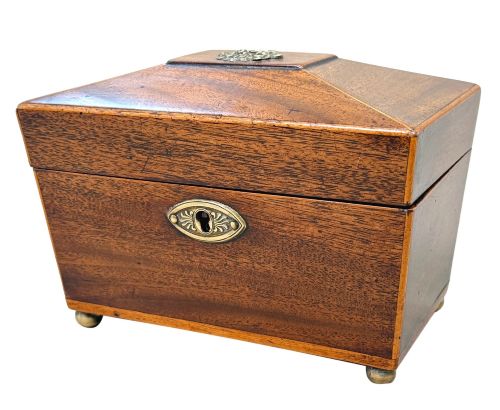
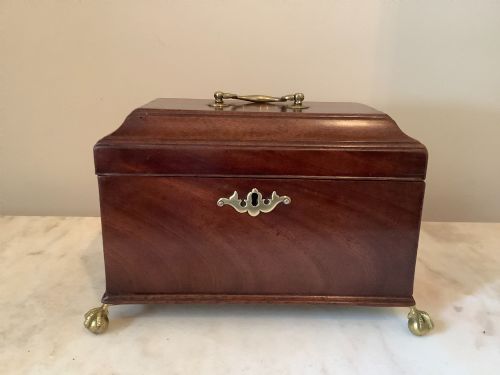


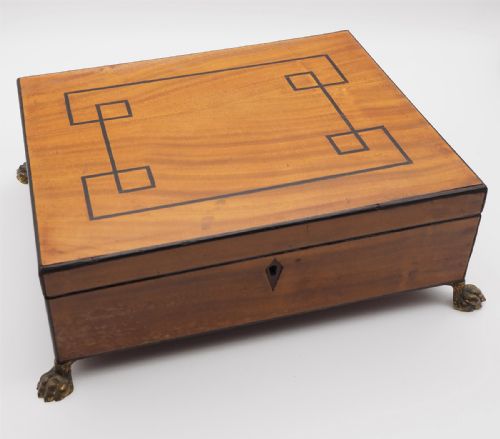
Brass Footed Tea Box
A brass footed tea box holds the leaves that once dictated polite society, combining fine cabinet timbers with elevated metalwork.
Brass Footed Tea Box
A brass footed tea box represents a dedicated container built to store precious dry leaves securely away from moisture and light during the eighteenth and nineteenth centuries. These vessels survive in forms ranging from sarcophagus shaped chests to oblong tapered caddies and larger freestanding teapoys.
The examples gathered here span the Georgian, Regency, and Victorian periods, with mahogany and rosewood predominating alongside exotic veneers. Makers employed materials such as tortoiseshell and satinwood to signal the status of the drawing room they inhabited.
Buyers will encounter items retaining internal compartments, mixing bowls, or secret drawers designed for locking up valuable commodities. Each specimen demonstrates the domestic rituals attached to tea preparation before blends became commonplace household goods.
How they were made
Cabinetmakers constructed these boxes using solid timbers and fine veneers like mahogany, rosewood, and satinwood, often enhanced with boxwood stringing or tortoiseshell panels. Metal mounts, handles, and small bracket or ogee feet in brass or gilt metal were then secured to elevate the wooden body.
Interiors required precise joinery to house fitted canisters, mixing bowls, and tiny secret drawers hidden behind sliding panels or false bottoms. Surface finishing relied on hand-rubbed polishes that brought out the natural grain patterns of the tropical hardwoods.
Brass Footed Tea Box Retail Price Guide 2026
Typical asking prices for brass footed tea box among the pieces listed under this phrase on Sellingantiques today, from the lower quarter to the upper quarter. They describe what is for sale here now, not the wider market.
Current listings span the eighteenth century through to eighteen-ninety, covering Georgian, Regency, and Victorian design vocabulary.
What varies in quality
Quality rests in the precision of the timber selection, such as the depth of figure in a rosewood veneer or the crispness of ebony and satinwood inlay. Finer boxes display harmonious proportions and meticulous attention to the interior fittings rather than mere surface decoration.
The integration of the metal mounts and the retention of original internal elements dictate the standing of a piece within its period. Lesser examples show simpler secondary woods and replacement feet that lack the integration seen in high-grade workshop output.
The Brass Footed Tea Box Glossary
- Tea caddy
- A small box or chest designed to store loose tea leaves securely under lock and key. The term derives from catty, the Chinese unit of weight.
- Teapoy
- A freestanding piece of furniture featuring a box for storing tea mounted on a central pillar or legs. These often stood beside a chair in the drawing room.
- Sarcophagus
- A monumental coffin-like box shape with a domed lid and flared base, popular during the Regency period for large tea chests. The form borrows from classical antiquity.
- Stringing
- A narrow inlaid line of contrasting wood used to frame panels and accentuate the geometric lines of a box. Cabinetmakers utilised boxwood for this bright linear contrast.
Brass Footed Tea Box: Frequently Asked Questions
What is a brass footed tea box?
A brass footed tea box is a lidded wooden container raised on small metal feet, built to store expensive tea leaves in eighteenth and nineteenth century parlours.
These pieces range from simple mahogany boxes to elaborate tortoiseshell and rosewood chests equipped with locks to protect the contents.
How were these boxes used?
Households used them to keep precious black and green teas dry, secure, and measured out daily by the master or mistress of the house.
Inside, divided compartments held different varieties of leaf alongside a central mixing bowl for blending teas before brewing.
How do I date a tea box?
Dating relies on observing the prevailing wood choices, hardware styles, and cabinet shapes across the Georgian and Regency periods.
Earlier eighteenth-century pieces often feature mahogany with simple bracket feet, while Regency examples embrace rosewood, brass inlay, and tapered forms.
Why do some have secret drawers?
Secret drawers provided an extra hidden space for storing the key to the main lock, small valuables, or private recipe notes.
Cabinetmakers integrated these covert compartments behind removable panels or false floor sections as a mark of superior craftsmanship.