
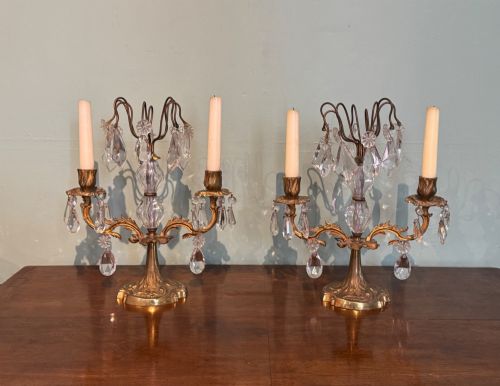


Brass Crystal Girandole
These brass crystal girandole pieces combine reflective metalwork and hanging drops, bringing distinct period illumination to a room.
Brass Crystal Girandole
A brass crystal girandole is a decorative lighting piece designed to hold candles or electric bulbs while reflecting the flame through cut glass and crystal drops. When you search for this phrase, you encounter wall sconces, table lamps, and freestanding candelabra originating from French workshops across the nineteenth and twentieth centuries.
The most common examples on this page are French twin-arm or multi-branch girandoles and candelabra dating from the 1920s and 1930s. These pieces utilise styles such as French Rococo Revival, French Louis XV, and French Neoclassical, often featuring gilded brass, ormolu, or toleware alongside cut glass lustres.
How they were made
Maker workshops shaped frames from brass, gilt metal, bronze, and ormolu, sometimes applying gilding to the metal surface for a rich metallic sheen. These metal structures were then assembled with arms and backplates, incorporating mirrored sections in certain wall sconces to amplify the candlelight.
Glass and crystal elements were hand-cut into drops, prisms, and lustres, then suspended from the metal arms using wire loops or pins. Table lamps and girandoles combined these traditional candle-branch configurations with electrical fittings during later twentieth-century adaptations.
Materials documented across the inventory include gilt brass, ormolu, toleware, cut glass, and mirrored glass backplates.
What varies in quality
The sophistication of the brass casting and the depth of the metal gilding set finer examples apart from simpler production. Heavier cast frames with crisp chased detailing and mirrored backplates demonstrate superior craftsmanship compared to lighter, plain metal foundations.
The clarity and cut of the crystal drops also determine the overall standard of a piece. Hand-cut glass lustres with sharp facets refract light more brilliantly than pressed glass alternatives, and the completeness of the hanging crystal fringe heavily influences the visual impact.
The Brass Crystal Girandole Glossary
- Girandole
- A branched decorative wall sconce or candelabrum featuring a mirrored backplate to reflect light. The term covers various mirrored lighting forms from French decorative traditions.
- Candelabra
- A branched candlestick holder designed for multiple candles or lights. These fixtures often form symmetrical pairs on tables or sideboards.
- Ormolu
- Gilded bronze or brass created through a mercury amalgamation process or modern electroplating. It provides a bright golden finish on nineteenth-century French frames.
- Lustre
- A cut glass or crystal pendant hung from a lighting fixture to refract and multiply the illumination. These drops catch both natural daylight and artificial light.
- Toleware
- Lacquered or enamelled sheet metal painted in various colours. It appears on specific French girandole frames alongside gilded brass.
Brass Crystal Girandole: Frequently Asked Questions
Where were brass crystal girandoles placed?
These pieces were traditionally positioned on mantelpieces, side tables, or mounted directly onto walls as sconces to maximise illumination.
In period interiors, placing them near mirrors or against panelled walls helped spread candlelight evenly across the room.
How do I date a girandole?
Dating relies on stylistic markers such as Rococo Revival curves or Neoclassical symmetry, alongside the manufacturing techniques of the brass and crystal.
Earlier nineteenth-century examples often feature heavier bronze casting, while pieces from the 1920s and 1930s adopt specific French revival aesthetics.
Are these pieces wired for electricity?
Many girandoles on this page retain their original candle-branch setup, while others have been adapted as table lamps with internal wiring.
Descriptions clarify whether a piece functions with standard candle sockets or maintains its configuration as a traditional candelabra.
How do I clean the crystal drops?
Crystal lustres should be cleaned gently using a mild soapy solution and a soft cloth while still attached, or removed individually for thorough washing.
Avoiding harsh chemical cleaners protects the antique gilding on the surrounding brass and bronze frames.