

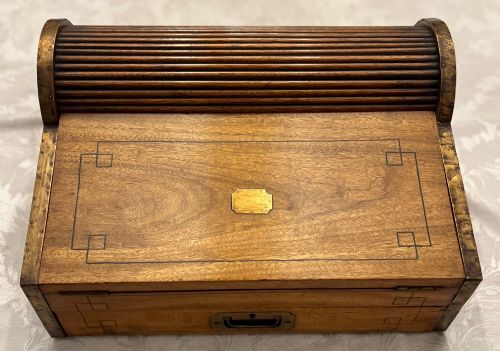


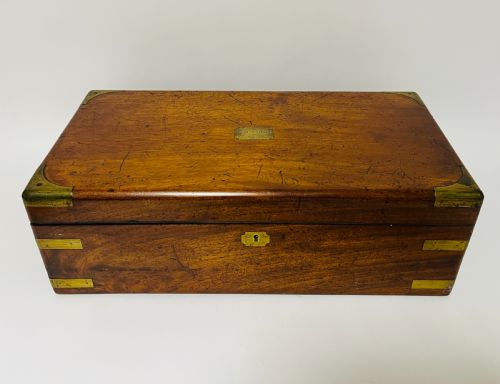


Brass Corner Lap Desk
These brass corner lap desks are portable writing boxes built for travel, offering sturdy timber construction and secure brass corners that collectors prize for their utility and history.
Brass Corner Lap Desk
A brass corner lap desk is a portable writing slope or box designed to hold stationery and provide a sloping writing surface during travel. The form appears primarily across Georgian, 1800, and Victorian periods.
Buyers on this page most commonly encounter Victorian and 19th-century examples fashioned from mahogany, walnut, and camphorwood. These pieces often feature fitted interiors with secret drawers or leather writing surfaces.
The category includes military campaign variations and desk boxes bound in brass to withstand rugged use on the move. Each piece reflects the functional requirements of writing away from a permanent home or office.
How they were made
Cabinet makers constructed these writing boxes using dense timbers such as mahogany, walnut, oak, and camphorwood to endure frequent transportation. These woods were chosen for stability and finished to highlight natural grain patterns.
Corner mounts, braces, and edge bindings made of brass were applied to protect vulnerable joints from impact. Interior compartments incorporated hinged lids, small drawers, and fitted spaces for inkwells and pens.
Brass Corner Lap Desk Retail Price Guide 2026
Typical asking prices for brass corner lap desk among the pieces listed under this phrase on Sellingantiques today, from the lower quarter to the upper quarter. They describe what is for sale here now, not the wider market.
Listings feature woods including mahogany, walnut, figured walnut, camphorwood, and oak across Georgian and Victorian periods.
What varies in quality
Quality rests in the selection of timber figures, such as figured walnut or select mahogany, and the precision of the brass work. Superior examples display tight corner joints, well-fitted internal stationery compartments, and integrated secret drawers.
Maker attribution elevates a piece significantly, as seen in signed boxes by makers like Fisher. The presence of original fitted elements, leather inserts, and uncompromised brass hardware separates standard utility boxes from finer campaign items.
Fisher
The Brass Corner Lap Desk Glossary
- Lap desk
- A portable box designed to rest on the knees or a table, opening to form a sloping writing surface. These pieces contain compartments for paper, ink, and pens.
- Campaign style
- Furniture and writing equipment made for travel, typically featuring recessed brass handles, reinforced corners, and robust timber construction.
- Writing slope
- A box with a hinged lid that opens at an angle to create a comfortable writing plane. Interiors often feature green or black leather panels.
- Secret drawers
- Hidden compartments built behind removable partitions or false bottoms within a desk box. Makers used these to secure valuable documents or currency.
- Brass bound
- Furniture or boxes reinforced along the edges and corners with strips of brass. This technique prevents splitting during transit.
Brass Corner Lap Desk: Frequently Asked Questions
What is a brass corner lap desk?
A brass corner lap desk is a portable wooden box designed for writing while travelling, featuring protective brass corners and a slanted lid that opens to reveal compartments for stationery and ink.
These pieces date largely from the Georgian and Victorian periods, serving officers, travellers, and writers who required a mobile desk setup.
How were these writing boxes used?
Users placed the box on a table or across their knees to write letters, manage accounts, or store important documents securely while away from home.
The interior typically includes slots for pens, inkwells, and paper, alongside hidden compartments for sensitive papers.
How do I tell Victorian from Georgian desks?
Georgian and early 19th-century examples often display simpler, robust lines associated with campaign use, whilst Victorian versions frequently utilise figured walnut and more elaborate internal layouts.
Examining the construction of the interior secret drawers and the thickness of the brass mounts helps determine the approximate period of manufacture.
What woods were used in these desks?
Cabinet makers relied primarily on mahogany, walnut, figured walnut, oak, and camphorwood for their durability and attractive grain.
Camphorwood appears in specific campaign pieces due to its insect-resistant properties, while mahogany and walnut remain the standard choices for domestic writing boxes.