
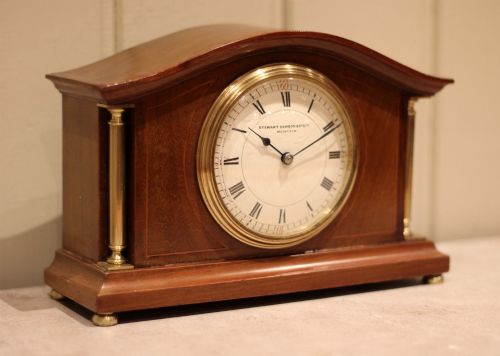
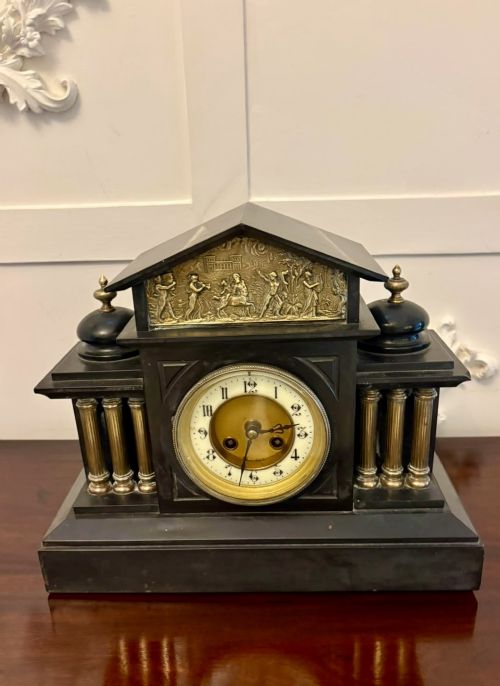
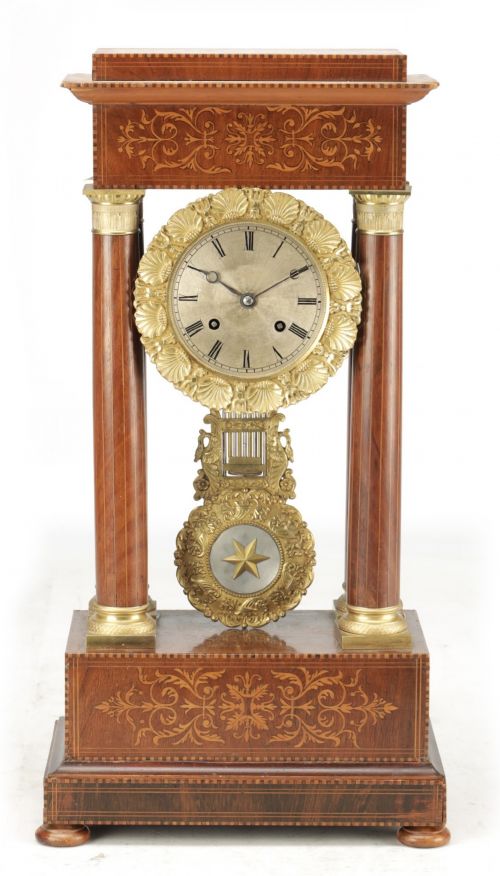


Brass Column Mantel Clock
A brass column mantel clock brings weighty domestic dignity to a room, combining upright structural columns with dependable mechanical timekeeping.
Brass Column Mantel Clock
A brass column mantel clock sits squarely on a surface, using vertical metallic supports to frame the central dial and movement housing. These architectural timepieces draw on nineteenth-century design idioms, spanning the Victorian period through to the Edwardian era.
Most examples encountered here originate from French workshops or British retail establishments, often pairing metal structures with contrasting materials such as marble, slate, or glass. The selection ranges from compact carriage clocks with columnar details to substantial portico designs and architectural mantel clocks.
Makers integrated various classical revival motifs into these pieces, including Corinthian column capitals, gilt bronze accents, and inlaid timber frames. The resulting objects function both as reliable timepieces and as focal points for a mantelpiece or desk.
Materials and construction
Dials were typically formed of white enamel with painted Roman or Arabic numerals, frequently protected behind bevelled glass panes fitted into hinged brass doors. Decorative elements relied on hand-finishing techniques such as engine turning on mask dials, fine wood inlay, and mercury gilding.
Listings incorporate nineteenth-century periods alongside Edwardian eras, uniting slate, marble, mahogany, and gilt brass within architectural mantel forms.
Distinctions in quality
Quality reveals itself in the crispness of the casting around the column capitals and the weight of the bronze or brass used in the case. Finer pieces feature complex movements with striking trains, grand sonnerie functions, or moon-phase complications rather than standard time-only mechanisms.
The integration of materials sets apart better examples, such as cases combining matched marble panels with fire-gilded mounts, hand-painted enamel dial panels, and maker signatures engraved directly onto the backplate of the movement.
Philippes Paris·Baby and Jannings·Mappin and Webb·Clerke Royal Exchange London·A Delépine·Benson 67 Ludgate Hill London
The Brass Column Mantel Clock Glossary
- Portico clock
- A tall, architectural mantel clock featuring four vertical pillars supporting a pediment above the dial. This classical style became popular in nineteenth-century France.
- Carriage clock
- A portable, spring-driven timekeeper fitted with a carrying handle and glass panels on all sides to view the internal mechanism. They were originally designed for travelling.
- Garniture
- A set comprising a central clock accompanied by matching decorative side pieces, such as urns or vases, intended to be displayed together on a mantelpiece.
- Grande sonnerie
- A complex clock movement that strikes both the hours and the quarters automatically on every quarter-hour without requiring a pull repeat cord.
- Fretwork
- Openwork metal or wood ornamentation pierced with patterns, frequently seen on the panels or escape-wheel bridges of better quality carriage clocks.
Brass Column Mantel Clock: Frequently Asked Questions
How do I wind a brass column mantel clock?
Most mechanical clocks use a dedicated winding key inserted into small arbors on the enamel dial face. Turn the key gently until you feel resistance, taking care not to overwind the mainspring.
For clocks with striking mechanisms, ensure you wind both the time side and the strike side fully so the movement remains synchronised.
Where should I place a heavy marble mantel clock?
Position the clock on a sturdy, level surface such as a fireplace mantel, sideboard, or heavy desk capable of supporting substantial stone and metal weight. Avoid placing the piece in areas prone to excessive dampness or direct sunlight.
A stable foundation helps the pendulum swing evenly and keeps the ticking rhythm steady.
How do I tell an Edwardian clock from a Victorian one?
Victorian examples often favour heavy architectural marble, slate cases, and ornate French ormolu mounts dating from the mid to late nineteenth century. Edwardian pieces tend to show lighter construction, frequently utilising inlaid mahogany and simpler proportions.
Examine the overall styling and timber types to determine whether a piece leans towards mid-century revivalism or early twentieth-century domestic restraint.
What is the difference between a timepiece and a striking clock?
A timepiece indicates the hours and minutes only, containing a single train of gears dedicated solely to keeping time. A striking clock includes an additional gear train and hammer to ring out the hours or quarters on a bell or gong.
Look for multiple winding holes on the dial to identify whether a clock includes a striking or chiming function.
Why does my carriage clock have a glass top?
The bevelled glass panel fitted into the top of a carriage clock allows natural light to flood downwards onto the escapement. This design choice let owners view the moving balance wheel and regulator from above.
It also served as an observation window for checking the condition of the delicate platform escapement without opening the outer case.