



Brass Castor Canterbury
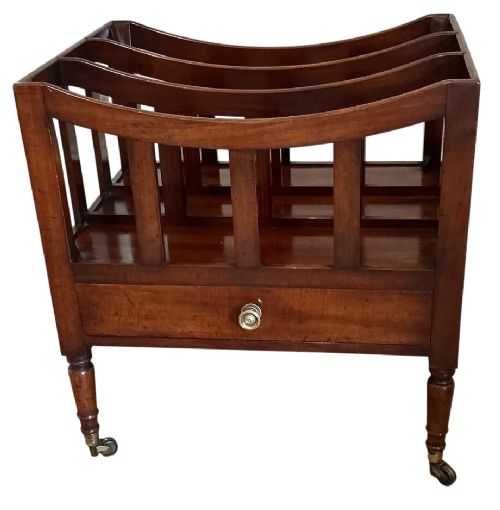
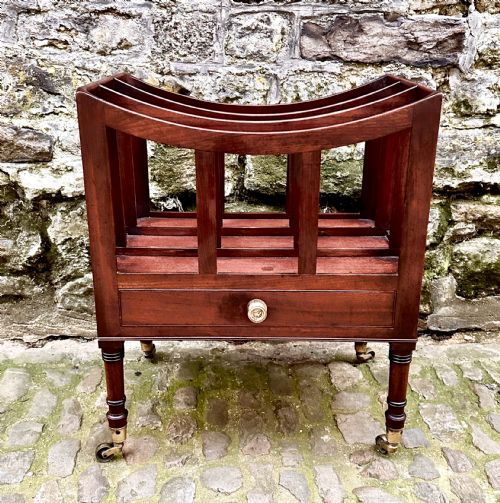
A brass castor canterbury provides a sturdy mobile resting place for sheets, books and newspapers, built with small wheels to move easily across the floor.
Brass Castor Canterbury
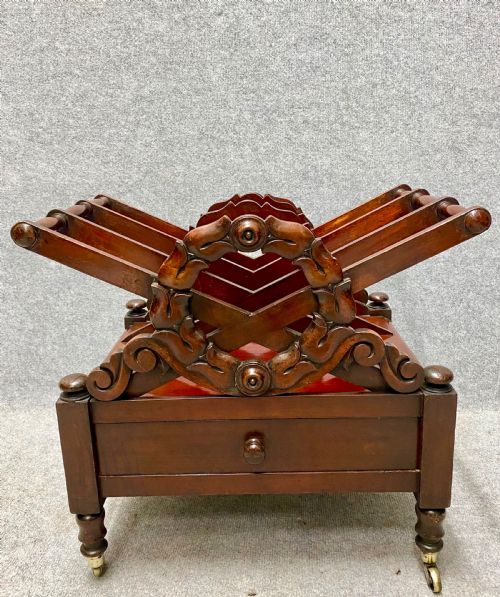
A brass castor canterbury is a compartmentalised stand designed to hold newspapers, magazines, sheet music and folios, sitting upon small metal wheels. The pieces seen on this page span the Regency, George III, Georgian, Victorian and nineteenth century periods.
The forms vary across the selection, taking shape as boat shaped models, traditional dividers, music stands, folio stands and combined what-not designs. Most examples are constructed from mahogany, rosewood or ebonised mahogany, originating from English workshops.
Materials and construction
Cabinet makers utilised dense hardwoods such as mahogany and rosewood to build the slatted partitions and drawer bases of a brass castor canterbury. These timbers were selected for strength and finished with polished surfaces that accentuated the grain.
Small metal wheels known as castors were fitted to the base of the legs, allowing the rack to be wheeled across a carpet or floorboards without lifting.
Some oversized country house variants are large enough to swallow entire newspaper subscriptions in one go.
Judging quality
The distinction between standard examples and finer pieces rests upon the crispness of the timber turning, the solidity of the vertical partitions and the proportion of the frame. Pieces attributed to specific workshops display superior joinery and more refined decorative details.
The use of figured rosewood or rich mahogany alongside well-cast metal fittings marks out the better specimens from simpler utility items.
Gillows of Lancaster·J.C.Loudon
The Brass Castor Canterbury Glossary
- Folio stand
- A large upright rack designed to hold oversized art folios, prints or maps. They frequently share similar mobile bases with canterburys.
- What-not
- A set of open shelves supported by slender pillars, sometimes combined with a canterbury base below. It served to display ornaments and hold reading material.
- Castor
- A small wheel fitted to the foot of a piece of furniture to allow easy movement. They are typically cast in brass on these stands.
Brass Castor Canterbury: Frequently Asked Questions
What is a brass castor canterbury used for?
These stands were originally designed to hold folios, sheet music, newspapers and periodicals near a seating area. The compartments keep paper items upright and sorted.
Today they function effectively as magazine racks or bedside book holders in domestic rooms.
How do I date a canterbury?
Dating relies upon identifying the prevailing style, such as Regency curves or Victorian ebonised finishes, alongside the construction methods used in the partitions. Cabinet making details shifted noticeably across the nineteenth century.
Examining the timber types, like rosewood or early mahogany, also helps narrow down the period of manufacture.
Can these stands hold heavy books?
Most models are structured to hold paper folios, sheet music and weekly journals rather than heavy volumes. The vertical slats are joined to support moderate loads of reading material.
Overloading the compartments can strain the base joinery and the small wheels beneath.
Why do some have wheels?
The brass wheels allowed owners to wheel the stand easily across a parlour or drawing room to wherever reading material was required. This mobility was practical in large period interiors.
It meant the rack could be repositioned without lifting its timber frame.