
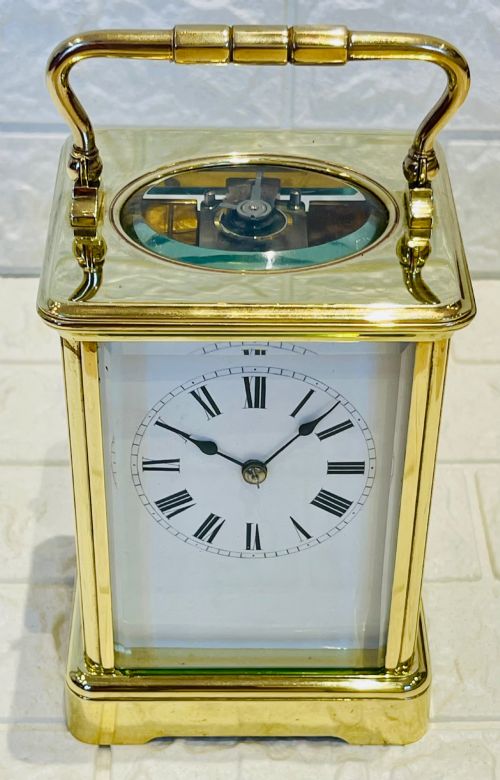


Brass Case Travel Clock
These brass case travel clock examples combine mechanical precision with robust protective housings designed for transit across nineteenth-century Europe.
Brass Case Travel Clock
A brass case travel clock most frequently appears on this page as a French carriage clock produced during the Victorian and Edwardian periods. These portable timepieces range from standard striking models to complex examples featuring alarms, repeaters and grand sonnerie movements.
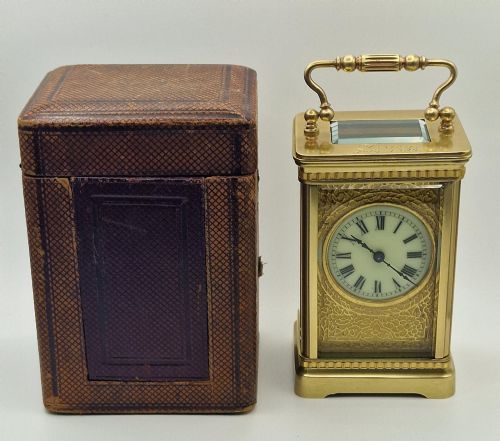
Makers housed these mechanical movements within heavy metal frames fitted with bevelled glass panels to display the escapement. Many retain their original leather travel cases or fitted wooden boxes designed to safeguard the delicate escapement during journeys.
Miniature versions and giant gorge cased pieces appear alongside standard designs, originating from workshops in Paris and London during the nineteenth century. The typical specimen balances utilitarian portability with decorative engraving and gilt brass surfaces.
Materials and construction
Craftsmen built these mechanisms using brass, gilt brass and steel, housing them behind thick bevelled glass panels that allowed the movement to remain visible from multiple angles. Enamel featured heavily on dials and decorative panels, often decorated with delicate hand-painted numerals or floral motifs.
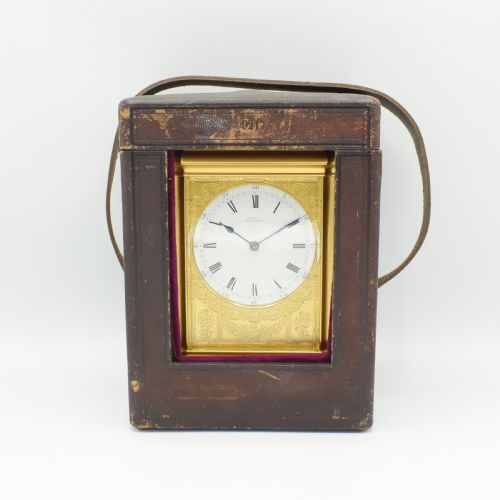
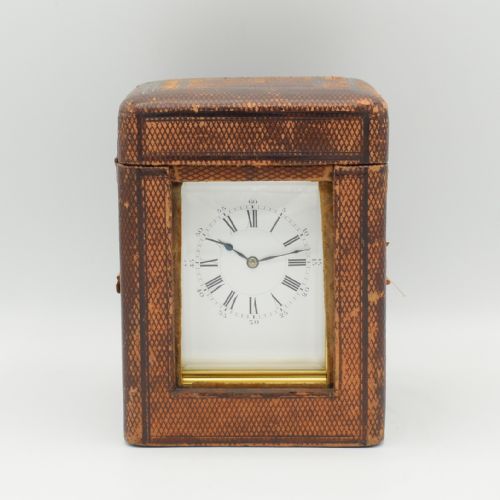
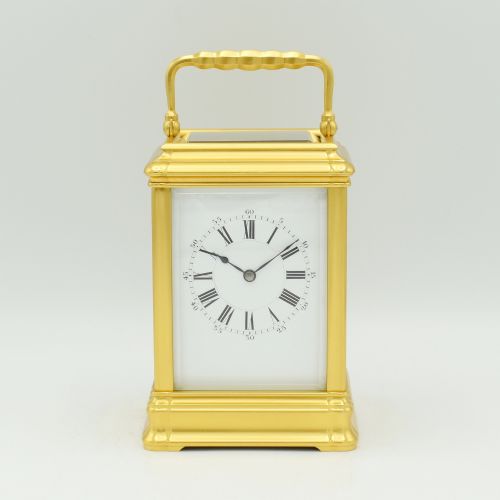
Exterior housings relied on cast and engraved brass or gilded brass, sometimes formed into distinctive gorge cases with stepped mouldings or oval shapes. Makers protected these portable clocks with bespoke leather travel cases lined with velvet or silk to absorb the shocks of horse-drawn carriages and early railways.
Some nineteenth-century travellers relied on a patent alarm mechanism to wake them inside their carriages before dawn broke.
Assessing the craftsmanship
Quality rests upon the complexity of the movement, separating basic timepieces from examples equipped with striking mechanisms, quarter-repeating functions or integrated alarms. The weight of the cast brass case and the depth of the hand-engraving across the gilt surfaces further distinguish superior workshop output.
The presence of an original leather travel case or matching fitted box substantially elevates the completeness of a piece. Finer examples display meticulous attention to detail in the dial enamel and the crispness of the escapement architecture.
Henri Jacot·Drocourt·Margaine·Antoine Redier·Pickford of London
The Brass Case Travel Clock Glossary
- Gorge case
- A distinct rectangular brass case style featuring stepped mouldings at the top and base. This housing is characteristic of finer nineteenth-century portable clocks.
- Carriage clock
- A small, spring-driven portable timepiece designed for officers and travellers. They typically feature a swinging handle on top and glass panels on all sides.
- Striking mechanism
- A gear train that automatically sounds the hours or half-hours on a bell or gong. More complex versions include repeating functions that sound the last hour upon command.
- Petite-sonnerie
- A striking complication that sounds the hours on the exact hour and chimes the quarters at each quarter-hour without repeating the hours. It represents a high level of horological skill.
- Escapement
- The internal mechanism that controls the unwinding of the spring by delivering regular impulses to the balance wheel. It forms the heartbeat of the mechanical movement.
Brass Case Travel Clock: Frequently Asked Questions
What is a carriage clock?
A carriage clock is a portable spring-driven timepiece invented in the nineteenth century for use while travelling. They feature protective brass frames and glass panels so the movement can be seen.
Most include a folding handle on top for carrying and were originally supplied with leather travel cases to withstand the bumps of transit.
How do I wind a brass travel clock?
These clocks use a dedicated key inserted into winding squares on the backplate or underneath the movement. Turn the key gently until resistance indicates the mainspring is fully tensioned.
Care should be taken not to overwind the springs, and direction varies depending on whether the clock drives time, strike or alarm trains.
What is the difference between a time-only and a striking clock?
A time-only clock simply records the hours and minutes without producing sound. Striking models contain an additional gear train and a bell or gong to announce the passage of time.
More advanced versions also incorporate repeating mechanisms or alarms that can be set using an auxiliary hand on the dial.
Why do some clocks have leather cases?
The original leather travel cases were designed to protect the delicate escapement and polished brass surfaces from dust and impact during journeys. Finding a clock with its matching case preserves its historical context and completeness.
These outer cases are often lined with velvet or silk and fitted with small compartments for the winding key.