
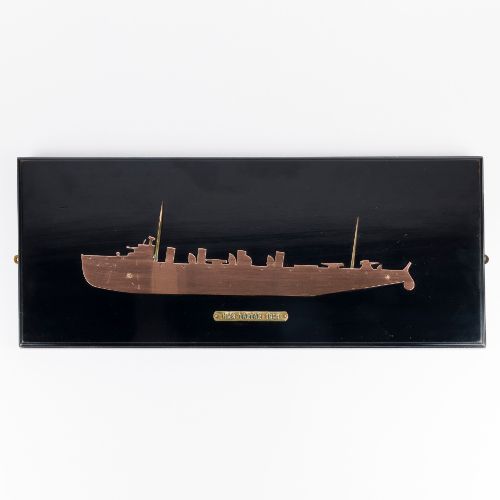


Brass and Copper Plaque
These brass and copper plaque pieces range from heavy repousse chargers to small eighteenth-century enamel insets, chosen for their metalwork and decorative depth.
Brass and Copper Plaque
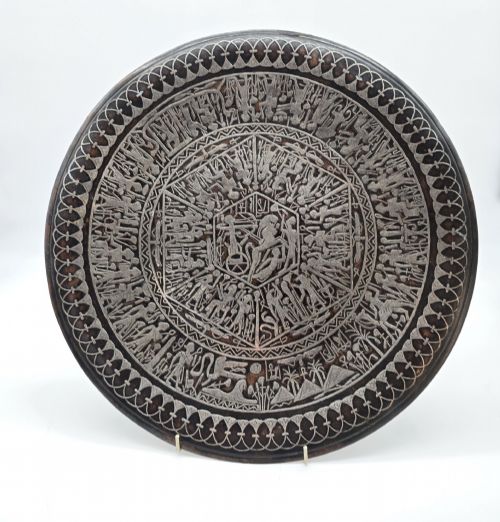
A brass and copper plaque encompasses wall chargers, decorative dishes, and inset panels worked in mixed metals across several centuries. The selection leans heavily toward nineteenth-century Egyptian Cairo Ware, Raj period Indian chargers, and Japanese mixed-metal dishes alongside earlier enamel pieces.
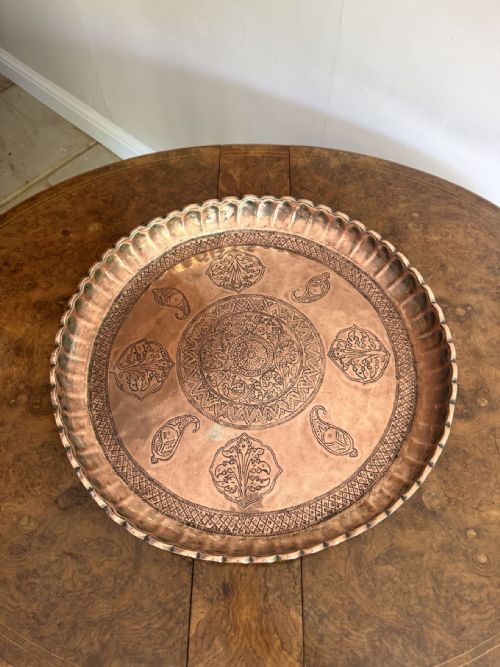
Forms vary from circular wall plaques and trays to rectangular snuff box lids and oval enamel plaques. Buyers often encounter large repousse wall chargers and hammered trays bearing animal motifs or classical scenes.
Origins stretch from eighteenth-century South Staffordshire workshops to Meiji period Japan and Edwardian Britain. Each piece serves primarily as wall art or a decorative display dish utilising the contrast between warm copper and bright brass.
How they were made
Maker techniques rely on repousse hammering, hand piercing, and mixed-metal inlay to build surface texture. Artisans raised designs from the reverse of copper and brass sheets before refining the details from the front with chisels and punches.
Enamel work appears on copper bases, particularly in eighteenth-century plaques and snuff box lids where vitreous colours were fused to the metal. Silver and other metals are occasionally inlaid into the copper ground, as seen in Cairo Ware and Japanese Komai style pieces.
A solitary fire extinguisher from nineteen twenty stands guard among the wall plaques and chargers.
What varies in quality
The distinction between ordinary and exceptional metalwork lies in the crispness of the hand hammering and the depth of the repousse relief. Fine examples show careful attention to facial expressions, drapery, and animal motifs without mechanical shortcuts.
Surface preservation and the integrity of mixed-metal inlays dictate the standing of a piece. Pieces retain their character best when cleaning has not erased the original tool marks and patination built up over the centuries.
The Brass and Copper Plaque Glossary
- Repousse
- A metalworking technique where the artisan hammers the design from the reverse side to create a raised relief on the front. This method allows for sculptural depth on wall chargers and plaques.
- Cairo Ware
- Metalwork produced in Egypt, typically featuring brass inlaid with silver and copper in complex Islamic geometric or calligraphic patterns. These items were popular souvenirs during the Grand Tour period.
- Cloisonne
- An enamelling technique where thin metal wires are soldered to a metal base to create compartments which are then filled with coloured enamel paste and fired. Japanese examples frequently depict natural subjects such as shrimp and flora.
- Charger
- A large ornamental dish or plate intended for display on a wall or sideboard rather than for dining. They provide a broad canvas for elaborate hammered or engraved decoration.
- Komai Style
- A method of decorating iron or copper surfaces with delicate gold and silver inlays, named after the Kyoto metalworkers who perfected the technique during the Meiji period.
Brass and Copper Plaque: Frequently Asked Questions
How do I hang a heavy charger?
Heavy wall chargers require a secure picture wire or a specialised bracket that supports the rim evenly without straining the metal body.
Ensure the fixing enters solid masonry or a wall stud to bear the weight safely over time.
How should I clean copper and brass?
Dust gently with a dry microfibre cloth and avoid harsh chemical dips that strip away the aged patination.
Aggressive polishing ruins the subtle dark recesses created by the original maker's punches.
What is Cairo Ware?
Cairo Ware refers to nineteenth-century metalwork from Egypt featuring heavy brass inlaid with silver and copper.
These pieces were collected by European travellers on the Grand Tour for their intricate geometric and arabesque designs.
How do I date a hammered plaque?
Dating relies on the style of the motif, the method of edge finishing, and the specific composition of the metal alloys.
Nineteenth-century examples often show machine-rolled sheet brass combined with hand chasing, whereas eighteenth-century enamel plaques use distinct copper blank preparation.
Can I display these pieces outdoors?
These decorative items are intended for indoor environments where temperature and humidity remain relatively stable.
Moisture causes active corrosion and pits the delicate copper and brass surfaces.