



Boxed Silver Condiments
Boxed silver condiments are fitted dining sets housed in custom presentation cases that bring formal Victorian and Art Deco tables together with utilitarian elegance.
Boxed Silver Condiments
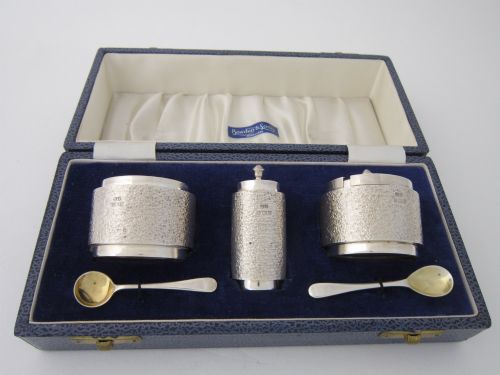
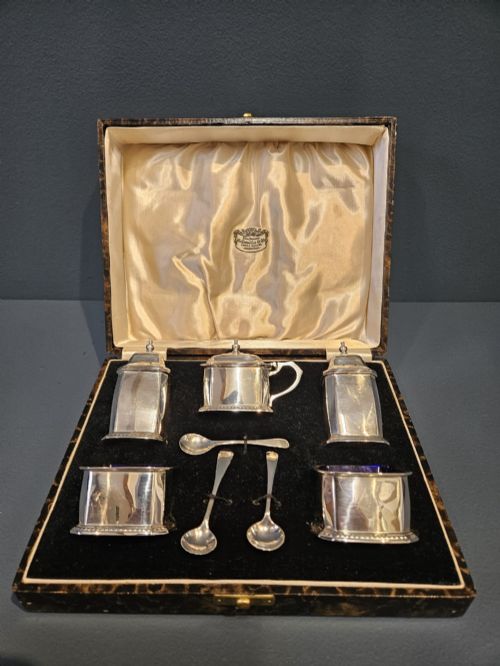
When you search for boxed silver condiments, you encounter matched groupings of salt cellars, pepper pots, mustard pots, and specialised spoons resting in tailored compartments. These ensembles span the Victorian, Edwardian, and mid-century periods, capturing shifts in domestic dining habits over more than a century.
The most common versions on this page are Victorian three-piece condiment sets and cruet sets housed in fitted wooden boxes lined with silk or velvet. Alongside these standard table settings, you will find specialised butter dishes, hors d'oeuvres forks with mother-of-pearl handles, and Art Deco geometric designs from the 1930s and 1940s.
Materials and Construction
Silversmiths formed the condiment vessels primarily from sterling silver, employing techniques of casting, spinning, and hand-piercing to create decorative pierced galleries and sturdy bodies. Many open salt cellars incorporate fitted glass liners to protect the silver from the corrosive nature of table salt.
The protective cases themselves utilise robust wooden foundations wrapped in leather, leatherette, or textured cloth. Interiors are carefully fitted with moulded inserts upholstered in silk, satin, or velvet to cradle each silver piece and prevent movement during storage.
Boxed Silver Condiments Retail Price Guide 2026
Typical asking prices for boxed silver condiments among the pieces listed under this phrase on Sellingantiques today, from the lower quarter to the upper quarter. They describe what is for sale here now, not the wider market.
Victorian diners required an astonishing variety of miniature spoons just to manage their salt, ensuring that losing one tiny utensil caused immediate domestic panic.
Evaluating Quality and Craftsmanship
Quality in these sets depends upon the weight and gauge of the sterling silver used for the vessels and spoons, alongside the integrity of the original fitted case. Thicker gauge silver resists dents and maintains crisp detailing on embossed or chased decorative borders.
The degree of completeness significantly influences the tier of a set, particularly when all original matching spoons and glass liners remain intact. Furthermore, the condition of the interior silk or velvet lining and the exterior leather housing indicates how well the presentation box has protected its contents.
Wilmot Manufacturing Co·Mappin & Webb
The Boxed Silver Condiments Glossary
- Cruet set
- A matched collection of containers for holding condiments such as oil, vinegar, salt, pepper, and mustard at the dining table. In later periods, this term often describes boxed sets of open salts, pepper pots, and mustard pots.
- Open salt
- A small cellar designed to hold loose table salt, intended to be used with a miniature spoon rather than shaken. These frequently feature removable blue glass liners.
- Sterling silver
- An alloy of silver containing 92.5 percent silver and 7.5 percent other metals, usually copper, ensuring durability for functional tableware. British pieces typically carry full sets of hallmarks confirming this standard.
- Mother-of-pearl
- The iridescent internal layer of mollusc shells, utilised for decorative handles on hors d'oeuvres forks and butter knives found in dining sets. It provides a tactile, pale contrast to the polished metal.
- Leatherette
- A synthetic material designed to imitate leather, commonly utilised for the exterior covering of presentation cases from the Edwardian period onward.
Boxed Silver Condiments: Frequently Asked Questions
What is included in a typical set?
A standard set generally comprises open salt cellars with matching spoons, pepper pots, and occasionally a mustard pot with its own tiny spoon. Many formations also include custom glass liners designed to fit snugly inside the silver bodies.
These components rest securely within a tailored presentation box, often accompanied by specialised serving implements like butter knives or hors d'oeuvres forks depending on the specific dining purpose.
How do I date these silver pieces?
English silver carries a series of hallmarks stamped directly onto the metal, including a leopard's head for London, an anchor for Birmingham, and a specific letter stamp that denotes the exact year of assay. Examining these tiny stamped marks provides the most reliable method for determining manufacture dates.
Stylistic cues also help narrow down the era, such as heavy embossed floral motifs on Victorian examples or clean geometric lines on Art Deco pieces from the 1930s.
How were these sets used originally?
Victorian and Edwardian households placed these matched cruet sets on the dining table or sideboard so guests could season their food during formal meals. Open salts required diners to use the tiny accompanying spoons to transfer salt to their plates rather than pinching it.
Specialised sets containing butter dishes or hors d'oeuvres forks were brought out during afternoon tea or specialised course servings, keeping delicate items protected in their custom cases between uses.
How should I care for silver in presentation boxes?
Silverware benefits from gentle cleaning with a specialised polish only when tarnishing becomes heavy, avoiding any abrasive cloths that might wear down engraved details. Keep the pieces dry and free from moisture to protect both the metal and the delicate silk or velvet box linings.
Store the items in a stable environment away from direct sunlight and damp conditions to preserve the structural integrity of the leather or leatherette exterior cases.