
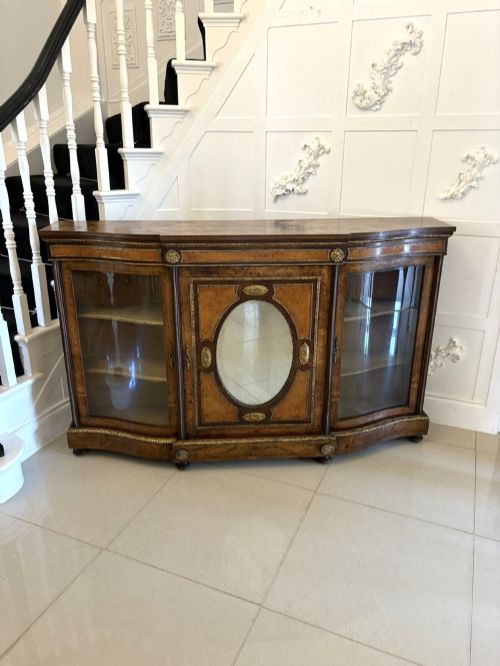
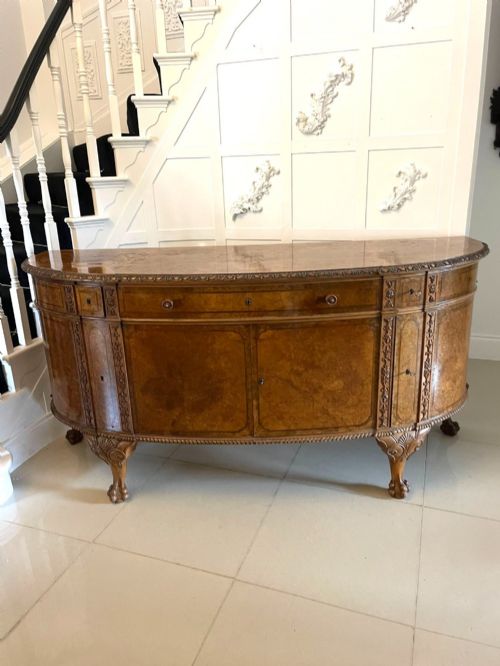


Bowfront Walnut Sideboard
A bowfront walnut sideboard brings rich grain and curved form to a room, offering practical storage with distinct period character.
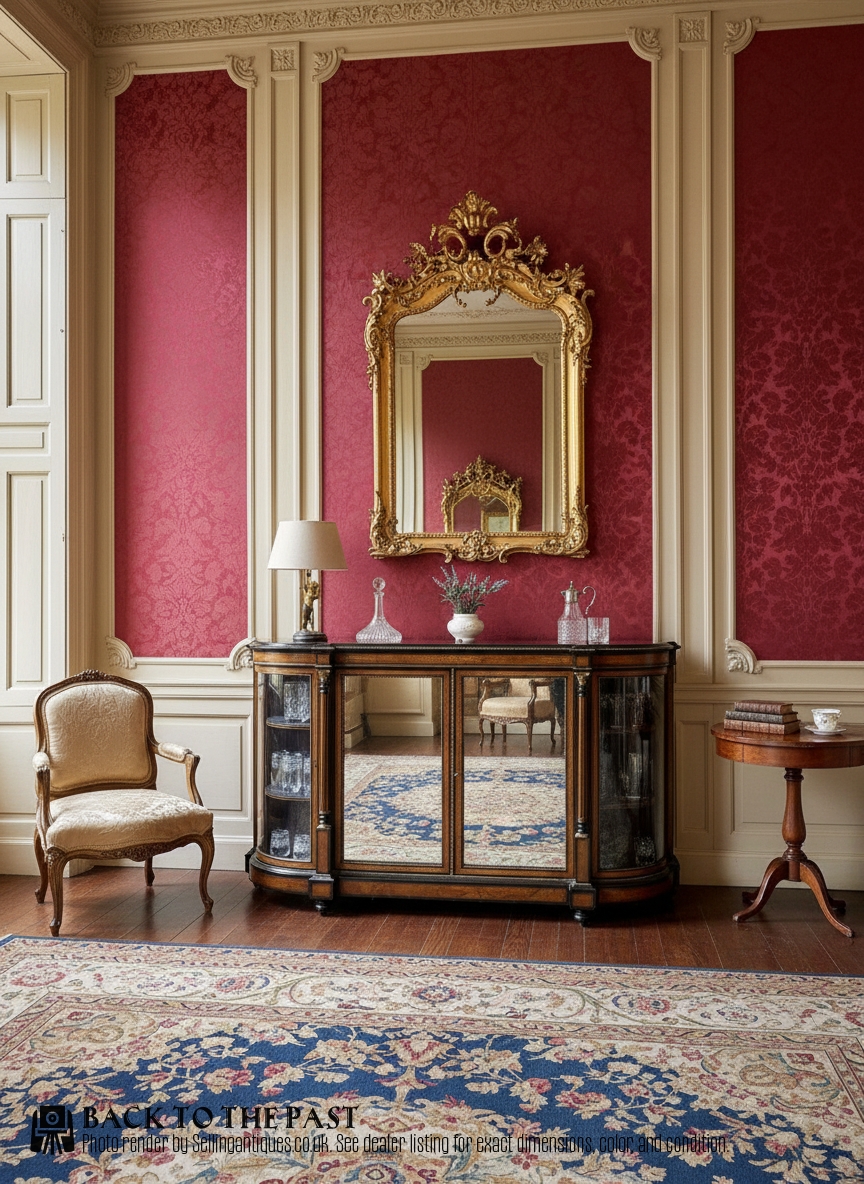
Bowfront Walnut Sideboard
When you search for a bowfront walnut sideboard, you encounter case pieces defined by a convex curving front and dark timber surfaces. The items gathered here span the eighteenth, nineteenth, and early twentieth centuries, drawing on Victorian, Georgian, and French Provincial styles.
The selections on this page lean heavily toward Victorian burr walnut examples and credenzas with glazed or inlaid doors. Alongside traditional sideboards, you will find related forms such as commodes and side cabinets that share the characteristic curved profile and walnut construction.
How they were made
Cabinetmakers constructed these pieces using solid walnut and decorative burr walnut veneers applied to secondary timbers to create striking grain patterns. Marquetry inlay, often featuring floral or geometric motifs, decorates the surfaces of many Victorian and revival examples.
Mounts and hardware in cast or gilt ormolu and brass accent the timber frames, while glass panels and mirrors appear in doors and backsplashes. Skilled joinery allowed craftsmen to bend timber and shape the complex convex curves characteristic of the bowfront design.
Periods represented span from the eighteenth century through the Victorian era up to nineteen-twenty.
What varies in quality
The standard of a piece rests on the choice of timber and the precision of its veneer work. Highly figured burr walnut with matching grain across drawer fronts and doors commands greater attention than plain stock.
Execution of inlay, crispness of carved details, and the quality of brass or ormolu mounts elevate certain items above standard production. The integration of curved glass and the stability of the bowfront structure further distinguish superior examples.
The Bowfront Walnut Sideboard Glossary
- Burr walnut
- A prized timber harvested from walnut tree growths, showing swirling, knotty grain patterns. It is sliced into veneers to adorn the principal surfaces of fine furniture.
- Bowfront
- A curved furniture front that bulges outward in the centre in a convex sweep. This shape softens rigid room lines and requires advanced cabinetmaking skill.
- Ormolu
- Gilt bronze ornamentation applied to furniture mounts and feet. It provides a bright metallic contrast against dark walnut surfaces.
- Marquetry
- Decorative patterns formed by fitting small pieces of veneer into a scored background. Craftsmen utilise different woods to create pictorial or abstract designs.
- Credenza
- A low cabinet, often enclosed by doors, originating as a side table for serving or displaying valuables. Victorian versions frequently incorporate glazed central sections and curved ends.
Bowfront Walnut Sideboard: Frequently Asked Questions
How do I date a walnut sideboard?
Dating relies on examining construction methods, secondary woods, and stylistic details such as inlay and mount design. Georgian, Victorian, and later revival periods each employ distinct hardware and assembly techniques.
Comparing the primary timber figure and decorative motifs with documented period pieces clarifies the era of manufacture.
Where were these sideboards placed originally?
These cabinets stood primarily in dining rooms to hold silver, linen, and glassware. They also served in reception rooms for display purposes.
Their decorative fronts and finished backs allowed them to occupy prominent wall spaces where guests could admire the timber.
How should I care for burr walnut?
Burr walnut requires stable indoor humidity levels and protection from direct sunlight to prevent veneer cracking and fading. Regular dusting with a soft, dry cloth preserves the polished finish.
Avoid placing items with high moisture or heat directly onto the timber surface.