

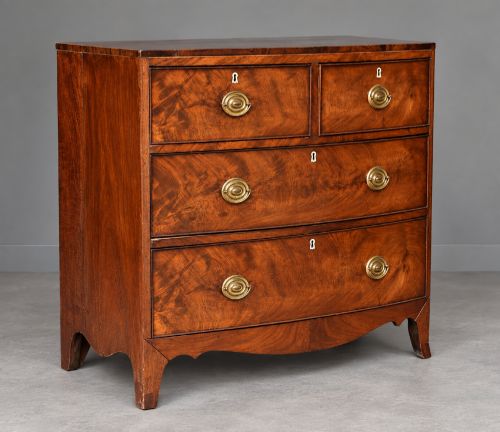
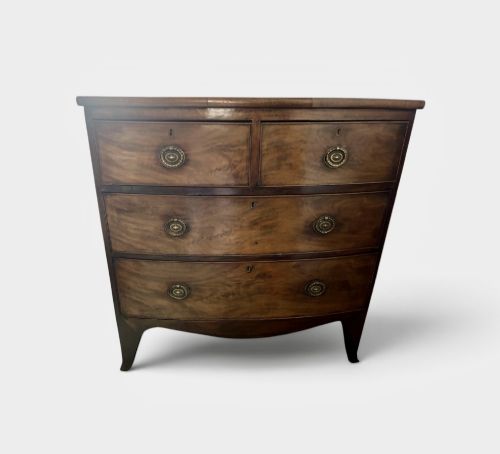

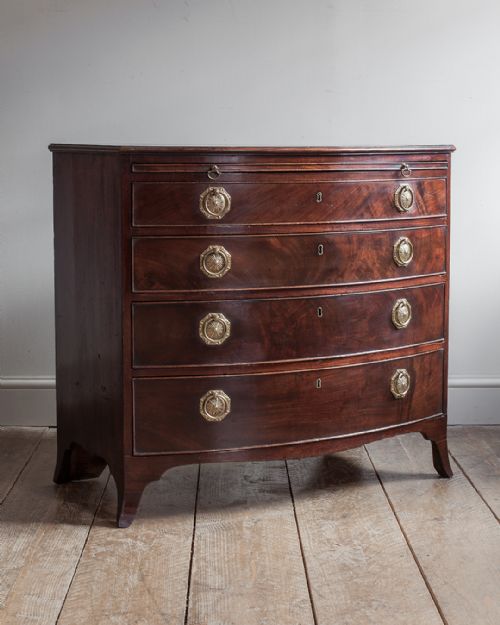
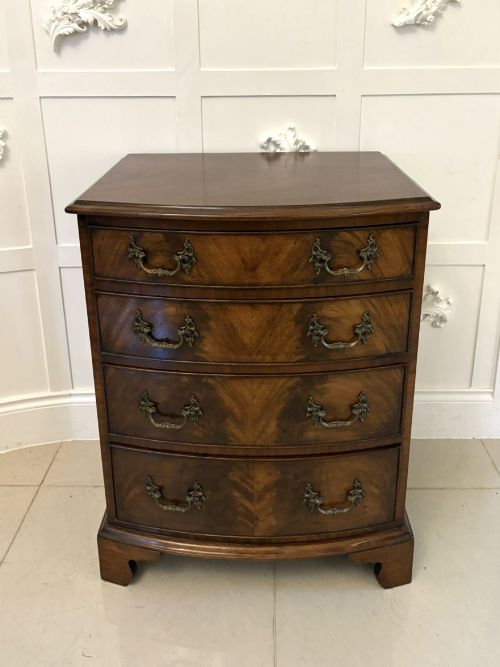
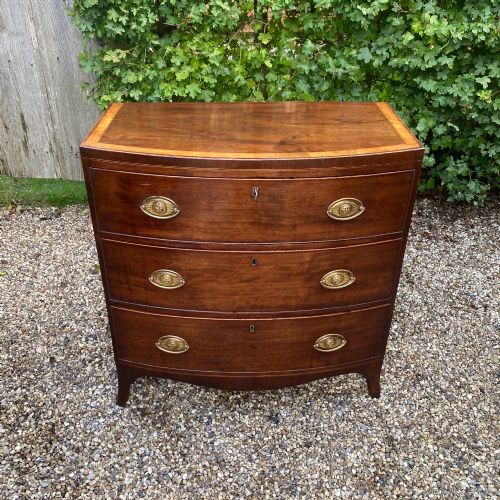
Bowfront Bedroom Drawers
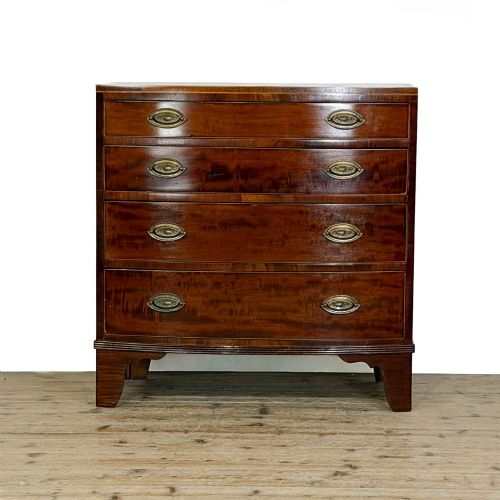
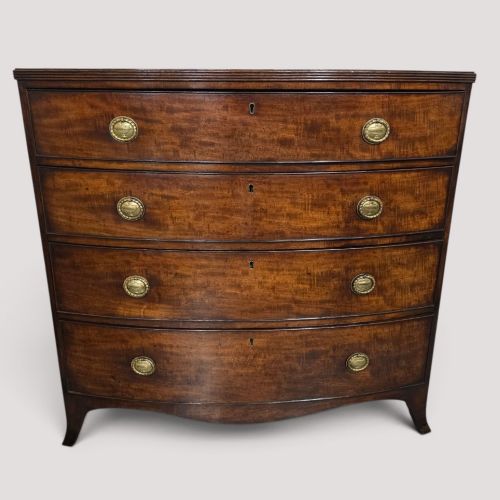
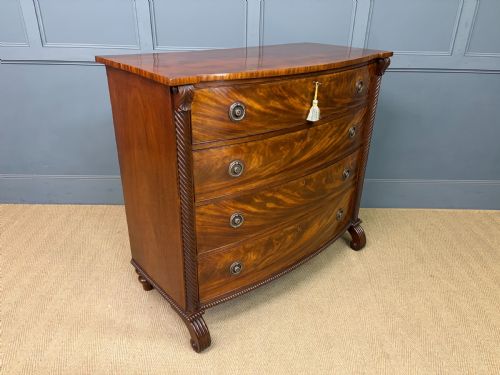
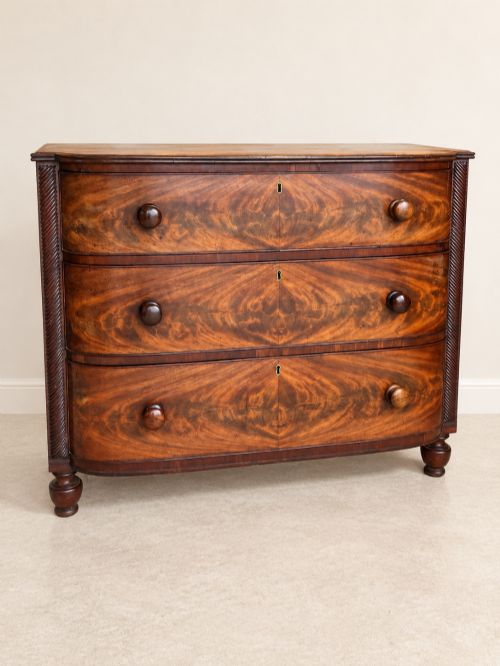
Bowfront bedroom drawers bring curved fronts and generous storage to a room, offering Georgian, Regency, and Victorian elegance.
Bowfront Bedroom Drawers
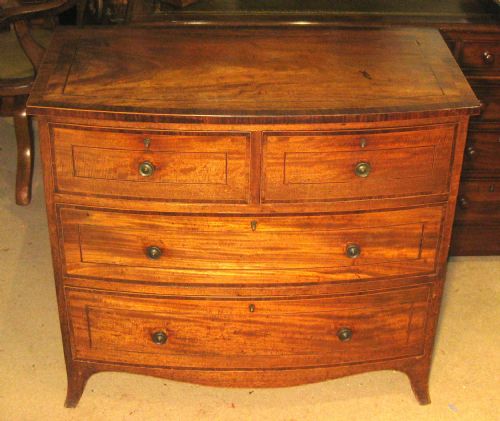
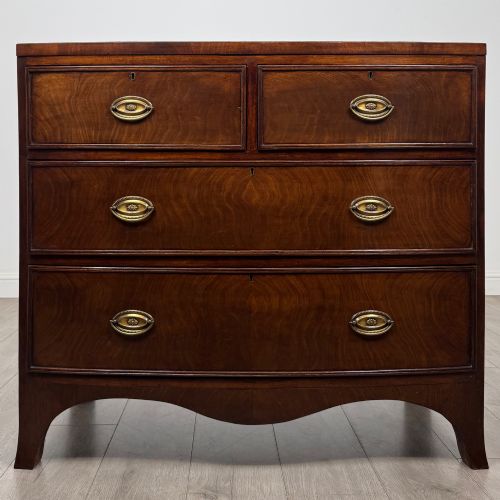
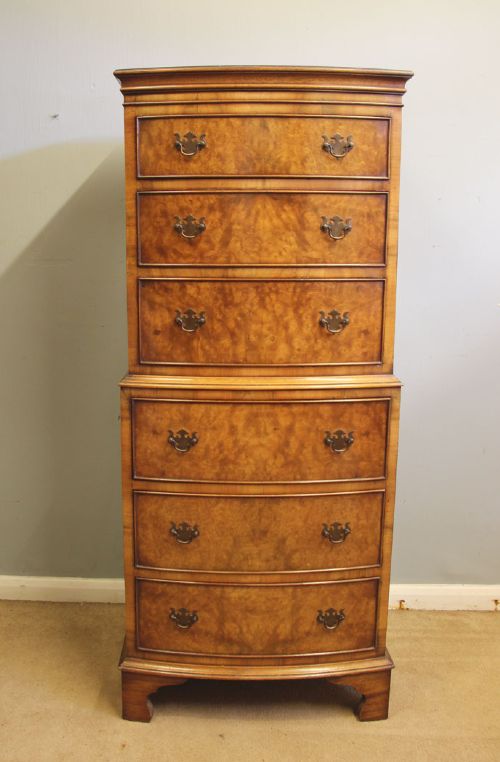
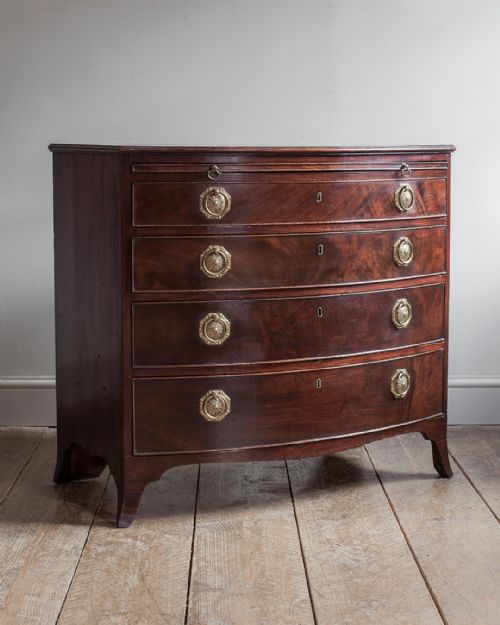
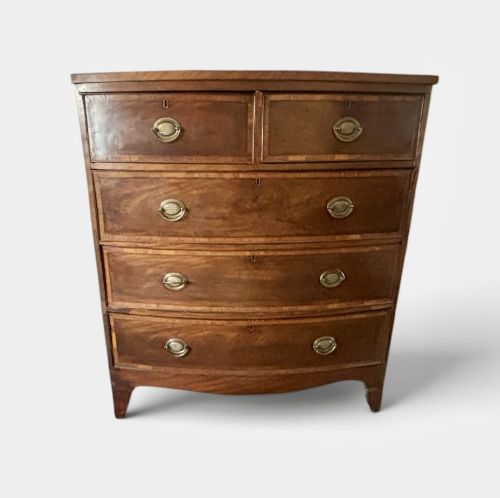
Mahogany and flame mahogany veneer dominate the listings, frequently paired with smaller chests and occasional satinwood banding or burr walnut finishes. Pieces range from compact small proportions to larger five-drawer formats and towering chest-on-chest constructions.
Regional variations appear in Scottish and Welsh examples, while revival pieces from the 1920s and 1930s replicate earlier Georgian and Regency designs. Buyers most commonly encounter nineteenth-century mahogany chests with graduated drawers and brass hardware.
Materials and Construction Techniques
Cabinetmakers utilised solid mahogany and pine carcasses overlaid with figured mahogany or flame mahogany veneer to achieve the characteristic curved drawer fronts. Crossbanding and satinwood stringing provide contrasting borders around the main drawer faces and top edges.
Drawer construction relies on hand-cut dovetails and solid oak or pine secondary timbers inside the carcase. Brass handles and escutcheons secure the drawer fronts, often matching the specific period of manufacture from the eighteenth to the twentieth century.
Listings feature woods including mahogany, flame mahogany veneer, satinwood, burr walnut, oak, pine, and brass across eight periods.
Markers of Quality and Execution
Quality rests in the selection of timber figure, where highly figured flame mahogany or burr walnut veneer displays deep natural grain patterns across the curved drawers. The crispness of satinwood crossbanding and the integration of secret drawers or caddy tops further separate standard pieces from superior examples.
Proportion and scale dictate desirability, with neat small proportions commanding attention alongside taller chest-on-chest configurations. The preservation of original brass hardware and the precision of the curved drawer joints indicate superior cabinetmaking skill.
The Bowfront Bedroom Drawers Glossary
- Bowfront
- A convex curved cabinet front that projects outward in an arc. This shape defines the primary profile of these chests and wardrobes.
- Flame mahogany
- A veneer cut from the branch junction of a mahogany tree to produce a dramatic feather-like grain pattern. Cabinetmakers placed this timber on prominent drawer fronts.
- Crossbanding
- A narrow strip of veneer laid perpendicular to the grain of the surrounding wood. It creates a contrasting border around the edge of a top or drawer.
- Caddy top
- A raised or moulded table top with stepped edges reminiscent of tea caddy lids. It appears on select early nineteenth-century chests.
- Graduated drawers
- A set of drawers that decrease in depth from bottom to top. This arrangement maintains visual balance on case furniture.
Bowfront Bedroom Drawers: Frequently Asked Questions
How do I style bowfront bedroom drawers?
Place a chest against a flat bedroom wall to let the curved projection catch the light and define the space. Keep surface styling minimal with a simple mirror or tray to preserve the timber grain.
Pair the piece with neutral walls to allow the mahogany or walnut tones to stand out as the primary focal point.
Are these drawers suitable for modern clothes storage?
The deep internal capacity of nineteenth-century and Georgian chests accommodates folded garments and daily bedroom items easily. Graduated drawer depths allow for the organisation of bulkier items at the bottom and smaller garments at the top.
Check the internal drawer dimensions and runner condition to ensure smooth daily operation for modern use.
How do I tell Regency from Victorian pieces?
Regency pieces often display refined satinwood banding, delicate brass ring handles, and slimmer proportions dating from the early nineteenth century. Victorian examples tend to feature heavier proportions, darker finishes, and distinct mahogany or walnut veneers.
Examine the secondary timbers and construction methods inside the drawers for further clues regarding the manufacturing era.
What is a chest on chest?
A chest on chest, or tallboy, consists of a smaller upper chest stacked directly upon a larger lower base section. This vertical configuration provides substantial storage capacity while occupying a compact floor footprint.
Examples appear in mahogany and burr walnut across eighteenth and twentieth-century periods.