

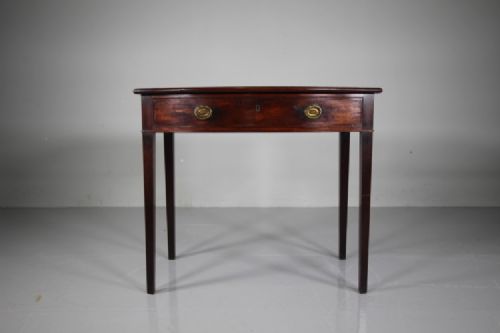


Bow Fronted Hall Table
A bow fronted hall table brings a curved, space-saving profile to a narrow passage, pairing practical surface space with refined period character.
Bow Fronted Hall Table
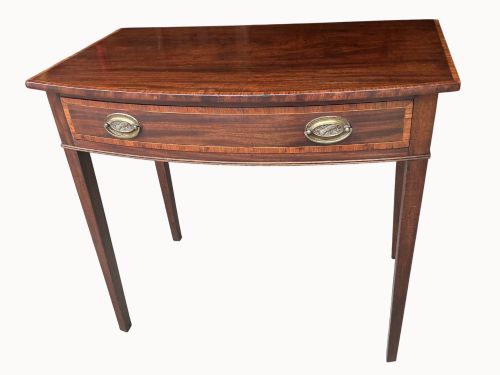
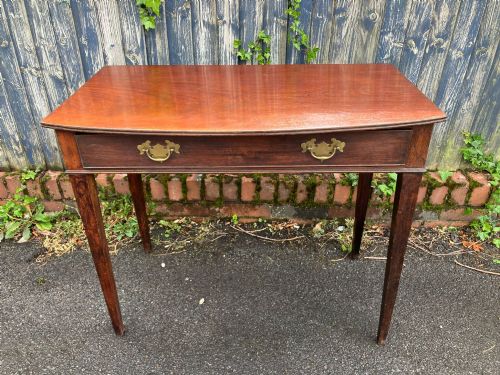
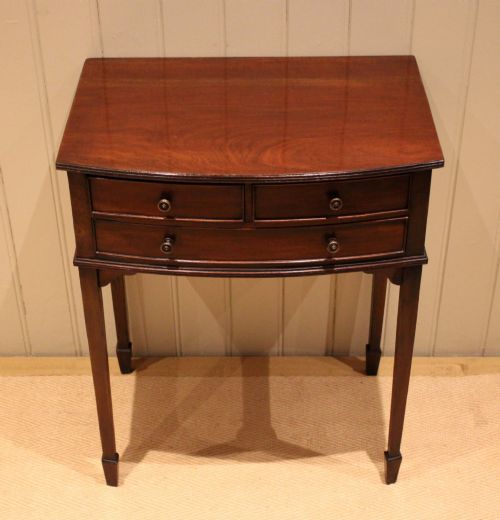
A bow fronted hall table is a slender, curved-front surface designed for narrow spaces like hallways, passages, and compact reception rooms. The pieces appearing here span Georgian, Regency, Victorian, and Edwardian periods, alongside later revival interpretations.
Makers adapted these forms across various furniture types, appearing frequently as side tables, console tables, and dressing tables, as well as occasional compact sideboards. Their defining characteristic is the convex curved front that softens the linear geometry of a hallway.
Most examples rely on mahogany as the primary timber, sometimes enhanced with flame mahogany veneer, burr walnut, or pitch pine. They range from simple single-drawer variants to more elaborate inlaid designs featuring boxwood stringing and brass hardware.
How they were made
Cabinet makers constructed these curved fronts using solid hardwoods or applied veneers over secondary timbers, often incorporating oak linings within the drawer construction. Bending timber or cutting curved rails required precise carpentry to ensure the convex sweep remained structurally stable over time.
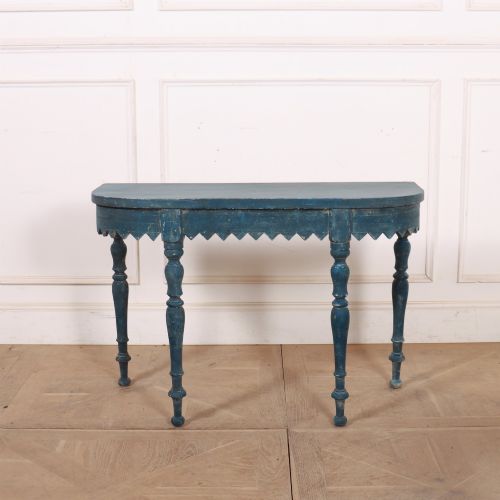
Surface ornamentation relied heavily on timber selection, utilising the natural grain patterns of mahogany and burr walnut, sometimes complemented by boxwood stringing or painted finishes. Brass handles, knobs, and occasional escutcheons provided functional contrast to the dark polished woods.
Listings feature mahogany predominantly, alongside accents of boxwood, brass hardware, burr walnut, and painted pine finishes.
What varies in quality
Quality rests in the fluidity of the curved front and the precision of the joinery where the curved rails meet the legs. Superior examples display seamless timber matching across the bow, whereas lesser pieces show disjointed grain patterns or heavy secondary repairs.
The choice of materials distinguishes fine cabinet work from utilitarian production, with figured flame mahogany veneer and intricate boxwood inlay marking out the better workshops. Drawer construction also reveals standards of execution, particularly in the hand-cut dovetails and the thickness of the internal oak linings.
George III·Hepplewhite
The Bow Fronted Hall Table Glossary
- Bow front
- A convex, outward-curving front profile typical of certain chests and tables. This shape softens the corners of a piece and helps it fit into narrow spaces without catching shoulders in a hallway.
- Console table
- A table designed to stand against a wall, frequently supported by wall brackets or distinct legs. In older interiors, they served primarily for display rather than heavy storage.
- Stringing
- Thin inlay lines of contrasting wood used to outline drawers and tabletops. Boxwood was a popular choice for this decorative banding on mahogany furniture.
- Flame mahogany
- A veneer cut from timber where the branches join the trunk, producing a distinctive flickering flame pattern. Cabinet makers reserved this expensive cut for the most prominent surfaces.
- Demilune
- A half-moon or semicircular shape used for tabletops and console designs. This geometry allows the piece to sit flush against a wall while projecting a curved edge into the room.
Bow Fronted Hall Table: Frequently Asked Questions
Where should I place a bow fronted hall table?
These tables find their natural home in narrow hallways, entrance passages, and compact landings where standard rectangular furniture might block movement. The curved front minimises sharp corners in confined spaces while offering a convenient surface for post, keys, or a decorative lamp.
They also function well in sitting rooms or dining spaces as console or serving surfaces. Their shallow depth allows them to hug the wall without dominating the floor plan.
How do I distinguish Georgian from later revival pieces?
Examining the timber, construction methods, and secondary woods helps separate original 18th-century pieces from Edwardian or 1920s revivals. Original Georgian examples often feature hand-cut dovetails, distinct patination on the mahogany, and oak or pine secondary linings that show genuine age.
Revival pieces from the early twentieth century tend to have cleaner, more uniform machine finishes and standardised interior elements. Comparing the drawer construction and hardware fixings usually clarifies the true period of manufacture.
Do these tables offer useful storage?
Many variants incorporate one, two, or three frieze drawers beneath the top surface, designed for small domestic items. While the curved front can slightly limit internal drawer depth, they remain practical for organising correspondence, gloves, or table linens.
Some unusual Victorian or Edwardian variations include lift-up lids or deeper cabinet spaces configured for specialised storage. Assessing the drawer depth helps determine whether a specific piece suits your storage needs.
How do I care for mahogany surfaces?
Maintenance requires little more than regular dusting with a soft, dry cloth to prevent grit accumulation on the polished finish. Avoiding direct sunlight and extreme humidity fluctuations protects the timber veneers and prevents the wood from drying out or warping.
Applying a modest coat of quality beeswax periodically nourishes the grain and preserves the depth of the polish. Avoid modern silicone sprays, as they build up residue and dull the antique finish over time.