

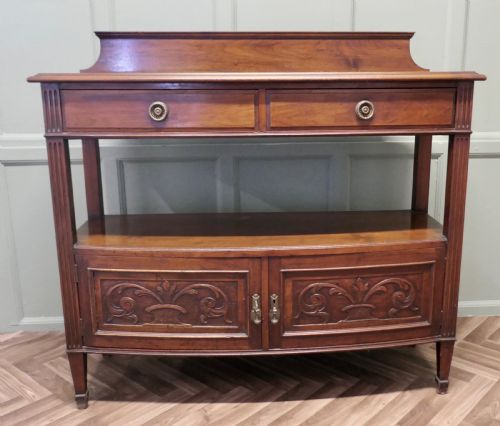


Bow Front Walnut Sideboard
A bow front walnut sideboard is a striking dining room centrepiece shaped with a curved sweeping front and rich timber figuring.
Bow Front Walnut Sideboard
When you search for a bow front walnut sideboard, you encounter formal dining room furniture designed to store silver, linen and serving dishes while displaying the decorative grain of the wood. The examples found here span several distinct eras, moving from eighteenth century provincial commodes and early nineteenth century Georgian dressers through to elaborate Victorian credenzas and later twentieth century cocktail cabinets.
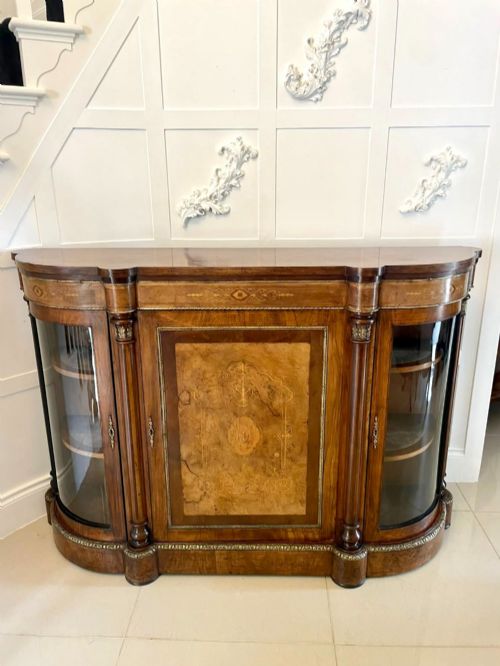
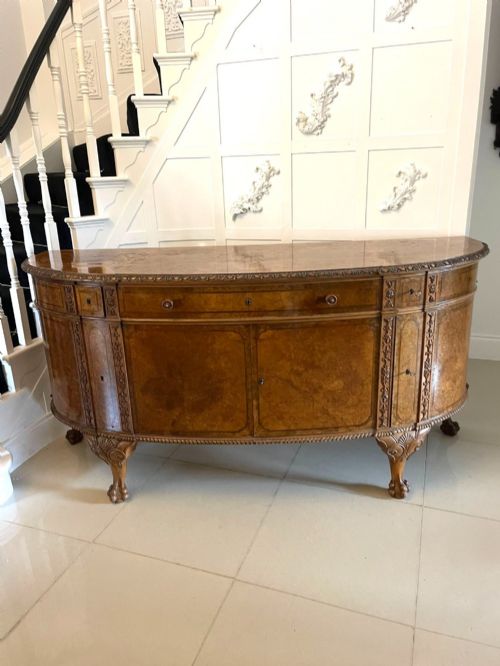
The version you are most likely to meet on this page is the Victorian burr walnut sideboard or credenza, often featuring curvilinear forms and rich cabinetwork. These pieces combine deep brown walnut and highly figured burr veneers with functional enclosed storage spaces behind panelled or glazed doors.
How they were made
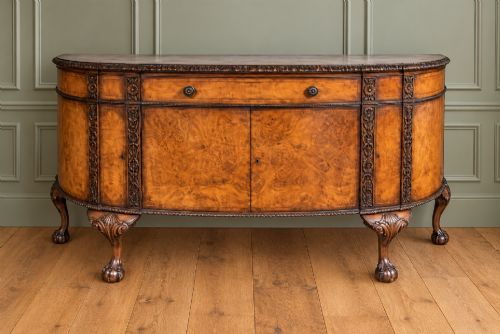
Cabinetmakers constructed these pieces using solid hardwood frames faced with finely sliced burr walnut veneers to create striking symmetrical patterns across the curved drawer fronts and doors. The sweeping bow front shape required precise steaming and laminating techniques to bend timber evenly without buckling the grain.
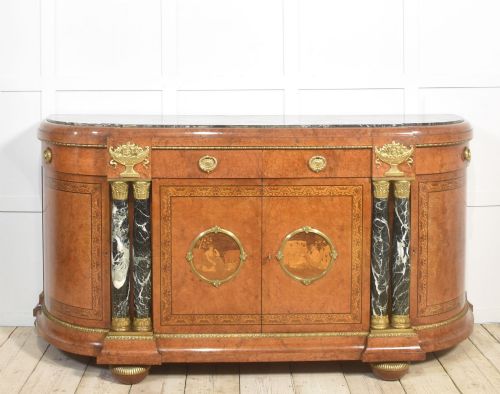
Mounts in cast brass and ormolu add metallic contrast to the dark timber surfaces, whilst delicate boxwood inlay provides linear borders around panels. Selected pieces incorporate polished marble tops or glazed glass doors to elevate the visual weight of the furniture.
The listings span from the eighteenth century through the Victorian era to the nineteen thirties, covering Georgian, Louis XV, Art Nouveau and Art Deco styles.
What varies in quality
The standard of timber selection sets individual examples apart, with top tier pieces displaying continuous, richly swirled burr walnut veneer carefully matched across every curve. Lesser pieces rely on plain walnut or uneven veneer patching that disrupts the natural flow of the grain.
Mastery of construction appears in the seamless fit of the bowed doors and the crispness of carved details such as those seen on Art Nouveau or Queen Anne Revival models. Ormolu mounts and boxwood stringing executed with fine definition indicate superior workshop production rather than mass output.
The Bow Front Walnut Sideboard Glossary
- Burr walnut
- A figured veneer sliced from the knotty growth of a walnut tree, prized for its swirling grain patterns. It creates a highly decorative surface on cabinet doors and drawer fronts.
- Ormolu
- Gilt bronze ornamentation applied to furniture for decorative contrast. It frames panels and edges on mid nineteenth century pieces.
- Credenza
- A low cabinet, originally used for food storage or display, often featuring glass doors and side cupboards. It frequently serves interchangeably with sideboard terminology in Victorian listings.
- Boxwood inlay
- Narrow strips of pale boxwood set flush into the darker walnut surface to form geometric borders and decorative lines. This technique requires steady hand cutting and precision fitting.
- Buffet
- A sideboard or serving table designed for dining rooms. It provides surface space for food presentation alongside lower cupboards.
Bow Front Walnut Sideboard: Frequently Asked Questions
What is a bow front sideboard?
A bow front sideboard is a storage cabinet featuring a convex curved front that projects outward in the centre. This curved profile softens the linear geometry of a dining room while offering practical interior depth.
Cabinetmakers utilised this shape to create elegant proportions and to showcase the decorative qualities of figured walnut veneers across a wider viewing surface.
How do I date a walnut sideboard?
Dating relies on examining the structural timber, hardware, and stylistic details present in the construction. Georgian pieces show linear restraint and simpler joinery, whereas Victorian examples favour rich burr veneers and ornate ormolu mounts.
Twentieth century pieces from the nineteen twenties and thirties often introduce streamlined curves or cocktail cabinet configurations while retaining traditional walnut finishes.
How do I care for burr walnut furniture?
Burr walnut requires stable indoor humidity away from direct sunlight and heat sources to prevent the veneer from drying out or cracking. Regular dusting with a soft, dry cloth maintains the polished finish without moisture damage.
Applying a traditional beeswax polish periodically helps nourish the timber and preserve the depth of the grain patterns without building up heavy residue.
What is the difference between a sideboard and a credenza?
A sideboard is traditionally a dining room piece designed primarily for storing tableware and serving food during meals. A credenza typically refers to a low cabinet without legs, often featuring central cupboards flanked by curved glass side cabinets.
Over time these terms overlap considerably in antique furniture descriptions, particularly when applied to Victorian and Edwardian walnut pieces.