
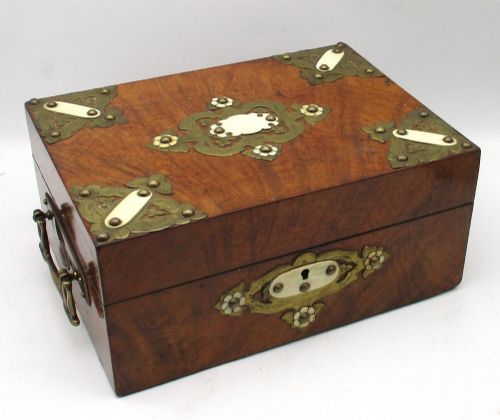
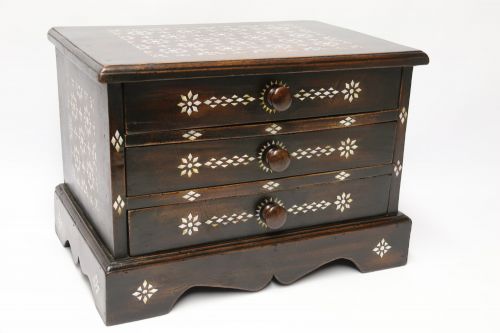


Bone Inlay Jewellery Box
A bone inlay jewellery box brings intricate geometry and tactile warmth to a dressing table, offering a secure home for small treasures.
Bone Inlay Jewellery Box
A bone inlay jewellery box is a decorative container designed to hold rings, pins, and keepsakes on a tabletop or chest. These pieces frequently appear in Anglo-Indian, Victorian, and continental styles, reflecting global trade routes and domestic pastimes of the nineteenth and early twentieth centuries.
Collectors encounter various formats across this inventory, including sarcophagus-shaped sewing boxes, domed glove boxes, and table caskets. Hardwoods such as walnut, rosewood, and ebony provide robust structural carcasses for the delicate surface work.
The most common examples draw upon nineteenth-century craftsmanship, utilising intricate geometric patterns that cover the lid and sides. Each vessel demonstrates a distinct regional aesthetic, ranging from Dutch Colonial severe lines to elaborate Italian Renaissance revival motifs.
Materials and construction methods
Makers constructed these boxes using dense timbers like walnut, rosewood, and ebony to form a stable carcass. Artisans then applied thin veneers of bone, horn, and occasionally ivory or porcupine quill onto the wooden surface.
Specialised techniques such as Sadeli mosaic work involved assembling minute geometric segments of bone and metal into complex banding. Craftsmen secured these individual tesserae with natural adhesives before planing and polishing the exterior smooth.
Current listings feature pieces spanning the nineteenth century, the Victorian era, and the 1920s through the 1940s.
Assessing craftsmanship and precision
Quality rests upon the tightness of the geometric fit and the uniformity of the individual bone segments. Finer examples maintain crisp alignment along corners and mitres without visible gaps in the mosaic banding.
The complexity of the surface ornamentation distinguishes standard utility pieces from masterwork caskets. Elaborate multi-material fields combining horn, ebony, and bone require advanced skill compared to simpler linear stringing.
The Bone Inlay Jewellery Box Glossary
- Bone inlay
- A decorative technique where small pieces of animal bone are embedded into a wooden substrate to create contrasting patterns. This method defines the primary visual appeal of the category.
- Sadeli mosaic
- A specific micro-mosaic technique originating in western India, utilising intricate geometric arrangements of bone, metal, and stained materials. It creates extremely fine banded borders on boxes and caskets.
- Sarcophagus shape
- A box design featuring a sloping lid that tapers upward, mimicking the architectural form of a classical sarcophagus. This silhouette was particularly popular during the Victorian era for sewing and jewellery boxes.
- Table casket
- A small, highly decorative box intended for display on a table or desk rather than for active travel. These pieces often incorporate architectural revival styles and multiple internal compartments.
- Porcupine quill box
- A container decorated with alternating sections of natural porcupine quills and bone inlay, commonly associated with nineteenth-century workshops. The quills provide a distinct striped texture and golden-brown hue.
Bone Inlay Jewellery Box: Frequently Asked Questions
What is a bone inlay jewellery box?
A bone inlay jewellery box is a small wooden container decorated with geometric pieces of bone arranged in intricate patterns across the exterior.
These pieces were produced across various global workshops during the nineteenth and early twentieth centuries to store small personal valuables.
How were these boxes used historically?
Owners placed them on dressing tables, writing desks, and parlour cabinets to keep rings, brooches, and sewing implements organised.
They served as both functional storage and decorative status objects that displayed the owner's appreciation for fine craftsmanship.
How should I care for a bone inlay jewellery box?
Keep the box out of direct sunlight and away from rapid temperature shifts to prevent the wood and bone from warping or cracking.
Dust the surface gently with a dry, soft cloth and avoid using liquid polishes that might seep into the mosaic joints.
How can I tell the different regional styles apart?
Anglo-Indian examples often feature dense micro-mosaic Sadeli bands or porcupine quill work on tropical hardwoods, while European revival pieces use walnut and ebony with architectural motifs.
Examining the underlying timber and the specific geometry of the inlay helps determine whether a piece originates from British colonial workshops or nineteenth-century continental Europe.